Published on: November 18, 2026
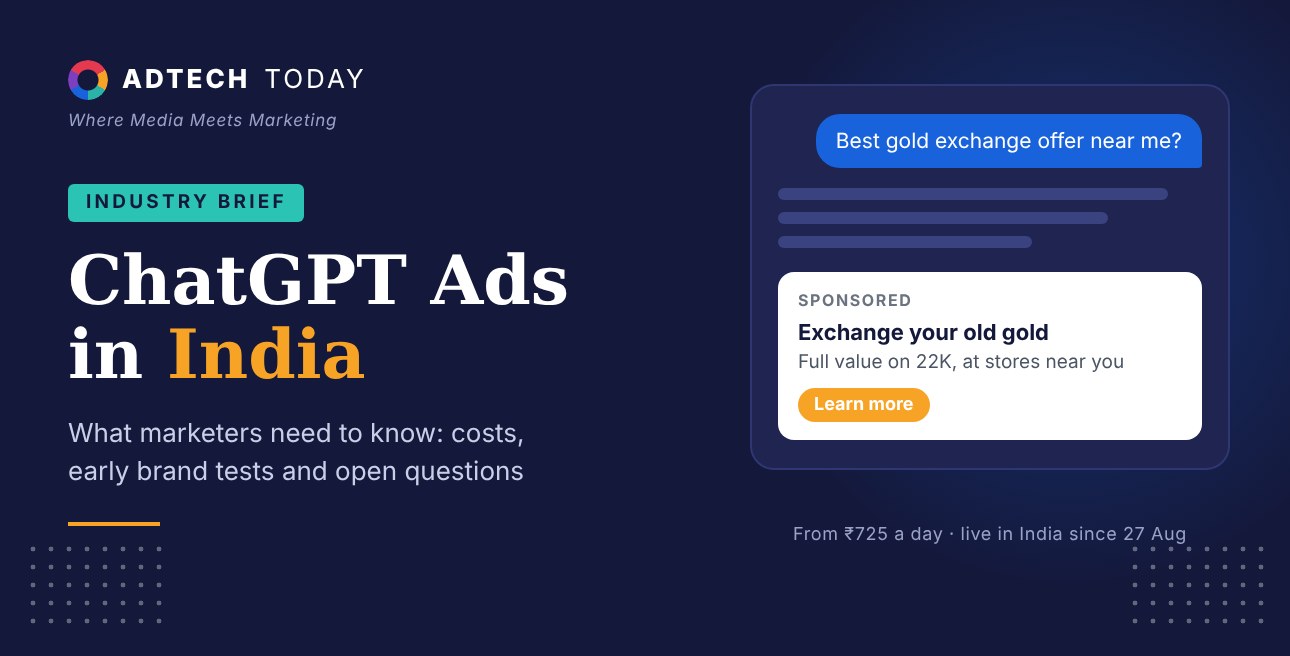
India is now ChatGPT’s largest market by weekly users, according to OpenAI India’s managing director. Since 27 August, brands here can also buy a place inside those conversations, from ₹725 a day. Mamaearth, Sebamed and Tanishq have already tried it.
What the format actually offers is less settled. This guide sets out what is known, what has been tested in India, and the questions marketers should ask before moving budget. We update it as the product changes.
OpenAI began testing ads in the US in February 2026, according to its announcement. Ads appear only to logged-in adult users on the Free and Go plans. Plus, Pro, Business, Enterprise and Education users see none.
Each ad is labelled as sponsored and sits apart from ChatGPT’s answer. Ads are matched to the topic of the conversation. OpenAI states that ads do not influence the answers ChatGPT gives. The formats are widening: since October, ads can also appear while ChatGPT generates an image (Dataconomy), and a multi-image format of four to six pictures entered open beta on 26 October.
There are firm limits. No ads are shown to users known or predicted to be under 18. No ads appear near sensitive or regulated topics such as health, mental health or politics. Advertisers never see a user’s chats or personal details, only aggregate results such as views and clicks.
India matters more than most markets. Prabhjeet Singh, managing director of OpenAI India, told The Economic Times earlier this month that India is now ChatGPT’s largest market globally by weekly active users, and that its user base has doubled since January 2026 (Inc42). In February, OpenAI put India’s weekly users at more than 100 million.
OpenAI launched ChatGPT Ads in India on 27 August 2026. Self-serve buying through ChatGPT Ads Manager opened within days, with a minimum daily budget of ₹725. At launch, advertisers bought on CPM, CPC or conversion-optimised CPC. Since 9 November, new campaigns bid on Target CPA or Target CPC instead, and the older Max Bid and Max CPC options retire on 1 January 2027 (Zoopa).
OpenAI said more than 50 brands were set to advertise in India in the first phase, with WPP and Omnicom among the first agency partners. Razorpay is the official launch partner for ChatGPT Ads in India.
The rollout has moved quickly. ChatGPT Ads crossed a $1 billion annualised run rate in under 200 days, with India named a key test market. It then expanded to 31 European markets, to Southeast Asia and Taiwan, and on 21 October to 26 more countries. That took it to 89 markets and more than 100,000 advertisers.
The pattern is telling. All three chose categories where people research before they buy: skincare concerns, gold exchange, wedding jewellery. That is the moment a conversation captures and a social feed often misses.
A buying and measurement ecosystem formed within months. Amazon Ads and Adform added ways to buy. AppsFlyer brought app measurement. DoubleVerify added attribution and brand suitability. Rebid launched activation analytics, and agencies such as AGL Hakuhodo have folded it into paid media plans.
Price. Early buyers paid a premium. One Indian performance marketer told exchange4media that the launch CPM was about three times Meta’s, and called it “appetite, not proven ROI.” In the US, average CPMs have fallen from about $60 in the pilot to roughly $45.
Measurement. Early buyers have reported problems with Ads Manager’s reporting. Search intelligence firm Adthena measured a 0.91% click-through rate for one client, against 6.4% for Google search in the same sector. The platform is young, and third-party measurement is still being added.
Tracking can also break on OpenAI’s side. After GPT-6 rolled out on 7 and 8 October, ChatGPT stopped tagging many links inside its answers, so the visits it sent began showing up as direct traffic in Google Analytics. Sites saw ChatGPT referrals fall by roughly a quarter to a half, until OpenAI reportedly confirmed a bug and began rolling out a fix on 15 October. The visits were mislabelled rather than lost, and ad clicks carrying an advertiser’s own UTM tags were not affected.
Results. Advertiser numbers are growing faster than the proof that the ads work. Adthena counted 6,333 brands advertising on ChatGPT in August, up from 1,082 in June. Yet a working paper by Maximilian Kaiser and Christian Schulze found that paid ChatGPT traffic converted at 0.37%, against 1.17% for paid Google Search.
Targeting. Delivery today is mostly contextual: the topic of the conversation, approximate location and device type. Personalisation is planned later, and only with user opt-in.
Trust. Labelling makes an ad visible, but a placement beside an answer can still feel like a recommendation. Categories near health face a further question, because a skincare chat can turn into a medical one, and OpenAI does not place ads near health topics.
This guide is updated as ChatGPT Ads changes. For every development, follow our ChatGPT Ads coverage.