Published on: October 27, 2026
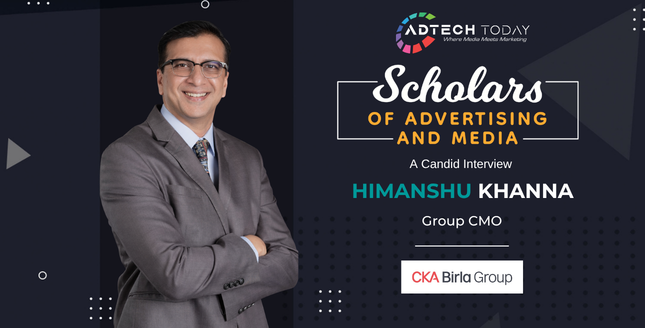
Himanshu Khanna has seen marketing from both sides of the boardroom table: as a brand builder and as a business owner accountable for the P&L. Now, a Group CMO of the CKA Birla Group, he has spent three decades in sales, marketing & P&L management, including at Nestlé, PepsiCo, Cadbury and Raymond. That experience shapes his view of what marketing must deliver, and what dashboards alone can’t tell you.
In this exclusive and candid conversation, he explains why the test for everything from festive spending to brand building is marketing’s contribution to business growth.
You’ve spent much of your career as a marketer, but you’ve also had the experience of owning a business and its P&L. What did being accountable for the number teach you about marketing that you could never have learned from the CMO seat?
One of the biggest advantages I’ve had is the opportunity to manage a business and its P&L. That experience has made me a far better CMO. It taught me that marketing does not operate in isolation and that a CMO’s success is ultimately measured by the success of the business.
Owning a P&L shows you the business as an interconnected system where every function plays a role in delivering growth. Marketing may create demand, but finance ensures profitability, supply chain ensures availability, sales ensures execution, and operations ensures consistency. Business success requires all the gears to move together for sustainable growth.
One of the most important lessons I learned is that a CMO needs to think beyond the boundaries of marketing. The role today is not just about communication, media buying, or brand building, but about understanding what drives the business and where value is created.
“A great campaign is of little value if the product is unavailable.”
The experience also taught me that as leaders, our first loyalty must be to the business outcome, and not to our individual function. Sometimes that requires making decisions that optimise the overall business rather than maximising a marketing metric. That shift in thinking is what differentiates a functional leader from a business leader.
This is why I strongly believe that the most effective CMOs are those who have a general manager mindset. They understand consumers, but they also understand numbers.
For me, the biggest lesson from owning a P&L was simple: marketing is not an end in itself. Its purpose is to help deliver business results. The best CMOs are not just champions of marketing; they are and must be champions of the business.
India’s festive season is approaching, putting pressure on marketers to prove that every rupee is working harder. What are you watching most closely this festive season that tells you whether consumers are genuinely changing how they spend, rather than simply spending more?
The winners this festive season won’t be the brands with the biggest budgets. They’ll be the brands that understand consumer intent the best. Consumers are both value-conscious and aspiration-driven, so marketing has to demonstrate value and make the path to purchase effortless.
What I am watching most closely is not whether consumers are spending more or less, but how they are allocating their spending. Historically, festive seasons were largely about increased consumption. Today, consumer behaviour is becoming far more nuanced. The real shift is from consumption-led spending to conviction-led spending. Consumers are willing to spend, and often spend more, but they are selective about the brands, categories and experiences that deserve a share of their wallet.
The metrics I pay attention to are therefore different. I watch whether consumers are trading up to premium offerings, whether they are willing to experiment with new brands, how early they begin their purchase journey, and whether they are prioritising value over discounts. The question is no longer ‘Can I afford this?’ but increasingly ‘Is this worth it?’. Reports from MiQ, NIQ and Deloitte all point to consumers being more deliberate, digitally influenced and increasingly open to both premium products and new brands, provided the value proposition is compelling.
My recommendations to the CMOs:
-Focus on high-intent consumers rather than maximising reach alone, as festive purchases are increasingly planned weeks ahead.
-Connect every marketing dollar to availability, distribution and execution; great advertising cannot compensate for poor fulfilment. Research shows shoppers start festive shopping earlier and use multiple digital touchpoints before buying.
-Work on conversion, because awareness is already high in many categories. The opportunity is to reduce purchase friction through better commerce experiences, sharper offers, availability and relevant content.
-Lastly, measurement must go beyond impressions and engagement to assess whether campaigns attract incremental buyers, grow basket size and premium mix, gain market share, and strengthen customer lifetime value. During festive periods, marketers should connect media investment directly to business outcomes.
Marketing has spent years being asked to prove its value in hard numbers, and the tools for doing that keep multiplying: dashboards, attribution models, real-time reporting. Has that actually made marketing’s impact easier to prove, or just made the same argument more complicated?
I would argue that it has done both. On the positive side, marketers today have far more visibility into performance than ever before. We can see consumer journeys in real time, track conversion paths and measure campaign effectiveness with a precision earlier generations could only dream of. But while data has grown exponentially, clarity has not kept pace. Dashboards, attribution models and reporting systems now generate thousands of data points, and we risk measuring everything while struggling to identify what truly matters.
I have often seen marketers become obsessed with proving marketing activity rather than proving business impact. We can accurately measure impressions, reach, clicks, engagement rates, leads, conversions, website traffic, and dozens of other indicators. But the real question remains unchanged: Did we grow the business? Did we acquire new customers? Did we increase market share? Did we improve pricing power? Did we drive profitable growth?
The underlying argument is unchanged: metrics have evolved, but the boardroom still values revenue growth, profitability, market share, customer acquisition and retention, and long-term value. The more metrics we create, the easier it becomes for different stakeholders to find data that supports their perspective. What leadership teams need is alignment on a handful of business outcomes that marketing is expected to influence.
The best CMOs are not asking, ‘How do I prove marketing worked?’ They are asking, ‘How do I demonstrate marketing’s contribution to business growth?’ That’s a very different conversation. For me, the real opportunity today is not more measurement but better linkage between marketing investments and business outcomes.
“We don’t suffer from a measurement deficit anymore; we suffer from a meaning deficit.”
The best CMOs don’t win arguments with more dashboards. They win them by showing how marketing drives growth, market share and profitability.
Brands built inside legacy, trust-led businesses earned their equity over decades, not campaign cycles. What’s the hardest habit from that older model of brand-building you’ve had to unlearn to compete in a market that now moves in weeks?
Having spent much of my career building brands that earned consumer trust over decades, I’ve learned that while trust is built over years, relevance is earned every day. The challenge for marketers today is to stay committed to the long term while adapting quickly enough to win in the short term.
Traditional brand building taught us the importance of consistency, patience and long-term thinking. Those lessons remain incredibly valuable. Those lessons matter even more today. What has changed is the environment in which brands operate. Consumers, culture, technology and competition now move at a pace that was unimaginable even a decade ago.
Earlier, marketers had the luxury of spending months perfecting a proposition, creating a campaign and then taking it to market. Today, by the time you’ve finished perfecting it, the conversation may have already moved on. The biggest mindset shift has been moving from certainty to adaptability.
What I’ve learnt is that while brand strategy should be enduring, execution needs to be adaptive. The purpose of the brand, the values it stands for and the promise it makes to consumers should remain consistent. How that promise is expressed, where consumers engage with it and how quickly you respond to changing needs must keep evolving.
In many ways, the challenge today is balancing two seemingly contradictory requirements. You need the discipline of a legacy brand builder who thinks in years, and the agility of a startup that thinks in days and weeks. The brands that succeed do both at once.
I often tell my teams that “trust still compounds slowly, but relevance can disappear very quickly.”
“The role of modern marketing is to protect the long-term equity of the brand while ensuring it remains relevant to consumers in real time.”
Data and AI are now central to how most marketing decisions get made. Where do you think that shift is starting to cost brands something on the emotional side that a dashboard won’t ever pick up?
“Data tells us what people do. Great marketing comes from understanding why they do it.”
The danger is not that we have too little data today, but that we mistake data for human understanding. There’s no question that data and AI have fundamentally improved marketing. They help us understand consumer behaviour better, personalize experiences at scale, optimize investments, and make faster decisions.
But the very tools that make marketing more scientific can make it less human. Data is excellent at identifying patterns, but brands are built on people, emotions, aspirations and culture, and those are much harder to capture on a dashboard. One area where I think marketers need to be particularly careful is confusing what is measurable with what is meaningful.
Consumer trust, emotional connection, cultural relevance, admiration and affinity are often the factors that create long-term brand strength, yet they don’t always show up immediately in performance metrics. A dashboard can tell you what consumers clicked on. It cannot always tell you how a brand made them feel. AI can help optimize content, but it cannot replace the empathy required to understand people’s hopes, anxieties, motivations and unmet needs.
The risk is that we start optimising for the wrong things, improving click-through and conversion rates while slowly eroding the distinctiveness and long-term equity that make a brand valuable.
For me, the most enduring brands are built when we combine machine intelligence with human insight. Data should tell us where to look. It should never replace our understanding of people.
What’s an assumption about the Indian consumer that shaped your thinking early in your career, but that you’ve had to completely let go of since?
One assumption I had early in my career was that there was such a thing as the ‘average Indian consumer’. Over time, I’ve come to realise that India is far too diverse, dynamic and fragmented for that assumption to hold true anymore.
Earlier, marketers often thought in broad segments. Urban versus rural. Premium versus mass. North versus South. While those distinctions still matter, consumer behaviour today is far more fluid. You can find a value-conscious shopper buying premium products in one category and seeking discounts in another. Consumers in smaller towns adopting new technologies as quickly as those in metros. Aspirations, access and exposure have become far more democratized.
Indian consumers today are far more informed, empowered and discerning than ever before. They are no longer simply buying products; they are evaluating value. They are willing to experiment with new brands, but they are equally quick to move on if expectations are not met.
What this means for marketers is that broad generalizations have become increasingly dangerous. Success today comes from understanding consumer contexts rather than consumer categories. The same individual can behave very differently depending on the occasion, category, need state or life stage.
The biggest lesson for me has been that there is no single Indian consumer anymore.
“There are crores of consumers, each with their own aspirations, influences, and definitions of value.”
The brands that succeed are the ones that understand those nuances rather than relying on old stereotypes.