
Published on: August 7, 2026
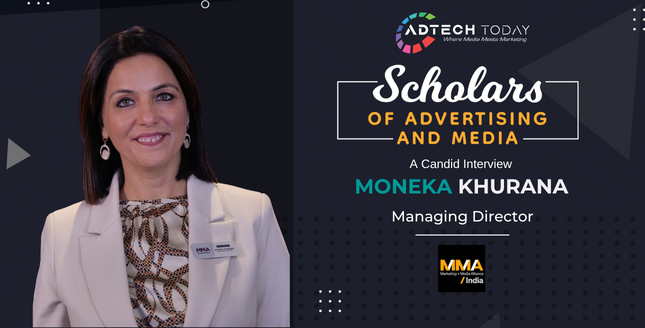
Moneka Khurana has just been promoted to Managing Director of MMA India, and she takes the role at a moment she thinks marketing has been waiting years for. The Marketing + Media Alliance rebranded from MMA Global in late 2025, and India, she argues, has gone from a market the alliance serves to one it now helps shape.
In this interview, she is unsparing about what that shift demands: measurement that stands up to a CFO, an honest reckoning with AI, and awards submissions that lead with the business case rather than the campaign. She talks about the industry belief she’s glad to see die, the attribution argument that has outlasted digital itself, and where she thinks AI will test brands hardest.
You have just been elevated to Managing Director, MMA India — what changes now, and what does this mean for MMA’s global agenda?
I now carry a mandate to bring the Marketing + Media Alliance’s (MMA) global research, our Think Tanks and marketer capability-building programs into India at full scale.
For MMA’s global agenda, this is bigger than one appointment. It signals India has moved from a market MMA serves to one it sees as strategic and high-growth. Our CMOs are wrestling with AI adoption, commerce complexity and measurement rigour at a pace few markets match. That earns India a real seat in shaping MMA’s global thinking, not just adapting it. a
Practically, expect us to bring global best practices to India, deepen CMO engagement and help marketers advance their ability to create value.
Read more: MMA Elevates Moneka Khurana to Lead Its Next Phase of Growth in India
What is the industry belief from your early years that has aged the worst?
That marketing was a cost centre, not a growth engine. A decade ago, plenty of Indian CMOs spent budget cycles justifying spend to CFOs instead of sitting where growth decisions actually got made. We accepted that as normal.
That belief has aged badly. The brands winning today, and the CMOs leading them, treat marketing as an investment with a return you can model, not a leap of faith. 2025 proved this. Marketing moved from the sidelines into the boardroom because the industry finally built the measurement discipline to back its own claims.
You said 2025 was the year marketing stepped into the boardroom — as MD, what is the one conversation you now want the industry to stop avoiding?
There are actually two.
The first: financial fluency, the language that bridges the gap between the CEO, CMO and CFO. We fought hard to earn that seat. Now the harder work starts: showing up every quarter with numbers that hold up under real financial scrutiny, not just reach and engagement. I want the industry to stop treating measurement as a nice-to-have and start treating it as the entry ticket to every strategic conversation.
If it doesn’t move the needle, it doesn’t make the cut anymore, and that includes the CMO’s own credibility.
“The boardroom seat was the easy part. Keeping it is the real test, and that test is measurement, not messaging.”
The second: AI fluency and adoption, to drive business impact and real decision-making. The industry needs to stop talking about AI replacing humans. The real conversation is AI driving business impact. We need to better enable AI skills at organisational levels, to drive effectiveness, not just efficiency.
MMA India’s think tanks — MATT, MOSTT, ALTT and DATT — are tackling enterprise-ready frameworks. Which one is solving a problem the industry has avoided the longest?
MATT, our Marketing Attribution Think Tank. Attribution is the oldest unresolved argument in marketing, older than digital itself. Which channel actually drove the sale, how much of that growth is brand versus performance, what’s a fair way to split credit across a funnel that no longer behaves like a funnel. The industry has argued this for over 20 years without landing on shared ground.
“MATT is the first serious attempt I’ve seen at measurement that survives everyone’s scrutiny, including the CFOs.”
MATT has been building answers for 7+ years globally, with 125+ marketing leaders across 18+ industries feeding into the work. In India, we’re bringing that rigour home, arming brands with tools to prove long-term impact, not just short-term sizzle.
Why has this problem lasted so long? Because it’s genuinely hard, and because everyone had incentives to avoid a shared standard. Platforms wanted their own maths to win. Agencies wanted flexibility in the story they told clients.
You have called for navigating AI without losing brand distinctiveness and ethical imperatives — where do you see that line being tested most?
Creative, without question. AI can generate a hundred ad variants in the time it takes to brief one human team, and the temptation is to let the algorithm optimise purely for performance. Do that long enough, and every brand starts to sound and look the same, because the models are trained on the same data and chasing the same metrics.
The second place: personalisation versus privacy. India’s data volumes and diversity make hyper-personalisation tempting, but consumers here are getting sharper about what “personalised” means and how their data built it.
My position hasn’t shifted: calibrate AI with brand values and creativity, not just efficiency.
“Every brand needs a point of view on what it will and won’t automate, before the technology forces the answer on them.”
Our focus through 2026 is intentional, ethical, brand-aligned AI, and that’s exactly why the AI Leadership Think Tank (ALTT) exists in India now, to help marketers build that muscle deliberately instead of reactively.
With SMARTIES India 2026 around the corner, what is the one gap between what Indian brands are submitting and what genuinely future-ready marketing should look like?
Too many submissions still lead with the campaign, the idea, the execution, and treat business impact as an afterthought slide at the end. Future-ready marketing flips that order. The business case comes first. The creative is the mechanism that delivers it.
The best entries we judge demonstrate a clear business case, often backed by real data modelling, not just campaign impressions or awareness lifts. That’s the bar rising every year at SMARTIES, and it’s the bar Indian brands need to close in on.
“The gap isn’t creative ambition. Indian work is genuinely strong there. It’s proof.”
Show me the incrementality, the attribution, the actual enterprise value the work created, not just that people saw it and liked it. Brands bringing that rigor to their submissions are already doing it in their day-to-day marketing, and it shows.
SMARTIES India 2026 is a good reinforcing function. My hope is more entrants use it to build that discipline internally, not just win a trophy.

