Published on: November 19, 2026
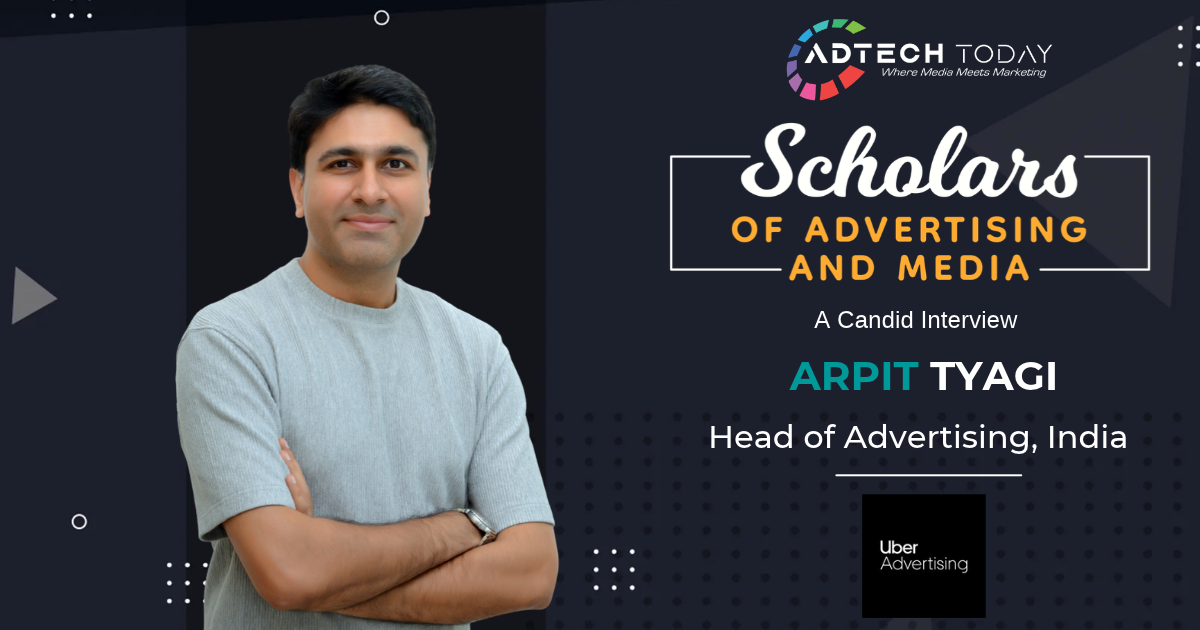
Uber’s ad business works with more than 200 brands and agencies. Before joining Uber, Tyagi spent more than seven years at Amazon, most recently leading its agency business for Amazon Ads, and headed client services at The Trade Desk.
In this exclusive conversation, Tyagi argues that India’s data rules favour first-party signals over borrowed identifiers, and that AI agents should optimise within limits set by people. He also shares the test he uses to assess any new advertising channel: try it from the back seat.
You’ve sold to brands, partnered with agencies on a retail ad platform, worked on the buying side of the open internet, and are now building a team from the ground up. Which of these experiences has shaped your thinking about advertising the most?
Building Uber Advertising in India over the past quarter has shaped my thinking the most. I brought experience in understanding what brands want and how agencies plan. But building a business means testing those lessons and adapting them to a new context.
My biggest learning is that brands need relevant attention and clear evidence of business impact. They want to reach consumers at a meaningful moment and demonstrate that the investment delivered results.
That is what makes Uber Advertising compelling. A journey creates an opportunity for a brand to be relevant to someone’s day, whether they are commuting, heading to the airport or going out.
My focus is to make those opportunities easy for brands and agencies to buy, and their impact easy to measure.
Commerce-led media is projected to be India’s fastest-growing ad segment this year, driven by the push for measurable outcomes. Where should sales measurement stop and longer-term brand building begin?
I’d stop looking for a line. Commerce media is growing because it closes the loop, and that’s healthy. But last click measures demand someone else created. So I use a simple split. Performance owns what you can prove incrementally. Brand owns what only a lift study can prove: awareness, favourability and consideration.
Kantar’s studies of our campaigns show a 27% lift in brand consideration, and put us in the top 10% of platforms globally for ad awareness. Those are brand outcomes you’d never see in a last-click report.
A recent example is a leading CPG brand’s monsoon campaign across Delhi NCR, Mumbai and Bangalore. We reached riders during the morning and evening commutes, when the weather is most on their minds. It reached more than 2 million riders at a 1.55% click-through, against a 1.4% CPG benchmark, and a third-party study measured the brand lift.
We can also bridge to the store. With Destination Offers, a brand can reach a rider within about 200 metres of its store. So brand lift, attention, store visits and sales are all measured on one platform, with independent verification.”
Having worked closely with both agencies and ad tech platforms, where does the relationship between them need to be redrawn?
Agencies buy audiences and outcomes, but platforms still sell products. A planner doesn’t think in ‘ride types’. They think about travellers, shoppers or working professionals. So we’ve started packaging Uber the way planners think. For example, our festive audience packages are built around travellers at airports and stations, shoppers in malls, and working professionals in tech corridors. That makes us easy to slot into a plan.
“Agencies buy audiences and outcomes, but platforms still sell products.”
The second shift is data. Brands should be able to bring their own first-party data and measure results independently. We support first-party data matching with partners like LiveRamp, plus mobile-measurement integrations for installs and post-click performance.
With India’s data protection rules being phased in through 2027, what will change for advertising that relies on consumer data and personalisation?
Personalisation doesn’t die. It changes shape. Under DPDP, consent has to be specific, informed and easy to withdraw, and data use is tied to a stated purpose. That’s hardest on models built on third-party identifiers passed through the bidding chain.
Instead of ‘targeting’, say ‘consumer intelligence’. The signals are observed, first-party and real-world: time of day, city, ride type, and where the rider is headed. They’re not modelled inferences from a profile. Every user is logged in, with one unified ID across Rides.
“Personalisation doesn’t die. It changes shape.”
Picture a rider heading to a mall on a Saturday. You don’t need her name. You need the moment. Our cohorts work that way: airports, hotels, offices, malls, restaurants. They’re about places and moments, not personal profiles.
My advice to brands is to audit consent flows now, move budget toward contextual and first-party signals, and check that your measurement still works on aggregated data.
You trained as an engineer before moving into marketing. As AI agents take on more of the media planning and buying process, which decisions should still depend on human judgement?
Agents should optimise inside the box. Humans should draw the box. Pacing, bidding, forecasting, trafficking and reporting can be automated. But four things stay human.
First, what you optimise for. Second, anything you can’t undo, like price. Third, the experience guardrail. For example, Our Journey Takeover changes the vehicle icon on the map, so we cap it at one impression per rider a week. That’s a judgement about the rider’s trust, not an optimisation. Fourth, cultural judgement. An agent can tell you a trend is spiking. It can’t tell you whether your brand has earned the right to join it. Brands that tag onto a trend without understanding the culture behind it get found out quickly, and in India the culture changes city by city.
“My rule: if a mistake is reversible and low-stakes, automate it. If it’s irreversible or touches trust, a person decides.”
As brands plan their 2027 budgets, what should marketers evaluate before investing in a newer advertising channel?
I use five questions, and honestly they’re the ones we built our ad business to answer.
Is the moment valuable? Most channels reach you when you’re idle. We reach people between a decision and a destination, when intent is highest. The ride is the context.
Is the attention real? There’s no skip button and no clutter, and a brand can own 100% share of voice across the trip.
Is the data first-party? Targeting runs on observed signals like place, time and ride type, not guesses. That matters even more as India’s data rules phase in.
Can it be measured independently? Brand lift with third parties, attention measurement, store visits, and app attribution through mobile-measurement partners.
Does it scale without hurting the experience? About 60 million people a month in India, with guardrails like frequency caps to protect the rider’s trust.
My practical advice is to put roughly 5–10% of budget into a test and agree success criteria up front. And try the product yourself.
Related Read: Meher Patel: Beyond Media into Unified Intelligence