
Published on: July 13, 2026
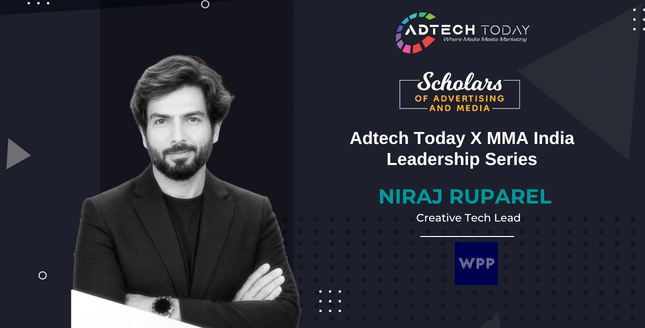
Niraj Ruparel, Creative Tech Lead at WPP Media India, has spent his career pushing the boundaries of innovation from mobile-first ecosystems and the metaverse to AI-powered robotics and immersive brand experiences. Known for his visionary, human-centric and future-focused approach, he is driven by the ambition to build inclusive AI ecosystems that can scale across India, the Global South and beyond.
In an exclusive conversation with Adtech Today as part of the MMA Impact India 2026 series, he discusses why India needs a new creative philosophy for AI, how robotics is reshaping brand storytelling, and why marketers must move beyond experimentation to build scalable, meaningful and accessible AI-driven experiences for the next billion users.
You’ve moved from mobile to metaverse to robotics. At what point did you realise emerging tech in India needed a completely different creative philosophy, not just a different tool?
I realized this early when we started building beyond smartphones into voice, telephony, and access-led ecosystems. India doesn’t adopt technology in a linear way. You are solving for extreme diversity across language, literacy, bandwidth, and access.
That’s where the shift happened from “campaign thinking to platform thinking.”
“In India and across the Global South, technology has to be invisible, inclusive, and intuitive.”
You are not designing for early adopters but for first-time users. That changes how you think about creativity, storytelling, and scale. At WPP, this translated into building telephony AI, accessible pack experiences, and now robotics-led
interactions. Creativity is not layered on top of technology. It is built into the system itself.
The philosophy is simple: we shouldn’t be trying to showcase the technology. We should be absorbing it into natural human behavior because that is where the real impact lies for a brand.
A humanoid robot at an IPL activation is spectacular, but spectacle and effectiveness are not the same thing. How did you measure whether the Coca-Cola robotics experience actually built brand value?
With RoboCool for Sprite at IPL, the idea was to move beyond spectacle into cultural participation. We deployed a humanoid robot that gatecrashed the Lucknow Super Giants team dinner as Sprite’s biggest fan. What made it powerful wasn’t just the presence, but the behavior. It engaged cricketers in real-time, multilingual conversations, adapting tone, humor, and responses dynamically.
“That’s where robotics becomes interesting for brands; not as a display of hardware, but as an intelligent, interactive medium.”
We measured success through depth of interaction, content velocity, and cultural resonance. The experience drove strong organic traction across Sprite and LSG’s social handles, with high engagement from younger audiences who didn’t just watch but reacted, shared, and amplified it.
The real shift here is how robotics is evolving. It is no longer about programmed actions. It is about responsive, AI-led interaction that can exist inside culture.
For brands, this opens up a new layer of storytelling. Not just telling stories, but showing up as a participant in moments that matter. Today, effectiveness is not just reach. It is interaction, memory, and shareability working together.
During the WPP x Google collaboration, where did AI genuinely surprise you on cultural nuance and where did it expose a gap no technology can currently fix?
AI surprised us most in its ability to handle language and cultural fluidity. In India, people switch between languages within seconds. Seeing AI adapt to multilingual inputs, dialects, and tone opened up scale in a powerful way, especially for Bharat audiences.
However, to be honest, it also exposed a very clear limitation. AI can replicate patterns, but it does not truly understand context, emotion, or consequence.
In areas like inclusion, public health, or behavior change, human judgment is still critical. This is where creative and strategic talent becomes essential.
“AI is an amplifier, not a replacement.”
The real value comes when human insight shapes AI output and turns it into something meaningful and responsible.
Most adtech investment today still chases reach and targeting precision. Where does creative AI fit in a media plan, and why is it still being treated as an afterthought?
Creative AI is still an afterthought because media has traditionally optimized for efficiency, like reach and targeting. But that model is evolving. In an AI-driven world, creative becomes the multiplier. You can target perfectly, but if the experience is not engaging or contextual, it does not work.
“Creative AI belongs at the core of modern media planning.”
It enables dynamic storytelling, real-time personalization, and interactive formats. At WPP, with platforms like WPP Open, we are seeing a shift where media and creative are no longer separate. Intelligence drives both.
The gap today is not lack of capability but the MINDSET.
any brands are still stuck thinking in “campaigns,” whereas AI requires us to think in “systems” and “platforms.” Once that shift happens, creative AI becomes central to effectiveness.
What are you building next that the industry hasn’t seen yet and why does it matter?
What excites me most is building inclusive AI platforms at scale.
We aren’t just looking at the already connected users, but at the next billion people across India, Sub-Saharan Africa, and the Global South.
“We are working on multilingual voice-led AI ecosystems, low-bandwidth experiences, and the convergence of AI with robotics for physical and digital storytelling.”
The focus is to move from interfaces to interactions.
We are also building DigiDoubles, AI-powered brand representatives that can scale human-like engagement across markets and languages. This matters because the future is not about more content. It is about meaningful and accessible interaction.
If AI does not include everyone, it fails its biggest promise.
MMA India has placed AI maturity at the centre of its 2026 agenda. As an active MMA India AI Council member, where do you see Indian marketing leadership actually standing today, and what does the gap cost brands?
India is at a very strong inflection point where there is immense intent, adoption, and talent. But maturity is still uneven.
Many brands are still in experimentation mode, chasing novelty instead of value. This shift from “doing AI” to truly operationalizing AI at scale is where the gap currently lies. And that gap is expensive; it costs brands speed, relevance, and their competitive advantage.
At the MMA AI Council, we strongly believe in doing more and talking less. That is why real case studies matter.
“The industry will grow only when we build and share tangible work that creates real impact”
The brands that will lead are the ones that build internal capability, collaborate across ecosystems, and treat AI as infrastructure. India has the opportunity to lead globally, but only if we move from experimentation to execution at scale.

