
Published on: June 5, 2026
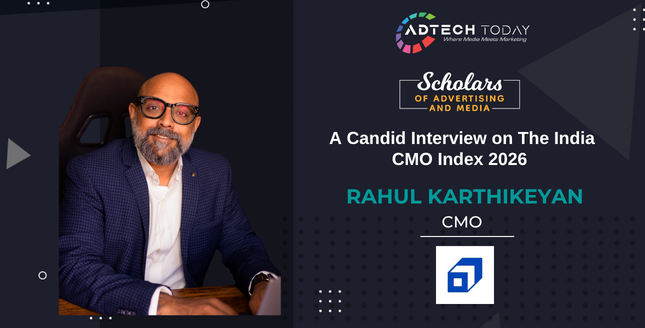
Rahul Karthikeyan is a leader defined by his sharp, practical approach to brand building. As the CMO of Scaler and a vital contributor to the India CMO Index 2026, he understands that scaling a business requires a fine balance between new technology and seasoned intuition.
In this exclusive interview with AdTech Today, the official media partner for the report, Rahul is strikingly articulate and honest about the path ahead. He views AI as a powerful engine to handle routine work; he believes this shift allows teams to rediscover the human magic that truly differentiates a brand in a crowded market.
The India CMO Index 2026 found that only 12% of senior marketing leaders have AI genuinely embedded in how work gets done. Does that number surprise you?
Honestly, NO.
Most companies are still using AI as a productivity layer rather than an operating layer. The teams are experimenting heavily, but very few have actually redesigned their workflows, decision-making, or team structures around it yet. That is exactly why true embedment remains so low across the board.
“Most companies today are not AI-first; they are still AI-assisted, and there’s a big difference.”
There’s a clear difference between using AI to speed up existing work and using it to do fundamentally different work. Where does most marketing adoption actually fall today and what does crossing that line require?
Most adoption today is still speed-led; it focuses on faster content, faster research, and faster execution. Very little of it is fundamentally changing how marketing operates. The shift happens when AI moves from individual usage to organisational workflows and decision-making.
“Right now, most brands are using AI to do old work faster instead of discovering entirely new ways to grow.”
You’ve drawn a sharp distinction between execution speed and judgment. How do you practically protect strategic judgment when the pressure to move faster is relentless?
For sure, speed helps; it is the judgment that differentiates. Strong marketing leadership is increasingly about knowing what not to chase, not just how fast you can move.
“Speed is now a commodity and your Judgment or experience is becoming the premium skill.”
Read more: India CMO Index 2026: The Report That Asked What No One Usually Does
The report flags a fast-rising shift from text-first to video-first AI at practitioner level before it registers in strategy. How significant is that shift, and what does it mean for how marketing teams are built?
It’s a massive shift. The marketing teams are moving away from static content creation toward storytelling at scale through video, adaptation, and iteration. The skill mix inside these teams will change dramatically over the next few years.
“Video-first AI will fundamentally reshape marketing org structures faster than most companies are prepared for.”
The report will track these numbers again in 2027. What would a meaningful shift in AI embedment actually look like and what needs to change for that to happen?
A meaningful shift in 2027 would mean AI is no longer treated as an experiment; it becomes embedded into planning, media optimisation, CRM, creative production,
and measurement itself. That only happens when leadership drives operational change, not just tool adoption.
Silicon Valley investor Vinod Khosla recently said that AI won’t just improve existing companies; it will fundamentally rebuild industries from scratch. I think marketing will see that shift faster than most functions.
“The real AI divide won’t be between companies using AI and not using AI instead it will be between companies redesigning workflows around AI and companies simply adding tools on top of old systems.”

