
Published on: September 29, 2026
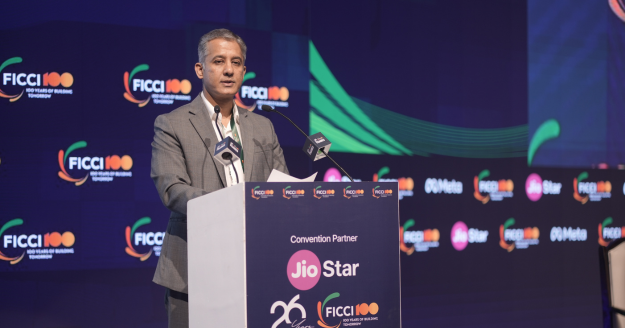
At the inaugural address of FICCI FRAMES 2026, Kevin Vaz highlighted the rapid transformation of India’s media and entertainment industry, emphasising the growing importance of attention, connected television, new content formats, content commerce, artificial intelligence and responsible innovation.
FICCI FRAMES 2026, themed “India’s Media Moment: Creating Value in an Age of Infinite Content,” brought together policymakers, creators, businesses, platforms and stakeholders from across the media and entertainment ecosystem.
Vaz, who has been closely associated with FICCI’s Media and Entertainment Committee for nearly two years, noted that the committee has completed 26 years of shaping conversations and supporting the development of the industry through FICCI FRAMES.
At the outset of his address, Vaz called for a moment of silence in memory of the late Leena Jaisani, Deputy Secretary General and Head of Media & Entertainment at FICCI. He described Jaisani as one of the founding members of FICCI’s Media & Entertainment Committee and a contributor whose commitment and legacy would continue to influence the industry.
According to Vaz, the Indian M&E industry grew 9% in 2025 to INR 2.78 lakh crore, with digital media crossing INR 1.1 lakh crore and live events recording 47% growth. He noted that while these figures indicate continued expansion, the more significant shift is taking place in the relationship between content and audiences.
He observed that distribution had historically been the industry’s primary constraint, with limited channels and screens available for stories to reach audiences. Today, however, the greater challenge is the abundance of content and the scarcity of audience attention.
Vaz described attention as the new currency in an environment where content and ideas are increasingly abundant, making the ability to create content that captures audience interest a key priority for the industry.
He also highlighted the convergence of television, streaming, mobile and Connected TV in India, noting that these platforms are increasingly coexisting rather than replacing one another.
While linear television continues to maintain a strong presence in Indian households, Connected TV and digital consumption are expanding rapidly. Vaz pointed to the evolution of the television set into a connected entertainment hub that combines linear channels, streaming, live sports and on-demand content.
He further noted that the large screen continues to function as a shared viewing environment, bringing families and communities together around entertainment and sporting moments. Recent industry estimates, he said, suggest that more than 80% of Connected TV viewing is shared with family or friends, while India’s CTV universe is estimated at more than 200 million viewers.
According to Vaz, Connected TV brings together the scale and lean-back experience of traditional television with digital capabilities such as search, recommendation, personalisation, addressability and measurement.
He stressed that the opportunity for the industry is not to choose between screens but to enable audiences to move seamlessly across them while providing businesses with more effective ways to understand and engage consumers.
Linear TV streaming, he said, is an example of this evolution, combining the scale and familiarity of television with the flexibility of streaming. It allows audiences to access live channels across screens and connections while creating additional opportunities for measurement and advertising.
Vaz cited TATA IPL 2026 as a strong example of this convergence, with the tournament reaching more than 1.2 billion viewers. He said the scale demonstrated by the event reflects the potential created when television, streaming, sport, technology and fandom come together.
The transformation is also influencing the formats in which stories are created and consumed. Vaz highlighted micro-drama as an emerging category creating new creative and commercial opportunities. The segment was valued at INR 650 crore in 2025 and is expected to grow at more than 50% annually by 2028, according to figures referenced in the address.
He also pointed to the opportunities new formats create for creators, writers, producers and production houses. JioStar’s entry into micro-drama through TADKA and its engagement with more than 50 production houses, he noted, are contributing to the expansion of the production ecosystem.
Another emerging opportunity highlighted during the address was Content Commerce, where audience engagement can increasingly translate directly into transactions. During TATA IPL 2026 and the live stream of Dhurandhar The Revenge, JioHotstar enabled viewers to discover and purchase products without leaving the platform.
Vaz said the model reduces the distance between discovery, engagement and action, positioning Content Commerce as an emerging value pool for the media industry alongside advertising and subscriptions.
He also addressed the regulatory environment, noting that innovation requires sufficient room to develop. He said self-regulation and strong industry best practices should play a central role as the sector enters its next phase of growth.
Vaz called for a tangible roadmap to reduce the regulatory burden and cost associated with linear broadcasting, allowing it to evolve alongside digital media while giving consumers greater flexibility in how and where they consume content.
He also welcomed the Ministry of Information & Broadcasting’s removal of the 10+2 advertising cap, describing it as an important step towards a regulatory framework aligned with the changing realities of linear broadcasting and the wider media landscape.
At the same time, Vaz urged the Ministry to restore the release of BARC audience ratings, stating that the absence of credible and verifiable audience data is creating uncertainty for broadcasters, advertisers and agencies, particularly during the festive season. He emphasised that reliable measurement remains important for brands to plan campaigns and reach audiences efficiently.
Vaz also underlined the wider economic significance of television, describing it as one of India’s most widely consumed and affordable media platforms. He noted that broadcasting and advertising contribute to the broader economic ecosystem and that reliable audience measurement is important for maintaining efficiency across the sector.
Artificial intelligence was another major focus of the address. Vaz highlighted AI’s growing influence across production, storytelling, workflows, analytics and personalisation, while stressing the importance of keeping people at the centre of the creative ecosystem.
He called for responsible development with greater clarity around copyright, consent, attribution and fair value for creators. According to Vaz, the objective should not be to slow innovation but to ensure that technology and creativity develop together.
Concluding his address, Vaz emphasised that success in an age of infinite content should not be measured simply by the volume of content produced or the number of screens reached, but by the value and impact created.
He highlighted three questions for the industry to consider: whether it created something audiences genuinely cared about, whether it built intellectual property capable of travelling from India to global markets, and whether it created value for audiences, creators and businesses across the ecosystem.
For Vaz, these questions lie at the heart of “India’s Media Moment” and the industry’s opportunity to create meaningful value in an increasingly fragmented and content-rich media landscape.
Read more: WPP Media Appoints Laura Ryan as Chief Media Officer