
Published on: September 1, 2026
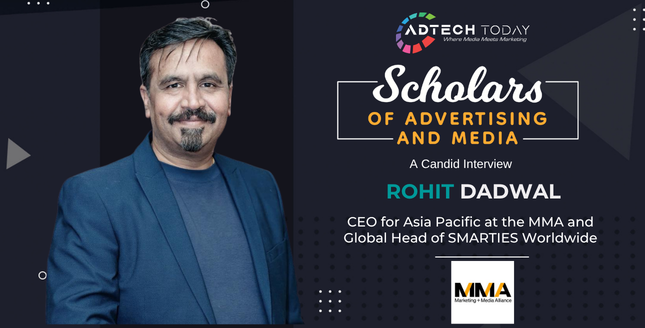
Measured and evidence-led, Rohit Dadwal has spent more than three decades on a conviction that AI has only made sharper: what separates organisations is how they are built to decide, not the tools they can buy. As CEO for Asia Pacific at the Marketing + Media Alliance and Global Head of SMARTIES Worldwide, Rohit leads a body that has given up the mobile category it was named after.
In this exclusive interview with AdTech Today, Rohit explains why digital maturity and AI maturity are not the same thing, sets out what creative governance looks like when a brand generates thousands of variants, and makes the case for a common measurement architecture across the ecosystem.
From building the mobile marketing movement to leading MMA’s rebrand as the Marketing + Media Alliance, what is the hardest belief you have had to let go of?
The hardest was believing the movement we built had to stay defined by the medium that created it.
When I joined MMA we had seven members in Asia Pacific. Within five years, more than 200, close to 30% of global membership. I was proud of that growth, but the more important measure was not size. It was that mobile had stopped being a specialist category and had become embedded across media, commerce, customer experience, data, martech and AI.
I was attached to that identity because we built it. But there comes a point when an identity that once creates momentum begins to impose limits. Leadership requires recognising that moment before the market recognises it for you.
The evolution to the Marketing + Media Alliance is not a rejection of our history but the completion of it. Our mandate was never to advance a channel, but to help marketers create business value with the knowledge, tools, standards and ecosystem they need. The new identity reflects what MMA had already become: CMO-led, industry-supported, focused on marketing’s contribution to enterprise growth.
A leader’s responsibility is not to protect what they built, but to keep it relevant after the conditions that created it have changed.
“Leadership requires recognising that moment before the market recognises it for you.”
You have written that nearly half of a campaign’s outcome is decided before a single media dollar is spent. What does strong pre-media discipline look like in practice?
Strong pre-media discipline begins by refusing to ask “Where should we spend?” until you have answered “What must be true for that spending to work?”
I apply three tests. Is the creative distinctive enough to be recognised, remembered and attributed to the brand? Is the audience genuinely responsive, not just reachable, and capable of incremental growth? And has the brand built enough equity for performance media to activate demand rather than manufacture it?
Brand as Performance indicates stronger brand outcomes can produce four to five times higher conversion and 1.8 to six times greater long-term sales impact. The Movable Middles Growth Framework shows that prioritising audiences with a higher propensity to move can improve ROAS by more than 50%, those audiences being approximately five times more responsive than average.
Organisations often devote substantial senior time to debating channel allocation while giving comparatively little attention to the assumptions underneath the campaign. Is the proposition genuinely differentiated? Is the audience definition commercially meaningful? Will the creative be remembered? Those are leadership questions, not simply executional questions.
Media can amplify a strong strategy. It cannot consistently rescue an indistinct idea, a weak brand, or an audience selected because it was easy to buy.
The costliest campaign mistake is rarely a poor bid or an inefficient placement; it is an upstream assumption that no senior leader challenged.
“The most valuable optimisation happens before the media plan.”
APAC leads globally on AI adoption, yet the pace varies widely across markets, with Japan at 69% despite its digital maturity. What explains that spread?
Access to AI is technological. Adoption of AI is organisational. That explains most of the spread, because most markets now have broadly comparable tools. What separates leaders from followers is whether AI has moved beyond experimentation into everyday workflows, measurement, creative development and customer engagement.
Our 2026 State of AI in Marketing research with Decision Lab, across five Southeast Asian markets, found 57% describing themselves as advanced adopters. More usefully, it named the real dividing lines: scaled integration, organisational capability, governance, and the move from use cases to an operating model.
Japan shows why digital maturity and AI maturity should not be confused. An organisation can have sophisticated infrastructure, strong data and deep technical expertise, and still
move cautiously because decision rights sit across several approval layers, failure is costly, or governance is stricter. That caution is not necessarily a weakness. In regulated or trust-sensitive categories, it can be entirely rational.
More than two decades across Asia Pacific have taught me that the fastest-moving markets are not always the ones with the best infrastructure. They are the ones where ownership is clear and teams have permission to experiment. Winners will not simply be the organisations with the best tools; they will be the organisations with the clearest decision rights, strongest learning systems, and greatest willingness to redesign how work gets done.
Read more: MMA India’s Board-Directed Growth Agenda For 2026
You have described how brand consistency is tested variant by variant across APAC markets. What does creative governance that holds at that scale actually look like?
Creative governance at scale is not a larger approval committee. It is a system that makes the right decisions repeatable. In an AI-enabled environment, a brand may generate hundreds or thousands of headlines, visuals, formats and local adaptations. Brand consistency is no longer tested once, at campaign level. It is tested every time a new variant is generated. A single execution looks small, but repeated inconsistency erodes years of accumulated brand equity and consumer trust.
Governance therefore has to be designed into the generation process. Brand voice, visual identity, product claims, cultural sensitivities, prohibited language and legal requirements have to be converted into usable rules and approved asset systems. Different forms of content then operate under different levels of autonomy: low-risk variations can be automated, while sensitive claims, regulated categories and major brand expressions require explicit human judgement.
MMA’s work through the Consortium for AI Personalization shows the commercial potential of getting this right. Across more than two dozen experiments, MMA has reported an average performance improvement of approximately 160%, with upper results reaching 272%. RAIL, the Responsible AI Innovation Lab, complements that work by developing practical frameworks around governance, risk, privacy, bias, intellectual property and transparency.
Building programmes across a region as diverse as APAC has taught me that standards fail when they exist only in policy documents or brand decks. Governance has to live inside the workflow. Local teams also need the authority to identify cultural nuance a central model will not understand.
“Good governance converts human judgement into scalable decision architecture. Governance is not the enemy of speed; it is what makes responsible speed possible.”
SMARTIES 2026 introduced a single set of channels and categories across every market. How do you keep regional distinctiveness visible within a unified global benchmark?
Uniformity is not the objective. Comparability is.
SMARTIES 2026 introduced a unified framework across markets, built on four channels: Creative & Innovation Impact, Impact Marketing, Media & Growth, and Purpose Driven Marketing. The purpose is a common language for judging creativity, innovation, measurable impact and business growth, so that work from Manila, Mumbai, Munich or Mexico City is assessed against a consistent standard rather than a different definition of excellence in every market.
That does not make the work culturally uniform. It makes regional distinctiveness more visible, and more credible.
As Global Head of SMARTIES, I have seen that the strongest regional work is distinguished not by a softer local benchmark but by showing how local context produced a more intelligent solution. APAC marketers operate across extraordinary language diversity, fragmented media systems, distinct commerce ecosystems, rapidly changing consumer behaviour and highly specific cultural codes. Those conditions often produce innovation that more mature or homogeneous markets have not yet had to develop.
Judges should apply the same standard of impact while examining the particular ingenuity behind the result. What market constraint did the team overcome? What cultural insight made the work more relevant? How did the platform or media environment shape the solution? And did that local ingenuity translate into measurable commercial or societal impact?
The framework is global. The path to excellence remains local. Standards should make difference visible, not flatten it.
As MMA evolves into an Alliance uniting CMOs, media and platforms across APAC, what is the most important conversation this collective needs to have in 2026 that it has not had yet?
The most important conversation is shared accountability. Not just whether platforms should be held accountable, but whether every participant in the ecosystem will operate under a common definition of value.
CMOs are increasingly expected to demonstrate marketing’s contribution to growth, profitability, customer value and enterprise performance. Meanwhile marketers, agencies, media owners and platforms still work off different scorecards. Each can produce evidence of success, but those measures do not always add up to a shared outcome.
The industry does not need one simplistic metric. It needs a common measurement architecture: an agreed business objective, transparent assumptions, a clear view of incremental contribution, and a balanced understanding of short-term performance and long-term brand value. Platforms should be prepared to take part in that standard. Marketers have to be clear about the outcomes they are seeking, and willing to hold every partner to the same principles.
The Modern Marketing Reckoner 2026 points towards measurement that connects incrementality, brand equity and business outcomes. The move to the Marketing + Media Alliance is meant to bring the whole ecosystem into that agenda.
After more than three decades in this industry, I have learned that real alignment begins only when every party gives up the right to define success exclusively on its own terms. An alliance cannot simply be another convening platform. It has to become a standard-setting institution.
“The next competitive advantage in marketing will not be more data. It will be aligned accountability.”