
Published on: May 6, 2026
MarTech is no longer being judged by its promise. It is being judged by its performance.
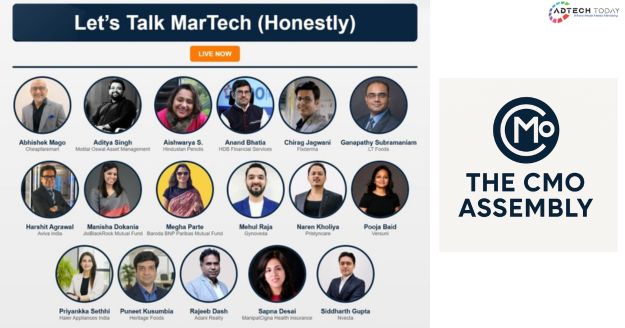
That was the clear signal from The CMO Assembly’s World MarTech Day Comment Café, where CMOs and marketing leaders assessed their stacks with unusual candour, rating their tools like employees up for review: promoted, put on PIP, or replaced.
The consensus? MarTech is not failing. But it is under growing pressure to prove it can move faster, integrate better, and drive business outcomes beyond dashboards.
Adtech Today Editor Neha Parikh joined the session live, putting questions to the panel. Their responses are woven through the conversation below.
Sapna Desai,ManipalCigna Health Insurance argued that MarTech has earned its promotion — it has improved how brands understand customers and act in real time. But she added an important caveat: the value lies not in the stack itself, but in the decisions it enables.
Manisha Dokania, JioBlack Rock Mutual Fund was more cautious, calling out underutilisation as the real issue. Most tools, she noted, come loaded with features, but only a fraction are actually used.
Aditya Singh, Motilal Oswal Asset Management described his stack as “promoted, but on an integration PIP,” especially where data silos still exist between direct-to-consumer channels and distributor networks. Priyankka Sethhi, Haier Appliances India, echoed that balance — core tools such as CRM, analytics, and performance marketing have earned their place, while over-engineered dashboards and disconnected layers need course correction.
For Mehul Raja Gynoveda, the break is more operational: in inbound-heavy retail journeys, the MarTech flow can collapse at the dialler level. Harshit Agrawal, Aviva India, added that MarTech deserves promotion only if teams commit equally to upskilling and business impact.
“MarTech may stay, but the mandate is sharper. Leaner, connected, outcome-first.”
When asked which tool no one likes but no one removes, CRM dominated the conversation.
Abhishek Mago, Cheapfaremart, called CRM the category that survives every cost optimisation exercise: slow, complained about, but never replaced. Naren Kholiya, Pristyncare, described legacy CRM workflows as a “classic hostage situation” — painful, but mission-critical.
Others widened the list. Manisha Dokania pointed to Google Analytics, especially the GA4 transition. Sidharth Gupta at Nivecta flagged reporting layers that still lack real-time intelligence. Chirag Jagwani, Fixderma, pointed to Meta and Google as expensive in CAC but impossible to walk away from.
Aishwarya S., Hindustan Pencils offered the sharpest CDP critique: many companies buy customer data platforms for personalisation, but end up using them as data warehouses.
The most revealing responses came when leaders were asked where the customer journey still breaks.
For Sapna Desai, the answer was friction and ambiguity — when the experience becomes complex or unclear, engagement drops. Sidharth Gupta located the break between marketing, sales, onboarding, and success, where context gets lost. Megha Parte, Baroda BNP Paribas Mutual Fund, agreed: handoffs still break the customer experience.
Puneet Kusumbia, Heritage Foods, pointed to transitions such as ad to landing page and the “post-purchase golden silence.” On what the stack has genuinely improved, he added that MarTech’s strongest contribution is behavioural — the what, when, at what price, and time of day, enriched further by backtracking to attitudes or connecting dots from other sources.
Manisha Dokania highlighted cross-device movement — from web to app and back. K. Ganapathy Subramaniam, LT Foods, added that journeys break when the same customer is treated like multiple people across devices or channels.
In healthcare, Naren Kholiya brought the human layer into focus. Between qualified lead and confirmed treatment, the funnel does not break on data — it breaks on doubt: trust-building, doctor availability, patient hesitation, and family influence.
“Journeys don’t only break because systems fail. They break because context, confidence, and continuity disappear.” — K. Ganapathy Subramaniam, CMO, LT Foods
When the conversation turned to revenue-driving use cases, leaders were quick to move past vanity metrics.
Sapna Desai pointed to context-driven engagement — identifying customer needs in the moment and responding with relevant communication. Manisha Dokania cited emails and interventions in drop-off journeys. Naren Kholiya named “speed to call” as a powerful revenue lever in healthcare: seconds versus minutes can change outcomes.
Sidharth Gupta focused on identifying accounts ready to upgrade and converting that signal into revenue. Abhishek Mago named performance marketing as the most consistent demand lever — high intent, scalable, and measurable, but flagged a real caveat: increasing costs driven by incorrect setups and teams not skilling up as fast as tools have evolved. Tie it with retention, brand leverage, loyalty, and a constant effort on improving UX for higher conversion, and you have a winning setup.
Chirag Jagwani credited reaching the right audience with the right content at the right moment. Rajeeb Dash, Adani Realty, highlighted progressive profiling and better storytelling in high-ticket categories. Pooja Baid brought in a sharp AI use case — influencer optimisation. By feeding past performance data into AI, her team could analyse what worked for which objective and make sharper decisions going forward.
On AI, leaders were split less by belief and more by maturity.
Sapna Desai called AI an operating system — shaping how organisations think, decide, and execute, while keeping direction human-led. Sidharth Gupta was unequivocal: a feature helps with one task; an operating system changes how everything works.
Naren Kholiya framed the transition neatly: feature today, OS tomorrow. Harshit Agrawal called it the operating system of tomorrow and urged marketers to make it part of their thinking design. Manisha Dokania agreed AI is currently a feature but evolving fast.
Puneet Kusumbia was more grounded, calling AI a feature and problem-solver for now. Pooja Baid, Versuni India described it as a support system until organisations reach greater maturity. K. Ganapathy Subramaniam argued that winners will treat AI not as a shiny add-on, but as a control plane for revenue, service, and customer experience. Aishwarya S. signalled that for some organisations, the shift is already underway — AI has become a daily way of working.
Chirag Jagwani was candid on what today’s marketer needs to unlearn: the assumption that human creativity and in-person designers will always do a better job. With smart use of AI, some marketing teams are losing their existence entirely.
“Winners will treat AI not as a shiny add-on, but as a control plane for revenue, service, and customer experience.” — K. Ganapathy Subramaniam, CMO, LT Foods (Daawat)
The strongest consensus emerged around MarTech’s limits.
Sidharth Gupta said MarTech should stop pretending it can fix a product that does not matter, work, or retain customers. Manisha Dokania added that it cannot solve broken products, bad strategy, or — in mutual funds — fund performance.
Aditya Singh made the same point for asset management: MarTech can improve onboarding and nurturing, but it cannot substitute for fund performance or market volatility.
Sapna Desai and Naren Kholiya both pointed to trust. MarTech can optimise journeys, but trust is built through consistency, clarity, credibility, and critical moments. In healthcare, no stack replaces human reassurance.
Megha Parte challenged the single customer view myth — data unification does not automatically solve execution gaps. Puneet Kusumbia said MarTech cannot fix weak messaging, positioning, or content. K. Ganapathy Subramaniam was equally direct — MarTech earns its seat at the strategy table only when it can answer three questions: what business problem it solves, what metric it moves, and what decision it improves. If it cannot do all three, it is just stack.
Pooja Baid put it simply:
“MarTech cannot fix bad decisions. That still sits with humans.”
Read more: The CMO Assembly Launches With 100 Founding CMOs, Crosses 150 Members In Its First Month

