
Published on: April 15, 2026
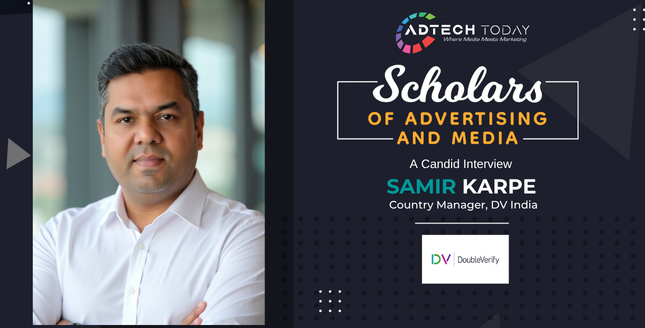
With nearly two decades spent navigating the trenches of traditional media and performance tech, Samir Karpe knows the digital landscape is brilliantly messy. As the DV India Country Manager, he isn’t just watching the ecosystem scale; he is actively trying to keep it honest.
Samir is convinced of the power of AI, not as a shiny new toy, but as a gritty, performance-driven tool that clears away the digital clutter. For him, the ultimate goal of all this technology is to find the “human magic”—real, meaningful attention in a highly fragmented world.
In our conversation, he unpacks the delicate balance between chasing massive reach and demanding high-quality media; revealing how true technological innovation gives brands the confidence to thrive.
You’ve worked across the digital media/growth spectrum. What pivotal moment led you to focus on strengthening the integrity layer of India’s advertising ecosystem—ensuring media quality keeps pace with scale?
There hasn’t been one defining moment. Rather, it’s been nearly 20 years working across traditional media, OTT, and performance technology that made it clear to me that media quality is directly tied to performance and must be a core focus for advertisers. Without that foundational layer, sustainable performance is difficult to achieve. In many ways, DV’s acquisition of DV Scibids™ reflects that reality—bringing quality signals directly into the optimisation layer so performance and integrity work together.
To that end, advertisers are no longer solely focused on reach and efficiency. As a growing share of marketing budgets shifts to digital, media quality has become central to every conversation.
“Strengthening the integrity layer isn’t about quality for its own sake; it is about driving better outcomes.”
When advertisers consistently access high-quality media, performance becomes more predictable and scalable. In turn, brands invest more confidently, ultimately benefiting the entire ecosystem.
India’s digital ecosystem is vast and highly diverse. As Country Manager, how do you balance universal brand safety standards with the realities of regional language, cultural nuance, and platform fragmentation?
While there are certain brand risk categories that everyone aims to avoid, the conversation in India and globally has really shifted toward brand suitability. That means tailoring standards to specific brand needs.
“It’s not just about avoiding risky content; it’s about ensuring brands appear in the right context, in the right state of mind, across languages and regions.”
And that introduces one layer of complexity. Then, to your point, there’s the regional dimension, as India’s digital ecosystem is incredibly diverse. Multiple languages, cultural contexts, and a mix of global and local platforms require nuance to meet suitability needs while navigating a very fragmented media environment.
To manage this complexity at DV, we’ve continuously invested in technology, tools, and capabilities that enable the level of customisation campaigns require today. Products like DV Scibids AI allow us to go even further, where media quality is one component, and additional data signals, including platform, cost, and advertiser first-party data, help drive more effective optimisation and performance outcomes.
The industry is moving beyond viewability toward attention as a more meaningful metric. In a high-clutter media environment like India, how does this shift change the way brands evaluate performance and engagement?
“The real objective of advertising is attention; did someone meaningfully engage with your message?”
Viewability and brand suitability are essential foundations. But in India’s high-clutter media landscape, where campaigns are often highly complex and run across multiple formats, optimising toward attention provides a more outcome-driven signal.
And that’s why DV Authentic Attention® , is designed to be both comprehensive and robust, analysing more than 50 signals per impression in near real time. Exposure data captures how the ad is presented on screen, such as viewable time, share of screen, video presentation, and audibility, while engagement data measures user-initiated interactions during that exposure. This includes eyes-on-screen, user touches, screen orientation, video playback, and audio control interactions.
Ultimately, this reflects how much advertiser expectations have evolved. Brands want a more holistic toolkit to evaluate performance and engagement. We’ve been building toward that by combining media quality signals, contextual intelligence, and attention metrics to move beyond standard measurement. The shift is toward evaluating performance more comprehensively and strategically.
As AI becomes deeply embedded in media buying and verification, how do you separate real innovation from hype while ensuring transparency remains measurable and accountable?
We’ve seen an explosion of hyped AI over the last two years—particularly in the past year. But hype and innovation are not the same thing, and hype doesn’t endure the way real innovation does.
At DoubleVerify, we’ve always believed that the best AI is focused on performance. That’s part of why we acquired DV Scibids. As an optimisation solution, it supported our broader vision of becoming a media effectiveness platform; not just a verification company.
“If innovation consistently delivers measurable performance improvements, then it’s not hype. It creates real business value.”
On the accountability side, transparency is critical. AI should not operate as a black box. Advertisers need clarity into what signals are being used, how optimisation decisions are made, and what outcomes are being driven. When AI is both performance-led and transparent, it becomes measurable, accountable, and sustainable. That’s how we separate real innovation from hype, that’s the standard we hold ourselves to.
There is growing global emphasis on responsible media and sustainable digital growth. What practical steps should Indian brands take to ensure their media investments support a safer, more trustworthy digital ecosystem?
First, brands need to prioritise independent measurement. Today in India, digital accounts for a significant share of marketing budgets, and advertisers are actively talking about media quality—fraud, viewability, brand suitability, and transparency. When that much investment is at stake, having independent visibility into what you’re buying is critical.
Second, brands should move beyond optimising purely for cost. Campaigns in India are increasingly complex—multiple creatives, languages, formats, and platforms. Incorporating media quality signals such as viewability and attention into optimisation frameworks helps ensure that performance is not just efficient, but effective.
Finally, engagement across the ecosystem is essential. Agencies, platforms, and technology partners each have an important role in supporting higher standards. When advertisers are empowered with independent verification, transparency and measurable outcomes, growth becomes more sustainable for everyone.
Looking ahead, how do you see India’s ad-tech infrastructure evolving in terms of data accountability, media trust, and global leadership?
“India is uniquely positioned as a high-growth, mobile-first market where innovation often happens at scale.”
Advertisers here are increasingly sophisticated in how they structure campaigns and measure performance. Conversations around AI, accountability, and quality are accelerating, and industry forums are actively engaging with these topics.
As the market matures, I expect greater emphasis on transparency in emerging channels like CTV, more adoption of AI-driven optimisation, and deeper integration between measurement and activation. If trust continues to be prioritised alongside growth, India has the potential to influence global best practices. At DoubleVerify, we’re committed to helping shape that evolution by strengthening transparency, accountability, and performance standards across the ecosystem.

