
Published on: November 17, 2026
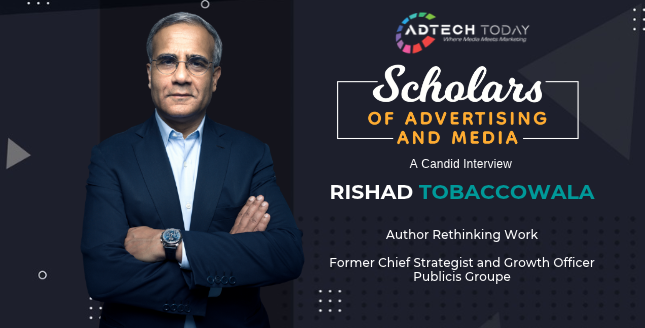
During his Publicis years, Rishad Tobaccowala believed first-party data would give agencies a competitive advantage. Now the author of Rethinking Work, he wonders whether a richer signal sits in the back-and-forth between a person and an answer engine. Earlier, he spent nearly four decades at Leo Burnett and Publicis Groupe, one of the world’s largest advertising groups, rising to Chief Strategist and Growth Officer.
In this exclusive conversation with Adtech Today, Tobaccowala explains the first question he would ask as a new CMO, and why he points to a newspaper that stopped seeing itself as one. He also says why India’s cheap mobile rates could leave global companies surprised.
You spent nearly four decades inside one of the world’s largest advertising groups, through the shift from analog to digital. What did you find hardest for talented people to unlearn?
The hardest thing to unlearn is that what got them to success to date will not take them to success in the future.
“People tend to use old playbooks that do not work in a world of tectonic change.”
For instance, talent is far more informed and impatient than it was. The benefits of scale are increasingly limited in a world where speed and agility are key.
You’ve argued that people choose with emotion and justify with data, and you advise companies building AI employees. Where should AI support human judgment, and where should people remain accountable for the decision?
AI is great at collecting, organizing and synthesizing information. When it comes to the final decision, it should loop in people for two reasons. First, to ensure that it has not made a mistake. Second, machines tend to lack the total context about the situation, the client or other sensitivities. Increasingly, we should start with AI first and then have the human finish the final product or service.
What is one belief about marketing you held firmly during your Publicis years that you have since changed your mind on?
I believed that first-party data across categories and clients would provide a competitive advantage for agencies. I still believe it does, but I wonder if the temporal data in the back-and-forth between a person and an answer engine is now much richer, and more filled with signals, than any first-party data.
If you were a CMO starting Monday with a flat budget and a mandate to bring AI into the team, what would be your first decision?
“I would ask how AI changes my business and not how AI can make my current business more efficient or effective.”
The New York Times succeeded in the digital transition because it did not use digital just to make the newspaper run more smoothly or to gain newspaper subscribers cost-effectively. Instead, it realized that digital meant it was no longer a print-based news publication focused on New York, publishing every morning, but a multimedia, global, always-on lifestyle business with some news.
You’ve spent time with India’s advertising industry. What capability or way of working from India do you think the global industry is underestimating as AI reshapes marketing?
Mobile rates are so inexpensive, due to Jio and others, and AI allows such amazing capabilities to be delivered cost-effectively. So most global companies will be surprised at how fast and ferociously future-focused Indian marketing will become. India is today the largest market by users for YouTube, the second largest for LinkedIn, and big for other so-called American platforms.
“The future of AI marketing may happen in India first.”
There are other ways global marketers can learn from India. Indian marketers have become great at personalizing in a multitude of ways, from language to region to affordability, given the spectrum of India’s audience. Their focus on accessibility and affordability is something everyone should pay attention to, in a world where inflation and a K-shaped economy are leaving people unable to engage with brands and services.
Looking toward 2027, what will marketing teams be paid to deliver that they aren’t paid to deliver today?
I believe marketing teams will be seen as the only way a company differentiates and drives growth, and they will be far broader in what they do, from product design to experience interfaces to running partnerships. There will be less communication and more marketing and growth.
More CMOs or Chief Growth Officers will make it to the board, since they will be seen as revenue drivers versus cost centers.