
Published on: November 6, 2026
Publicis Groupe has responded to remarks made by WPP CEO Cindy Rose during the holding company’s third-quarter earnings call, challenging her suggestion that some advertising groups secure new business through what she referred to as a “CEO handshake thing”.
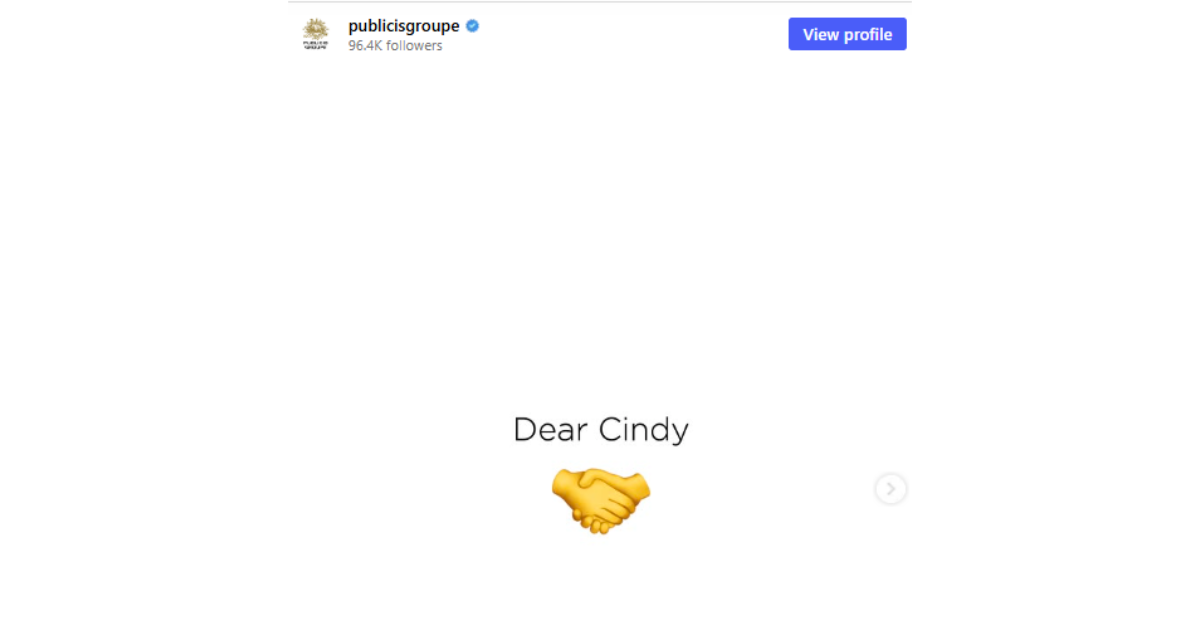
In an Instagram post titled “Dear Cindy”, the French advertising group addressed Rose’s comments, saying it welcomed healthy competition and industry exchanges but felt the need to clarify how it wins client accounts.
Publicis particularly disputed the implication that business partnerships were secured through informal agreements between chief executives. Describing the suggestion as an “insult to clients’ intelligence”, the group maintained that global companies would not entrust their data, media and technology operations to an agency based on a casual meeting or informal understanding. It added that its client partnerships followed extensive evaluation and months of rigorous testing.
“Skipping an old-school pitch circus isn’t skipping due diligence. It’s clients knowing what they need and testing us to the limit,” Publicis said.
The group also highlighted its investments in technology, talent and artificial intelligence (AI), pointing to its connected identity and media solutions, intelligent creative capabilities and AI engines as key factors supporting its relationships with large enterprise clients.
Taking a further swipe at WPP, Publicis referenced the recent Coca-Cola media review and questioned Rose’s comments about the growing demands of agency pitches.
“You can’t be a passionate defender of pitch culture and plead exhaustion in the same breath. If an extra six-week run was enough to sideline your teams, it’s not an endurance problem; it’s a capability one,” the post stated.
Publicis concluded by acknowledging the pressure advertising groups face when communicating performance and business outcomes to financial markets. However, it argued that agencies should not undermine clients, employees or the work delivered across the industry in the process.
“We understand the pressure of building a narrative for the financial markets and the urge to celebrate a win. But it shouldn’t require denigrating our clients, our people and all of our efforts. Our industry does extraordinary work. Let’s give it the credit it deserves.”
The Instagram post also tagged WPP’s official account and carried the caption: “We’re not angry, we’re just disappointed.”
Publicis’ response followed comments from Cindy Rose during WPP’s Q3 earnings call, where she was asked why the group had not participated in Coca-Cola’s North American media review and whether competitors were securing assignments without going through traditional pitches.
Rose said WPP was satisfied with the outcome of Coca-Cola’s global media review, highlighting that the group had retained the business in every market where it participated in the process. She explained that WPP decided against entering the North American pitch because it had already secured the account across the remaining international markets.
“We made a tough call between spending yet another six weeks pitching for North America versus delivering against what we had already won. It was a fine judgement call, which I made, and it’s as simple as that,” Rose said.
Commenting on reports of competitors winning accounts without formal pitches, Rose described the practice as a “CEO handshake thing”.
She also raised concerns about the increasing costs and demands associated with agency pitch processes, emphasising the importance of proper evaluation before clients make significant business decisions.
“Nobody loves pitching. The cost and burden of the process seems to be increasing. But I think what’s really important to me is that my clients fully understand the implications of the decisions they’re making,” she said.
“These are really high-stakes decisions with material business consequences, and they deserve careful consideration. I don’t think we do ourselves any favour as an industry of professionals by encouraging clients to bypass proper due diligence,” she added.
The exchange comes after Coca-Cola concluded a major global media review last month, with WPP retaining the majority of its international media business while Omnicom secured the North American account.
Within Asia Pacific, Coca-Cola confirmed that WPP Open X would continue handling its media business across most markets, while Dentsu retained responsibility for Japan and South Korea. In Australia and New Zealand, WPP Open X also retained the account, with EssenceMediacom continuing its involvement.
Manolo Arroyo, Coca-Cola’s Executive Vice President and Chief Marketing and Customer Commercial Officer, said the review was intended to identify the right partners, capabilities and operating structure for the company’s evolving marketing requirements.
“We began this process with a clear objective: ensure we have the right partners, capabilities and operating model to continue to lead in a rapidly changing marketing landscape,” he said.
“The outcome reinforces our confidence in the strength of our global marketing ecosystem and positions us to accelerate growth through deeper consumer understanding, greater agility and the responsible application of emerging technologies.”
Coca-Cola also explained that Omnicom’s appointment in North America was driven by the need for a more integrated regional structure. The model brings together media, data, customer relationship management (CRM), loyalty and creator capabilities to deliver more connected consumer experiences.
Meanwhile, Publicis Groupe strengthened its position in the global media landscape in September after securing PepsiCo’s worldwide media account. The appointment expanded Publicis’ responsibilities across the food and beverage company’s international media operations.
Publicis reportedly won the account from incumbent Omnicom agency OMD in several key markets without a formal pitch, bringing a relationship spanning more than two decades to an end.
The contrasting account developments have added further context to the exchange between the two holding companies, bringing the debate around traditional agency pitches, client due diligence and relationship-led business wins into focus.