
Published on: August 13, 2026
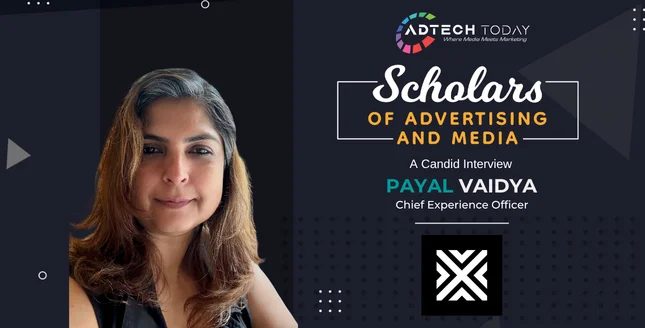
You spent thirty years building a brand people trust. An AI assistant has no memory of any of it. That is the problem Payal Vaidya sees coming for some of India’s biggest brands, and as Chief Experience Officer at VML India, one of the world’s largest experience agencies, she
is designing for it in real time. In an exclusive conversation with Adtech Today, she explains why brand equity now counts for nothing if a machine can’t read you, and what breaks next: zero-click metrics, ten-minute quick-commerce decisions, and a flood of AI content that converts no better. Her through-line: as machines take over execution, the last real advantage is human judgment.
On AI assistants browsing and shortlisting on the consumer’s behalf — what should experience teams now be designing for?
If you ask an AI assistant to recommend a running shoe or a fixed deposit today, you never actually visit a website. The model scans four sources, pulls three reviews, cross-references a forum and hands you a four-sentence summary. Your brand might be mentioned, but your UI, your custom typography and your expensive homepage layout were bypassed entirely.
For an Indian multinational with thirty years of brand equity, this feels bizarre. You have decades of trust stored in the heads of human consumers, but an LLM has no emotional memory of your 1998 TV commercials. It only knows what is structured, verified and readable in its training data or real-time retrieval.
“If your product specs, real user feedback and core differentiators aren’t documented in clean, machine-readable formats, you effectively don’t exist to the algorithm.”
For a Series C or D founder, the priority shifts from landing-page optimisation to what I call discovery architecture. You’ve spent millions driving traffic to a funnel you control, and now a significant chunk of your prospects will be qualified or rejected before they ever reach your site. Experience teams can’t just be UI designers anymore. They have to design data-layer structures, clear schema and factual content footprints that give AI models a reason to shortlist you over the competitor down the road.
Zero-click search is shrinking traffic even as brand visibility rises. How should brands be measuring content performance now?
When over 60% of Google queries end without a click, a figure that climbs sharply once an AI summary sits at the top, traditional marketing dashboards break down. If your primary KPI is sessions or unique visitors, your reports will look like a disaster even as your brand influence grows.
Zero-click AI answers now function much like broad media exposure used to, except they are hyper-targeted to immediate intent. Being cited as a primary source inside a ChatGPT answer or an AI Overview builds real authority, but you won’t see a neat attribution line in Google Analytics.
So we’ve changed how we evaluate content. Instead of chasing raw pageviews, we look at
three things:
– AI Share of Voice: Are our products consistently named when a user prompts an AI about our category?
– Citation Depth: Is our original research being pulled into AI summaries as an authoritative reference?
– Branded Search Velocity: Do people who read a zero-click summary come back later to search for our brand by name?
If you’re a founder or a CMO, you have to train your board to stop treating organic traffic as a pure volume game. Fewer people will visit your site, but those who do arrive with high intent, having already digested an AI summary. You’re converting higher quality at lower volume.
Quick commerce has collapsed the distance between discovery and purchase in India. What does that do to the role of brand content?
Quick commerce in India has completely disrupted the traditional funnel. On Blinkit, Zepto, or Instamart, the gap between “I need this” and “the rider is at my door” is ten minutes. The discovery, evaluation, and transaction happen almost simultaneously on a tiny screen.
In that environment, brand content loses its ability to educate in the moment. Nobody is reading a long-form comparison chart or watching a two-minute explainer video while ordering cold drink mixers at 10:00 PM. Content’s only job at the point of purchase is to trigger instant visual recognition. Your packaging needs to read clearly as a tiny thumbnail on an app grid, and your brand name needs to be familiar before the app is even opened.
“Content strategy now extends beyond campaigns into commerce content itself. Product titles, imagery, descriptions and ratings become critical touchpoints, because they decide the purchase in a compressed journey.”
Growth-stage D2C brands are succeeding because they use top-of-funnel content mostly on Instagram and short-form video not to drive immediate site visits, but to plant visual cues. When the consumer opens a quick commerce app ten minutes later, that seed pays off in a split-second decision. For established FMCG majors, this means breaking down internal walls: the brand team making high-budget ads and the trade team managing dark-store listings can no longer be separate silos. They are managing two halves of the same ten-minute loop.
As Chief Experience Officer, where do experience design and performance marketing pull in opposite directions?
The tension comes down to time horizons and friction.
Performance teams want instant, measurable conversion. They want shorter forms, fewer clicks, aggressive pop-ups, and stripped-back pages because that’s what wins a three-day A/B test. Experience teams care about brand recall, coherence, and customer lifetime value. They want to tell a story, so the customer remembers why they bought, not just that they bought.
If you let performance marketing run the entire show, they will strip out everything that makes your brand unique until every landing page looks like a generic SaaS template or a discount warehouse.
“Performance marketing converts today, but it burns brand equity tomorrow, leading to high acquisition costs down the line because no one remembers who you are.”
I see this constantly in post-Series C companies under pressure to hit aggressive monthly targets. They optimise so hard for short-term customer acquisition cost, CAC, that they destroy their organic retention.
My role as CXO isn’t to pick a side, it’s to enforce balance. Performance marketing is your acquisition engine, but experience design protects your pricing power and your retention. If your performance team is constantly stripping out brand context to shave a fraction off conversion cost, you need someone in the executive room asking what that does to your repeat purchase rate six months from now.
Brands are producing more content than ever and converting no better. What’s the real constraint?
Generative AI made content creation virtually free, and as a result, the internet is buried in generic noise. Ahrefs analyzed over 14 billion web pages and found that roughly 96% of them get zero traffic from Google. Publishing more low-grade content doesn’t move the needle anymore; it just adds to the clutter.
The actual constraint isn’t content volume, it’s depth and point of view.
“Most corporate blogs read like a rehash of the top five Google results because that’s exactly how they were written or prompted.”
They lack real expertise, original data, or a distinct opinion. A single piece of content built around proprietary research, specific customer data, or an unconventional industry take will generate more actual pipeline than fifty generic “How To” articles.
For an Indian multinational sitting on decades of proprietary consumer insight, this is your biggest advantage. An AI model trained on global web data cannot replicate your understanding of Tier-2 and Tier-3 consumer behaviour, local trade dynamics or regional preferences. Stop generating generic commentary and start publishing your actual insight.
For growth startups, stop trying to out-publish the incumbents. You won’t win a volume game against an enterprise budget. Focus strictly on deep, high-intent content that solves a specific, painful problem for your exact ideal customer profile.
What capability do Indian brands most need to build over the next 18 months? The most critical gap in the Indian market right now isn’t access to AI tools, it’s strategic judgment.
Industry data from NASSCOM and Deloitte shows a massive shortage of AI-proficient talent in Indian marketing, but the shortfall isn’t about technical execution. Anyone can learn to write a basic prompt or generate an image in five minutes.
“The real gap is finding marketers who understand how to analyse AI outputs, connect them to business strategy, and know when to override the machine.”
e saw the exact same pattern twenty years ago when digital marketing exploded. Companies rushed to hire “digital experts” who could manage ad portals but had no underlying commercial instinct. The same mistake is happening now with AI.
Over the next 18 months, Indian brands, whether scaling startups or massive conglomerates, need to build teams that combine technical AI literacy with deep human intuition. You need people who can interpret AI-driven analytics, but who also have the cultural empathy and brand judgment to keep customer experiences authentic.