
Published on: July 9, 2026
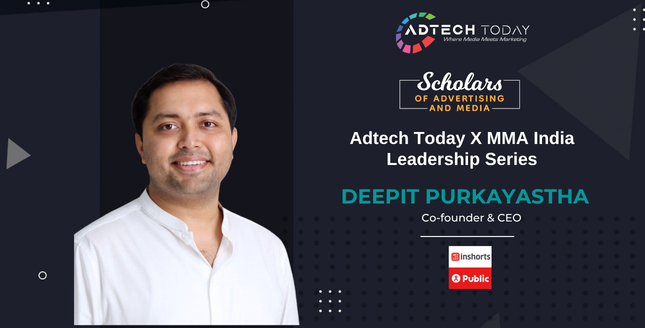
Deepit Purkayastha doesn’t see technology as a barrier to connection; he sees it as the bridge. It’s been over a decade since he turned an IIT Kharagpur dorm-room project into Inshorts, a platform that fundamentally changed how India consumes news. Today, as Co-founder and CEO of Inshorts & Public and a key member of the MMA India AI Council, he navigates the complex intersection of technology and storytelling.
In this exclusive collaboration for the MMA Impact India 2026 series, he moves past the buzzwords to focus on the human side of the screen. For Deepit, the real power of AI isn’t in its speed, but in how it clears the digital clutter; leaving more room for the human judgment and trust that no machine can replicate. He reminds us that while the tools have changed, the goal remains the same: respecting the user’s time and earning their attention in a messy, noisy world.
You started Inshorts in your final year at IIT Kharagpur and pioneered short-form content in India. What is the one founding instinct that still drives every product decision today?
It is incredibly humbling to look back at where this journey started—back in the dorm rooms of IIT Kharagpur.
When we first conceptualized what would eventually become Inshorts, we weren’t trying to build a media company. We were simply trying to solve a problem we faced ourselves. We wanted to stay informed about what was happening in the world, but we didn’t have the time—or frankly the patience—to read long articles filled with information that wasn’t always essential.
That led us to the one founding instinct that continues to guide virtually every product decision we make today: respect the user’s time.
In a world overflowing with content, attention is scarce, and time is the most valuable currency people have. Our original thesis was simple: if we worked hard enough, we could distill a complex news story into its most important facts—the who, what, when, where and why—in 60 words or less, without losing the essence of the story.
More than a decade later, the formats, technologies and platforms have evolved, but that principle hasn’t changed.
Whether we’re improving personalization, redesigning a user flow, launching a new feature, or experimenting with new content formats, we ask ourselves the same question: Does this help the user derive more value in less time?
“I’ve come to believe that when you consistently respect people’s time, you earn something far more valuable than attention, you earn TRUST.”
Users come back not because you’ve trapped them in the product, but because you’ve repeatedly proven that every minute they spend with you is worth it.
That focus on delivering maximum value with minimum friction was the foundation of Inshorts then, and it continues to be the foundation of everything we build today.
At MMA IMPACT India 2026, your session asked whether attention has become scarcer or just more scattered in the age of AI. What was your answer?
At MMA IMPACT India 2026, my perspective was that attention hasn’t necessarily become scarcer; it has become far more fragmented, contextual, and fluid. Every platform today has a different quality of attention. The way users engage with short-form video, news, commerce, or communities is fundamentally different. So for brands, the real challenge is understanding the context in which attention exists and how consumer moments evolve across platforms.
AI has accelerated this complexity. Today, there’s an explosion of AI-generated content and increasingly accessible tools that enable moment-level hyper-personalisation at scale. Trial-and-error capabilities have improved dramatically, and brands can move faster than ever before. But when everyone has access to similar tooling, the real differentiator becomes insight.
The key challenge now is not just capturing attention, but earning it. That requires brands to operate at an atomic level where the context of the consumer moment and the intent of the brand come together meaningfully. The brands that succeed will be the ones that can create nuanced, intent-driven engagement rather than broad-based messaging.
AI can optimise execution, but human insight still drives differentiation. Understanding cultural cues, emotional triggers, and consumer behaviour is becoming even more valuable in an AI-led ecosystem. So my answer was:
“Attention is not disappearing; it is becoming more dynamic, and brands that combine technology with sharper human insight will be the ones that truly win it.”
You also spoke on why publishers matter more in the age of AI. When AI can summarise anything, what is the one thing a platform like Inshorts can do that AI simply cannot replace?
AI can absolutely summarise information at scale, and increasingly, it can do that very efficiently. But what AI still cannot fully replace is human judgement around relevance, trust, and context.
In a world flooded with synthetic content and what many now call “AI slop,”
users are facing decision fatigue. The problem is no longer access to information; it is knowing what is credible, contextual, and worth paying attention to. What users consistently come to us for is trusted curation. Our platforms combine technology, behavioural understanding, editorial judgment, and deep local insights to help users navigate information overload more meaningfully. Whether it is Inshorts simplifying discovery for a fast-moving audience or Public emerging as a trusted short-video platform rooted in Bharat’s everyday stories, cultural content, civic alerts, the core value remains the same: relevance with trust.
“I believe the future advantage for publishers will not come from generating more content, but from filtering better.”
AI can generate infinite information, but trust, familiarity, cultural nuance, and editorial instinct are still deeply human capabilities, these become even more valuable as the internet gets noisier.
The Modern Marketing Reckoner 2026 put the Incumbent-Insurgent debate centre stage. As a founder who built an insurgent from scratch, what is the one thing legacy brands still do not understand about how challengers actually win?
I think one thing legacy brands still underestimate about insurgents is that they are fundamentally built to pursue uncertainty. Taking an example of product differentiation – both incumbent and insurgent brands understand the importance of it; but their risk-taking approach varies.
Large incumbent brands are optimised for scale and predictability. When they launch something new, there is naturally a bias toward protecting existing distribution, capital efficiency, and operating certainty. That often makes them more cautious about pursuing emerging or unconventional consumer opportunities.
Insurgent brands, on the other hand, are usually built around identifying behaviours or market gaps that look too small, too risky, or too unpredictable for larger players to prioritise early. That willingness to experiment creates differentiation.
I also think the lesson for legacy brands is that scale should not reduce curiosity. Incumbents, because of their size and operating complexity, naturally optimise for predictability and efficiency. Consumer behaviour evolves much faster than organisational structures do. Insurgents often win because they are more willing to experiment early, adapt faster to changing consumer intent, and invest in emerging behaviours before they become obvious or mainstream.
“The real advantage today is not just scale; it is the ability to stay close to evolving consumer contexts and respond to them quickly.”
As a member of MMA India’s AI Council, where do you see Indian marketers genuinely lagging in AI maturity and what needs to change urgently?
One thing I’ve observed through the MMA India AI Council is that India doesn’t have an AI adoption problem; it has an AI maturity problem.
Indian marketers are experimenting aggressively with AI, but much of that experimentation is still happening in silos. Teams are using AI for content generation, creative production, or reporting, but not yet embedding it deeply into how marketing decisions are made.
“The biggest gap is that we’re still thinking of AI as a productivity tool rather than an intelligence system.”
The real opportunity lies in using AI to predict customer behavior, optimize decisions, and create continuous feedback loops between consumer insights, creative execution, and measurement.
The second challenge is data. As AI models become increasingly accessible, proprietary consumer understanding becomes the real competitive advantage. Brands that build strong first-party data ecosystems and faster learning loops will have a significant edge.
In my view, the winners of the next decade won’t be the brands that simply use AI. They’ll be the brands that redesign their entire marketing operating system around it.

