Published on: June 19, 2026
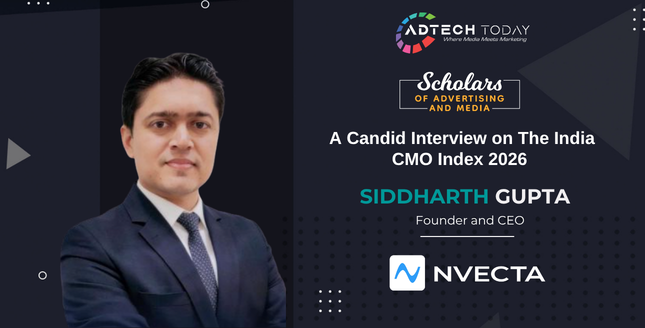
Siddharth Gupta is a builder who would rather fix a foundation than paint a wall. As the Founder and CEO of NVECTA, support partner for the India CMO Index 2026, he has spent years watching companies collect mountains of data without truly knowing how to act on it. Siddharth is a straight-talker who cuts through the noise of “must-have” tools to focus on how organizations are actually structured. He believes the real bottleneck in marketing isn’t a lack of technology, but the way companies trap intelligence in the hands of a few experts.
In this exclusive conversation with AdTech Today; the official media partner for the India CMO Index 2026; he explores why “unified data” is often a distraction and how brands can finally move from simple experimentation to making AI the core of their business.
Q1. NVECTA is a support partner for the India CMO Index 2026. What made this report worth backing?
We backed the India CMO Index 2026 because it does something most industry reports avoid; it tells the truth without dressing it up in corporate jargon. The pattern across the 2026 research is consistent: ambition is racing ahead of maturity. CMOs know AI matters and budgets are already committed, yet very few organizations are actually built to turn that spend into repeatable outcomes. What made this report worth supporting is that it benchmarks Indian marketing leaders honestly and specifically. It doesn’t just import global averages that fail to reflect how Indian enterprises actually operate. It separates leaders from laggards on real maturity signals rather than hype.
“The question marketers need isn’t which AI tool should I buy; it’s is my organisation structured to act on intelligence at all.”
The India CMO Index frames exactly that with the rigor and regional context to make it useful. Backing a report that sharpens the right debate and hands leaders an honest mirror matters far more to us than adding another voice to the noise. The clearer that debate gets, the better the whole category performs for everyone involved.
Q2. The report found 45% of CMOs use AI through a few power users only. From a platform perspective, what’s blocking that shift?
The blocker isn’t appetite; it’s architecture. When 45% of CMOs say AI runs through a handful of power users, what they’re really describing is intelligence trapped in individuals. A few skilled people have learned to prompt well and stitch tools together to produce impressive results. But that capability never becomes organizational because it lives in their heads rather than in a system everyone shares. Most teams have spent two years solving the data problem; they’ve pulled sources together and automated on top of them. That is necessary work, but it stops short.
“Unified data isn’t unified intelligence. You can have every customer record in one place and still have ten teams interpreting it ten different ways, acting on instinct rather than a shared, real-time understanding.”
That’s precisely where the power-user pattern comes from: the intelligence was never made common. The shift happens when intelligence itself is unified and made available to everyone, so the same understanding of the customer drives every campaign and automation regardless of who’s at the keyboard. This step of unifying intelligence is the gap we built NVECTA to close; until it’s closed, AI stays a personal advantage rather than an organizational one.
Read more: India CMO Index 2026: The Report That Asked What No One Usually Does
Q3. 35% of CMOs are still mostly experimenting with AI. What’s the difference between a brand that experiments and one that actually embeds?
Experimentation and embedding look similar from the outside, but they are structurally different. An experimenting brand treats AI as a set of tools it points at discrete tasks; it might draft a campaign, summarize a report, or generate creative variants. The output can be genuinely good, but it is episodic. It depends on someone choosing to use the tool, and that value disappears the moment they stop. An embedded brand runs on shared intelligence; AI isn’t something a marketer reaches for, it is the layer the whole operation runs on. Every team works from the same live understanding of the customer, so decisions trigger and optimize automatically without a human writing a clever prompt each time. That’s the line 35% of CMOs are still standing behind. Most stall because they assume embedding means doing more experiments, faster. It doesn’t. Embedding means making intelligence the default — unifying it once so the organisation acts on it continuously. That is exactly the shift NVECTA is built to enable: moving the value out of individual cleverness and into the system itself, where it holds.
“A brand that embeds has stopped treating AI as a project and started treating it as how the business runs.”
Q4. Only 26% of CMOs qualify as Strategists. What does a stack look like for that top tier versus the 67% still scaling?
The 67% scaling and the 26% who qualify as Strategists often use similar tools; the real difference is what those tools connect to. Scalers have done the hard, necessary work of unifying their data and automating around it. Campaigns fire on schedule and dashboards populate, but the intelligence still sits in fragments. The CDP knows one thing while the engagement tool acts on a third; nobody is working from a single, current understanding of the customer. Because of this, effort scales but it doesn’t compound. Strategists go a step further; their stack is built around one unified layer of intelligence feeding every decision in real time. Engagement,
measurement, and optimization aren’t separate systems reporting to each other; they are expressions of the same understanding.
“The gap between scaling and strategy was never more automation or more tools; it’s whether intelligence is unified, or only the data is.”
This is the design principle behind NVECTA. We focus on unifying the intelligence rather than just the data beneath it because that is what turns daily activity into a compounding advantage for the business.
Q5. What does a truly AI-ready CMO look like in 2026, and how far is the average Indian enterprise from that?
A truly AI-ready CMO in 2026 has moved past the question everyone else is still asking. The market spent years collecting data, then years unifying it, and is now busy layering automations on top. The AI-ready CMO has gone one step beyond all of that; they’ve unified intelligence, not just data. That means one shared, living understanding of the customer drives every automated decision. The organization acts coherently because every system reasons from the same place.
“It’s less about how many AI tools sit in the stack and more about whether the business runs on a single intelligence.”
The average Indian enterprise is closer than it feels but perhaps further than it thinks. The intent is unmistakable and budgets are committed, but the intelligence is still scattered across teams. This is why so much activity doesn’t translate into a long-term advantage. That one remaining step is the hardest because it can’t be bought as just another point solution; it has to be unified. That is the step we focus NVECTA on entirely; it is the one that separates being ready from simply being busy.

