
Published on: June 17, 2026
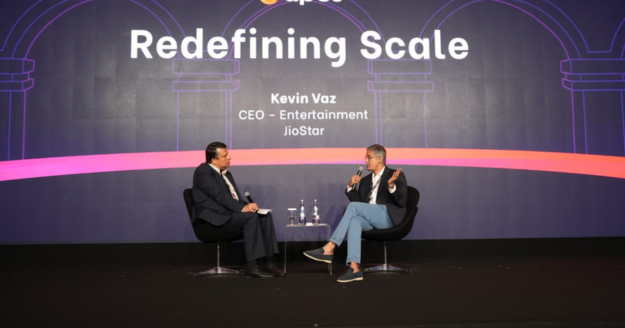
At APOS 2026, Kevin Vaz, Chief Executive Officer – Entertainment, JioStar, shared insights into the company’s transformation journey, the evolving media landscape, and the future of entertainment driven by technology, commerce, and consumer engagement.
Speaking during a session titled “Redefining Scale: Storytelling, Culture and the JioStar Playbook,” Vaz reflected on the creation of JioStar following the landmark merger that brought together two of India’s largest media and streaming ecosystems.
Describing the integration as one of the most significant transformations of his career, Vaz highlighted the complexity of combining successful businesses with distinct technologies, content libraries, consumer bases, and cultures.
“The last 18 months have been industry-defining in many ways,” said Vaz. “What people often see from the outside is the scale, but what they don’t see is the complexity involved in bringing together two highly successful companies into one seamless ecosystem.”
Following the merger’s completion in November 2024, JioStar combined JioCinema and Disney+ Hotstar into a single platform, JioHotstar, within three months. Vaz noted that such integrations typically take years in global markets.
Today, JioHotstar serves more than 500 million monthly active users, has surpassed one billion app downloads, offers content across every Indian pin code, and manages over 260 million paid subscriptions. The platform has also become home to some of India’s biggest streaming moments and record-breaking sporting events.
Vaz emphasized that while scale remains important, its definition has evolved.
“Scale is no longer about how many people you reach. It is about the impact you create in people’s lives once you reach them,” he said.
Addressing JioStar’s identity as a media company, Vaz argued that the traditional distinction between content and technology companies has largely disappeared.
“Storytelling will always remain at the heart of everything we do. But technology determines how those stories are delivered, personalized, experienced, and scaled,” he said.
He highlighted innovation as a key pillar of JioStar’s strategy, pointing to developments in artificial intelligence, content discovery, personalization, and short-form content experiences.
Vaz also discussed the growing intersection between entertainment and commerce, describing it as one of the industry’s most important inflection points.
Historically, content consumption and transactions existed separately. Today, digital platforms are enabling consumers to engage with content while simultaneously interacting, purchasing products, and participating in brand experiences.
He cited examples from JioStar’s partnerships that allow viewers to order food while watching live sports, shop fashion featured in entertainment shows, and engage with branded content experiences integrated directly into programming.
“Engagement today goes beyond passive viewing. Consumers want to interact, participate, discover communities, and increasingly transact within the same experience,” Vaz explained.
He also noted that commerce represents a significant future revenue opportunity for media companies as traditional advertising and subscription models continue to evolve.
Discussing JioHotstar’s recently launched micro-drama offering, Tadka, Vaz revealed that the format has already attracted nearly 100 million viewers within weeks of launch.
Designed to complement long-form content rather than replace it, micro-dramas cater to consumers seeking entertainment during shorter moments throughout the day.
Rather than creating a standalone platform, JioStar chose to integrate the format within JioHotstar, allowing consumers to move seamlessly between short-form and long-form viewing experiences.
Vaz reiterated his belief that India continues to be an “AND” market rather than an “OR” market, where consumers move effortlessly between television, connected TV, mobile devices, and short-form content platforms.
According to him, consumers do not differentiate between screens. Instead, they simply seek the most relevant entertainment experience based on context and convenience.
JioHotstar currently reaches more than 85 million connected TV homes, reflecting the growing demand for premium viewing experiences combined with digital personalization.
When asked about the future of entertainment, Vaz predicted that content consumption would become increasingly interactive and immersive.
Rather than simply watching content, audiences will participate in communities, interact with creators, engage in commerce, play games, vote, and personalize experiences in real time.
“The future of entertainment will move from passive consumption to active participation,” Vaz concluded.
As JioStar continues to scale its integrated media ecosystem, the company remains focused on combining storytelling, technology, and consumer engagement to shape the next phase of entertainment in India.