
Published on: June 11, 2026
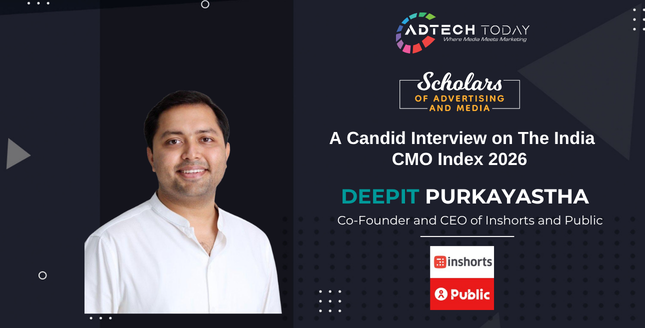
Deepit Purkayastha has spent over a decade building platforms that simplify the world for millions of people. As the Co-Founder and CEO of Inshorts and Public, he understands that while data tells you what happened, it doesn’t always tell you why. He is a straightforward thinker who believes technology is at its best when it clears away the repetitive “busy work,” leaving more room for the creative spark that makes a brand memorable. He views the future of marketing not as a battle between math and art, but as a chance to finally get the balance right.
In this exclusive conversation with AdTech Today, the official media partner for the India CMO Index 2026, Deepit explores how brands can move past short-term pressure to build long-term trust.
Inshorts and Public are support partners for the India CMO Index 2026. What drew you to this initiative?
Vivek and the team at CMO Assembly have built a genuinely valuable community, one where senior marketing leaders actually say what they think, not what sounds right. That’s rarer than it should be. I believe great communities create the conditions for honest conversation, and honest conversation is what actually moves industries forward.
When they approached us about the CMO Index, the design of it stood out. Anonymous. Unedited. No right answers. Most industry research tells you what people are comfortable saying publicly. This one was built to surface what they actually think. So supporting the community felt like the right thing to do.
Your quote draws a sharp line — performance marketing is really response marketing; the click is downstream of the brand. How did you arrive at that view?
Honestly, it came from watching a shift happen in real time. I began feeling increasingly uncomfortable with what was being lost in the process.
Over the last decade, the industry moved decisively toward what’s measurable. We prioritised clicks, conversions, and attributed revenue. The logic was compelling. Finally, we could prove marketing works. But the more completely
planning rooms organised themselves around measurable short-term signals, the more a different question started nagging: what about everything that happens before the click? Familiarity and trust are the real reasons someone is receptive to an ad in the first place.
That earlier work is invisible in most attribution models. It doesn’t show up in a dashboard. But it’s doing the heaviest lifting, and it happens in environments where people are genuinely present and attentive, not scrolling on autopilot.
What we call performance marketing is measuring the response to that earlier work. Not the work itself. The click is downstream of the brand.
“And if we keep optimising for the click while systematically underinvesting in the environments where the brand actually gets built — we’re borrowing against equity we’re no longer replenishing.”
Binet and Field put a number to it, thirty years of data across seven hundred brands showing the optimum split between brand-building and activation is 60:40. The data confirmed what the observation had already suggested. However, the observation came first.
63% of CMOs cite brand impact as their biggest measurement blind spot. As a media platform, how do you see brands trying to solve that — and where are they still getting it wrong?
The measurement tools certainly exist; brands are running brand lift studies, tracking incremental reach, and measuring search uplift. The problem isn’t the instruments themselves; it’s the time horizon they’re being applied to. A brand lift study after a single campaign is just a snapshot of something that only reveals itself over years. Brand equity doesn’t accumulate in one quarter. Pricing power, long-term market share, and the reason a consumer chooses you over a cheaper alternative are outputs of consistent investment. They require environments where the brand is consistently present and trusted.
“Measuring a campaign and measuring a brand are two different exercises.”
The industry has built sophisticated tools for the first, but the second remains largely unmeasured. This isn’t because it can’t be done; it is because the planning cycle doesn’t create the conditions for it. The brands getting this right ask a different question: which environments put my brand in front of an audience that is genuinely attentive? That is a context question before it’s a measurement question.
If you start with measurement in isolation, you end up optimizing for what’s easy to count in a single quarter rather than what actually builds a brand over years.
Read more: India CMO Index 2026: The Report That Asked What No One Usually Does
36% of CMOs say influencer ROI remains unmeasured. Inshorts and Public sit at the intersection of content and audience. What’s your view on how that gap gets closed?
Influencer ROI is unmeasured for the same structural reason brand impact is unmeasured; the industry built its measurement infrastructure around direct response, and influencer marketing doesn’t produce results in any clean, attributable way.
“The gap doesn’t get closed by finding a single magic metric; it gets closed by being real about the fact that different types of media investment do different things and need different proof frameworks.”
An influencer builds familiarity and shifts perception. You measure that differently from a search ad. What we observe consistently is this: media environments where genuine trust is established, where the audience has actively chosen to be there, where the context signals credibility, tend to be the ones where subsequent performance metrics also improve. The context of consumption is doing work that standard attribution models aren’t built to capture. Closing that gap starts with acknowledging the work is real and building proof frameworks that match the type of work being done, not the type that’s easiest to attribute.
The report tracks these numbers again in 2027. What shift would you most like to see?
The number that stayed with me from the report – 53% of CMOs claim balanced budgets but 44% would defend performance first if budgets were cut. That gap between what people believe and what they do under pressure is the most important data point in the report for me.
By 2027, I’d like to see that gap narrow, not because of a regulatory push or a measurement breakthrough, but because enough brands will have felt the cost of over-indexing on activation and under-investing in the environments where brand equity actually accumulates. The market has a way of correcting these things. The correction is already beginning – performance costs are rising, attention is fragmenting, and brands that built equity through consistent presence in trusted environments are increasingly the ones holding pricing power. The CMO Index will tell us in 2027 whether that lesson has landed; I really hope it has

