
Published on: June 12, 2026
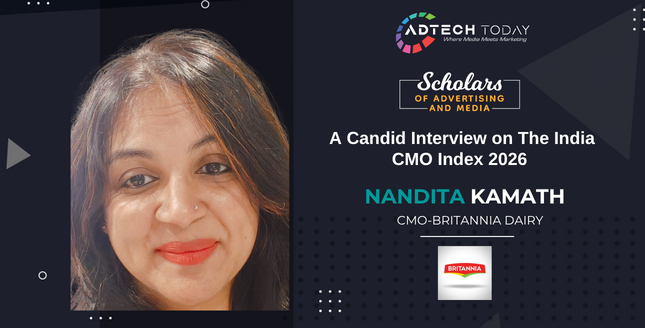
Nandita Kamath is the Chief Marketing Officer at Britannia- Dairy Business ; she is an astute leader who understands the immense weight of a legacy giant. As a CMO navigating one of India’s most complex consumer landscapes, she has successfully redefined her role from brand custodian to a high-stakes revenue driver with direct P&L accountability.
In this exclusive conversation with AdTech Today; the official media partner for the India CMO Index 2026; Nandita shares her strikingly honest views on the tension between quarterly pressure and long-term equity. She is a firm believer that while technology enables precision; the real magic lies in protecting the brand’s compounding interest.
The India CMO Index found 53% of CMOs claim balanced brand and performance budgets, but 44% would cut brand first under pressure. Does that contradiction resonate with your experience?
Absolutely, and I don’t think it’s necessarily a contradiction so much as it’s the reality of the role. The CMO mandate has fundamentally shifted over the past few years. We are no longer just brand custodians; we are revenue drivers with direct accountability to the P&L. That pressure is real, and it shapes every budget conversation.
In an ideal world, a well-balanced brand and performance investment strategy is the right approach and most CMOs, including myself, genuinely believe in that balance. The real skill is holding both without letting the ‘urgent’ always override the ‘important’.
But when market conditions tighten, share is under risk, or when growth targets are non-negotiable, the calculus changes quickly. Performance marketing delivers measurable, short-term conversions, and that’s what the business needs to see in moments of stress.
“The harder truth is that brand investment is often the first casualty precisely because its returns are harder to defend in a quarterly review.”
So yes, the tension between what we say and what we do under pressure is real. And I’d argue it reflects the increasingly complex position CMOs occupy today. We’re constantly balancing long-term brand equity with short-term business accountability.
Q2. You’ve described brand building as the compounding interest of marketing — invisible short-term, irreplaceable long-term. How do you make that case internally when quarterly pressure is relentless?
The good news is that most business heads today genuinely understand the value of long-term brand equity. however, the conflict is about timing, not belief.
When revenue targets are stretched, even the most brand-committed leaders look for places to pull back.
My approach is simple: I don’t defend brand budgets, I reframe them. As a CMO, I see myself as a revenue contributor first, and that changes the conversation entirely.
Under pressure, I propose a low investment, high impact model. Precision-targeted media reaching high-intent cohorts with sharp, USP-led communication tracked on Reach and Impressions. Simultaneously, I double down on owned media, particularly social, where content creation is affordable, boosting is efficient, and consumers are actively making brand decisions. A strong brand narrative here goes a long way. And increasingly, I’m investing in AEO — Answer Engine Optimization, ensuring the brand shows up authoritatively as consumers turn to AI for discovery and decisions.
“The case I make internally is simple: we don’t go dark on brand, we get smarter about it.”
Q3. Building a new dairy category in India means building both brand and demand simultaneously. How do you decide where to put the weight?
The dairy category is undergoing real Premiumization. Consumers are gravitating towards value-added products anchored in nutrition, convenience, and taste. And the affluent, discerning consumer driving this shift has largely migrated to e-commerce and quick-commerce for their grocery needs.
What makes this channel powerful is that it collapses the traditional funnel. Discovery, consideration, and purchase happen in the same session — brand and demand get built simultaneously, not sequentially.
For Britannia Dairy’s premium pipeline, we are deliberately over-indexing our investments here. That means investing in high-intent search keywords to capture consumers in discovery mode, owning sponsored listings and premium shelf placements at the point of purchase, and building rich product pages with strong nutritional storytelling to win consideration in the moment. Sampling and trial programs on these platforms further accelerate category adoption by lowering the barrier to first purchase.
“The weight goes where the consumer already is — and right now, that’s quick-commerce.”
Read more: India CMO Index 2026: The Report That Asked What No One Usually Does
Q4. The report found that short-termism and ROI pressure together keep 70% of CMOs up at night. What does good measurement of brand actually look like to you?
The measurement problem is at the heart of why brand budgets are always first to be questioned. If it doesn’t show on a dashboard, it’s hard to defend in a boardroom.
But brand health does reveal itself — you just need to know where to look. For me, the early signals are digital and observable: Are branded search volumes growing? Are ratings and reviews improving in volume and sentiment? Is organic social engagement strengthening — earned, not boosted?
These are real-time indicators that brand perception is moving in the right direction. Over time, they graduate into deeper equity markers, positive brand sentiment, stronger purchase intent, and consumer perception aligning with the brand’s core positioning. None of these are vanity metrics.
“Together, they tell a coherent story of a brand earning relevance, not just buying it.”
That’s what good brand measurement looks like directional, consistent, and honest.
Q5. The index will track these numbers again in 2027. What would a healthier brand vs performance balance look like for Indian marketing, and what needs to shift to get there?
By 2027, a healthier balance isn’t necessarily about equal splits; it is about treating brand investment as a business fundamental rather than a line item that gets cut when targets get tough. Achieving this requires movement on three fronts. First, brand measurement needs to mature; equity metrics must sit alongside performance numbers in boardroom conversations as equal indicators of business health. Until that happens; brand will remain perpetually vulnerable.
Second, finance and business leadership need to be active participants in this shift. When CFOs internalise brand as a compounding revenue asset rather than an expense; budget conversations change fundamentally.
Third, and perhaps the biggest unlock is CMOs themselves stepping up.
“The industry needs us to lead with confidence; armed with data, clear on the business case, and unapologetic about the long game.”
If those shifts take hold, 2027 won’t find us relitigating the same debate; the conversation will have moved from whether brand investment is worth it to how to make it work harder.

