
Published on: June 3, 2026
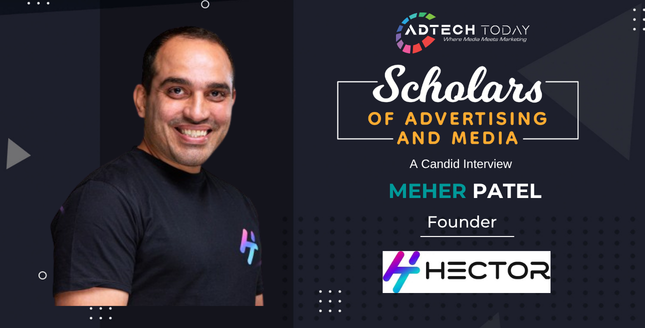
Meher Patel, the visionary founder of Hector, is a seasoned AdTech veteran with over two decades of experience navigating the industry’s messiest challenges. Known for his “in-the-trenches” perspective, Meher doesn’t just build tech; he solves the operational friction that bogs down human creativity. He is a big believer in the efficiency of AI, yet he maintains that the real “magic” happens when these tools free up humans to be strategic architects.
In this exclusive interview, he explores the shift from cluttered dashboards to conversational interfaces and explains why the future of advertising isn’t about silos, but about integrated intelligence systems.
You’ve been vocal about “Dashboard Fatigue.” Why do you believe a conversational interface (via ChatGPT/Claude) is superior to the visual dashboards we’ve used for the last decade?
Dashboards were a revelation a decade ago because they finally let us see advertising data clearly; however, the reality today is that we are simply drowning in them. If you’re a performance marketer, you’re likely juggling Amazon, Flipkart, Myntra, and a dozen other platforms alongside your own internal reporting systems
“At some point your job became more about navigating these interfaces than analysing the business. That’s the problem.”
A conversational interface changes everything. You simply ask what you want to know, like “Which campaigns are wasting spend?” Where is ROAS dropping?” The system gives you the answer away. Dashboards are still useful for analysis, but the main way you interact with data shifts from browsing to asking questions. This reduces friction and helps you go from insight to action faster.
Hector AI is a frontrunner in using the Model Context Protocol (MCP). How does this protocol move us past “chatting with a bot” to letting an AI “pilot” a multi-million dollar ad account?
Most people still think of AI as just a smarter search box. You ask it a question, it gives you an answer, and then you do the heavy lifting yourself. The Model Context Protocol (MCP) completely changes that dynamic. When an AI has deep access to your systems, APIs, and workflows, it stops being a simple chatbot you talk to and starts being a tool that actually does the work. This is where the real value lies.
With Hector, the AI isn’t just looking at the data; it is analyzing performance to find the underlying issues and taking actions directly on your behalf. It can pull the necessary reports, detect which keywords need a boost, and even adjust bids or pause campaigns without you ever having to touch the ad console.
“A chatbot just gives recommendations; an agent takes action, checks outcomes and keeps improving.”
This kind of closed-loop execution is a genuine breakthrough for our industry. For any team managing massive advertising spends, this shift moves AI from being a neat productivity tool to becoming a core part of the daily operation
Most platforms data after 90 days. How does Hector’s “unlimited memory” let a brand run Diwali analysis without a team of data scientists?
One big problem in retail media is short-term memory. Most platforms only provide advertisers with data for a limited window; after that, the data vanishes. This means every festive season, teams are forced to start from scratch using fragmented exports and spreadsheets. It is a cycle that prevents brands from actually building on their past successes.
Hector solves this by storing long-term advertising intelligence—including data on ASINs, keywords, and placements—over years. This allows brands to compare trends across cycles and see what actually worked. Earlier, this level of analysis required expensive analytics teams and custom pipelines.
“We think this kind of intelligence should be accessible to every advertiser, not just those with large data science teams.”
It is about giving brands a permanent memory so they can make strategic decisions based on history, not just current snapshots.
Scaling to ₹100 Cr in revenue in under a year is a feat. What was the single biggest “pain point” you solved that allowed Hector AI to gain rapid adoption among big spenders?
The biggest problem we solved was delivering instant insights along with the actual ability to take action on them; that was the real bottleneck holding brands back. Most advertisers are constantly juggling various marketplaces, ad consoles, internal reports, and disparate teams.
“By the time insights were put together the opportunity to act was often gone.”
Hector unified these systems into one operational layer. It reduced the gap between insight and execution. It meant teams could identify an issue and take action immediately from one central place rather than hopping between multiple tabs. This was especially powerful in the Indian market; brands here have to navigate a complex web of Amazon, Flipkart, Myntra, and the surging quick-commerce ecosystems. Having all major marketplaces connected through one intelligence layer accelerated adoption among advertisers.
How do you see the role of the “Media Buyer” changing now that Hector can handle diagnostics and bidding? Does the human rol9e become more about strategy and creativity?
The operational side of media buying is rapidly getting automated; tasks like bid changes, harvesting, keyword negation, and anomaly detection are essentially systems problems that AI is simply better at solving at scale. This shift is already happening in real-time across the industry.
What becomes significantly more important in this new landscape is human judgment. An AI can detect a sudden performance drop or a spike in spend, but it cannot fully grasp the messy nuances of category behavior or shifting competitive dynamics. It lacks the ability to sense consumer sentiment or understand the broader business context like an experienced operator can.
“The future media buyer looks more like a growth architect than a dashboard operator.”
As automation handles the repetitive basics, human expertise can finally focus on the decisions that require genuine intuition and a deep understanding of the market.
Beyond media and search ads, where do you see the next big opportunity for Agentic AI? Could we see Hector managing supply chains or creative production in the near future?
Retail media is currently the primary commercial use case because the feedback loops are measurable and incredibly fast; however, the underlying capability of Agentic AI is far more expansive than just search ads. Any environment where a system can analyze variables, detect deviations, and take corrective action is a prime candidate for Agentic AI.
Supply chain management is a natural extension. If a system truly understands inventory velocity alongside real-time advertising demand, it can automatically regulate spend to ensure we don’t drive traffic to products about to hit a stockout. Then there is the creative side. Once AI understands which messaging frameworks and visual formats drive performance, it can begin to influence the high-level strategy rather than just following a brief.
“Over time advertising, forecasting, inventory and creative production won’t operate as silos; they will operate as intelligence systems.”
That is the ultimate direction of the industry.

