
Published on: June 2, 2026
Priyanka Mehra, Global Marketing Director and Regional Director for South Asia and India at COMvergence, works across global strategy and regional market realities. Over the years, she has played a key role in expanding the company’s marketing function across more than 50 markets while keeping a strong focus on local relevance and client needs.
Measured and analytical in her approach, Mehra believes the biggest shift in 2025 is not a decline in pitching activity but a more thoughtful approach to partnerships. As brands move away from transactional reviews and focus on long-term value, she sees the APAC region entering a more mature phase of growth.
In this interview, she talks about the changing pitch landscape, India’s evolving MARCOM ecosystem, and the rise of digital-first Southeast Asian markets.
What is the most significant shift you’ve seen in how brands are approaching pitches in 2025 both globally and in APAC?
The most significant shift we’ve observed in 2025, both globally and in APAC, is a decisive move from volume to value in pitching.
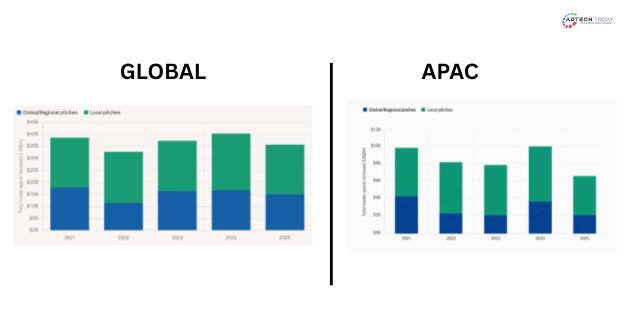
When you look at the COMvergence data from 2021 to 2025, covering over 18,000 pitches globally, it appears activity has been declining since 2022. However, what’s striking is that the total media spend reviewed has remained stable at around $37 billion annually.
This indicates that brands are not stepping away from pitches, they are becoming far more selective and intentional.
“Each pitch now carries greater strategic importance, with elevated expectations around business impact, transformation, and long-term value creation, rather than just short-term cost efficiencies.”
That shift is massive. Importantly, the structural mix of pitches—global, regional, and local—has remained relatively consistent, with local markets still driving the majority of activity.
In APAC, this global trend is clearly mirrored, but with an added layer of maturity and discipline. In fact, 2025 saw slightly lower-than-average pitch volumes and total spend compared to 2021–2024, reinforcing the idea that the region is moving toward fewer, higher-stakes pitches.
Ultimately, brands here are prioritizing deep partnerships over quick, transactional wins, signaling a more strategic and outcome-driven approach to agency selection.
In your dual role as Global Marketing Director and Regional Director India & SEA, how are you shaping the story of COMvergence’s growth for a global audience? What has been the most significant shift internally and externally?
Over the past few years, I’ve been focused on building and scaling COMvergence’s global marketing function and positioning from the ground up, working closely with Olivier and the founding team.
This has been a foundational journey establishing the building blocks across communications, partnerships, and brand visibility, with a clear objective:
“To create a globally consistent narrative that remains locally relevant across more than 50 markets.”
Given the diversity of those markets, a one-size-fits-all approach simply doesn’t work. Each region requires a nuanced understanding, and our marketing and communication strategies have been carefully tailored to reflect that, while still reinforcing a unified global identity.
Internally, the most significant shift has been the move towards a deeply client-centric model. Much of what we’ve developed — from product enhancements to new tools has been directly shaped by client needs and feedback. That continuous feedback loop has been critical in driving both relevance and innovation.
We’ve also expanded our ecosystem to include technology partners, which has broadened how our data is applied and created new use cases beyond traditional agency evaluation.
Externally, the most visible shift has been the significant increase in COMvergence’s market presence and credibility, particularly across India and APAC. Today, our data is not only widely used by agencies but also by consultants and increasingly embedded within competitive pitches, positioning COMvergence as a trusted intelligence partner in the global marketing ecosystem.
Read more: COMvergence Q1 2026 Global New Business Results: WPP Media Takes Top Spot
COMvergence released its Global MARCOM report earlier this year — what trends are you seeing in India in this space?
Looking at India over the past decade, the agency M&A landscape reflects a clear evolution from scale-driven consolidation to capability-led investment.
Between 2016 and 2025, COMvergence has tracked 36 acquisitions in India. Activity peaked in 2017 and again in 2019, when global holding groups were aggressively expanding their footprint. Since then, the pace has moderated, stabilising at around three to four deals annually, followed by a pause in 2024 and a gradual recovery in 2025.
What’s particularly noteworthy is the shift in the investor mix. While holding companies still dominate, we’re seeing increasing participation from consulting firms and technology-led players. This signals a structural shift in the market. India remains strategically critical, but the focus is no longer just about scale.
“It’s about acquiring specialised capabilities, data, and technology that can drive differentiated value in an increasingly complex ecosystem.”
Which SEA market outside India is showing the most interesting growth or innovation in new business right now, and why?
“Markets like Indonesia, the Philippines, and Malaysia are particularly exciting right now.”
They are highly digital-first and mobile-led, with social platforms especially TikTok and short-form video, playing a central role in both media consumption and advertising investment.
In contrast to Singapore, which remains a more mature and stable hub, these markets are driving the next wave of growth in Southeast Asia. This is especially evident in categories like e-commerce and, increasingly, in luxury, where brands are leveraging social-led discovery and creator ecosystems to scale rapidly.
What makes these markets stand out is not just growth, but the speed of innovation in how brands engage consumers — more agile, more platform-native, and far more integrated with culture and commerce.
What has remained your favourite part of the job over the past four years?
At the core, I’m a people person, so the most rewarding part of the role continues to be engaging directly with clients and spending time in my markets.
There’s no substitute for being in the room. One of the most fulfilling moments is seeing a client interact with the platform for the first time — that instant when the data clicks and they recognise the depth of insight it can unlock. That moment of clarity and excitement is something that never gets old.
I also deeply value the opportunity to build relationships in new markets. Understanding different business environments, working closely with clients, and developing long-term partnerships are what make the role both dynamic and meaningful.
Read more: A Decade of COMvergence: Olivier Gauthier on Data, Markets and the Future of Media Intelligence

