
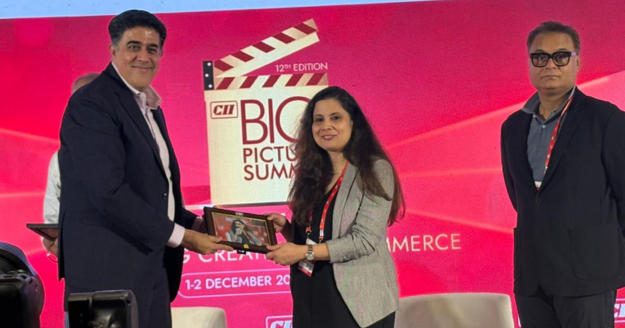
MUMBAI, India—December 5, 2025—Prime Video, India’s most-loved entertainment destination, participated in a highly engaging panel session themed “The Digital Media Explosion: India’s Next Growth Story” at CII Big Picture Summit 2025. This session explored how digital ventures are redefining content creation, distribution and audience engagement for the future. Moderated by Gunjan Soni, co-chair, CII National Council on Media & Entertainment and country managing director, YouTube India, saw participation from Shilangi Mukherji, director & head of SVOD business at Prime Video India, along with other industry leaders including LV Krishnan, chief executive officer, TAM Media Research; Neeraj Roy, managing director, Hungama Digital Entertainment; and Darryl Vaz, sr. director – product and program management, LTIMindtree.
The conversation started with Gunjan asking the panellists about the steps—technological, regulatory, or talent-driven—that need to be taken to create even greater value for India’s digital customers. Responding to this Shilangi explained how in a multilingual country like India that sees mobile-first behaviour, and increasing living-room viewing patterns, services must be designed around how consumers live and consume content. Taking the example of video streaming services, she highlighted how Prime Video and others have taken steps to create a personalized streaming experience for every user—offering something for everyone and everything for someone—and in the process, moving the needle from broadcast entertainment to unicast. “Streaming services globally have created access and discoverability of content and a wide selection of content,” she added.
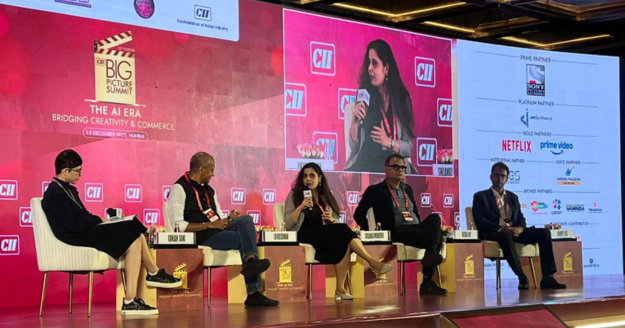
On being asked about Prime Video’s strategy to breakthrough, drive the next wave of adoption and shape the Indian market, Shilangi outlined a three-part approach. First, she spoke about the impact of a tiered subscription strategy, noting “that it democratizes content.” Prime Video also programs for diverse customer cohorts, with the definition of diversity extending across demographics, age, gender, contexts of viewing, and even affordability levels. To address this, Amazon Prime has introduced multiple subscription options tailored to India’s economic diversity, including Prime Lite, Prime Shopping Edition, in addition to Prime subscription that offers all benefits.
Second, she spoke about the diversity of the creators and talent that Prime Video works with, and how that helps achieve more diversity in storytelling, helping serve India’s heterogenous audience. “It’s no more a hegemony of a few studios, but it gives the opportunity for a lot of people to have a seat at the table and have their voice heard, have their stories be told in a meaningful and relevant manner,” she said. At Prime Video, over 65% of Originals in development and production feature new talent either in front of or behind the camera and this number continues to grow.
Next, she highlighted the importance of offering the right content mix across formats. This spans scripted long-form storytelling, with series including Mirzapur, The Family Man, and Panchayat delivering multi-season success; and unscripted shows, where Prime Video has seen breakthroughs this year with The Traitors and the celebrity talk show Two Much with Kajol and Twinkle. As she noted, “We’re opening up newer formats at scale because unscripted is something that has always been big on broadcast.” Movies are another area where Prime Video is democratizing access. With a clear understanding of which films have broad appeal and which are better suited for streaming, the service balances mass reach with content tailored specifically for digital audiences. This includes direct-to-service premieres, Originals produced for both streaming and theatrical release, co-productions with theatrical debuts, and films arriving on the service after their theatrical run.
Finally, she emphasized the role of devices in driving engagement. With a clear shift toward living-room viewing, Shilangi noted that while mobile phones remain essential for on-the-go consumption, true “stickiness” comes from customers choosing to watch series and movies on larger screens, especially when viewing with others. Shilangi also highlighted Prime Video’s role as a video entertainment marketplace, with Movie Rentals and add-on subscriptions enabling customers to access diverse content through a single device and simple payment method, expanding selection and accessibility across formats and devices. Summing up, Shilangi said, “Overall, when you look at content creation, access, devices, and distribution together, it positions us (Prime Video) strongly. Today, Prime Video receives viewership from 99% of the pin codes in India. But it’s still day one for us.”
When asked to envision the industry’s future, she added, “Content is India’s soft power, and it comes on the back of culture building. If I had a crystal ball, for me it will be two parts. The first one is how India can be the window to the world when it comes to storytelling. I truly believe that we are at the cusp of change, where our content can travel just as Korean content has travelled, just as Turkish content has travelled all over the world. So, we have to break those boundaries, and I feel like that’s the crystal ball that I love to gaze on. The second one is that it the large opportunity size for entertainment in India. From a streaming perspective, how can it be the first port of call for every customer when it comes to entertainment.”
Read more: Indian Streaming Still Awaits A Homegrown Superhero, Says Prime Video India’s Nikhil Madhok

