
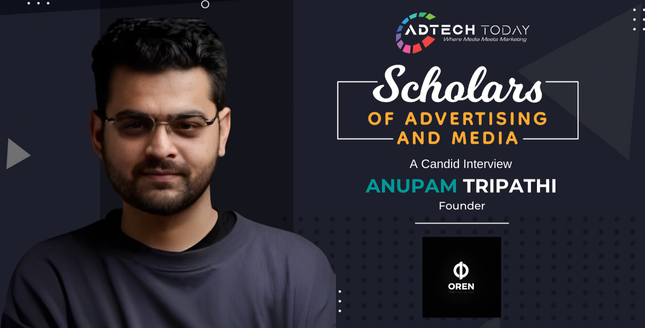
Every marketing journey begins long before a campaign goes live. Sometimes it starts in brainstorming sessions fueled by data insights; sometimes it’s in client meetings where brand narratives are debated and refined; or in the quiet hours spent analyzing consumer behavior and media performance. For Anupam Tripathi, marketing has always been about blending creativity with strategy, technology with human insight, and performance with purpose.
Few marketers traverse as many diverse terrains as Tripathi. From banking at Kotak Mahindra Bank, to agency leadership at dentsu X, and finally scaling consumer brands like Lenskart, he has built a reputation as a change agent who transforms brand narratives into measurable impact. Recognized among the Top 40 Under 40 marketers multiple times, his work spans integrated campaigns across ATL, BTL, digital, OOH, and even in-movie marketing, reflecting a rare fluency across channels and audiences.
In conversation, we explore how Tripathi navigates the complex intersections of data, creativity, and media strategy; how he balances short-term performance with long-term brand building; and what it takes to lead campaigns that resonate emotionally while delivering tangible results.
Q: You’ve led marketing across very different worlds — from banking to agencies and now consumer brands. How has this cross-industry journey shaped your approach to building brands?
Working across banking, agencies, and consumer brands has felt like living three different lives, each one teaching me something unique about people. In banking, I learned discipline, the value of trust, and how every message has to be earned. Agencies taught me creativity and speed, and how to turn a spark into a story that moves people. And brands like Lenskart showed me what it takes to scale that story and make marketing not just seen but felt.
This mix shaped how I think about brands today. I don’t see marketing as just performance or storytelling anymore but as building genuine connections that last. Whether it’s data, design, or emotion, it all comes down to understanding humans. The best brands don’t shout the loudest; they listen, evolve, and show up with purpose. That’s why I try to build brands that people don’t just buy from but believe in.
Q: You’ve often spoken about the importance of connecting data with emotion. How do you approach building campaigns that perform while still feeling human and relatable to audiences?
I’ve always believed that data gives direction, but emotion gives meaning. You can’t build brand love by staring at dashboards. Data helps me see patterns of what people are doing but emotion tells me why they care.
When I create campaigns, I always start with a human truth, something that feels real and relatable, and then use data to shape, time, and scale it. Data helps the story find the right people; emotion makes them stay with it.
The magic happens when logic and empathy meet. Every metric should serve a feeling, not replace it. Because in the end, marketing isn’t about algorithms or impressions, it’s about connection.
A great campaign performs not just because it’s optimized, but because it moves people. That’s the balance I chase every day. When you have data for clarity and emotion for depth, it together builds brands that people don’t just remember, but genuinely trust.
Q: The retail category is seeing a shift from awareness to measurable outcomes. How do you approach building performance frameworks that go beyond ROAS and capture long term brand value?
The obsession with ROAS is understandable, but it’s also limiting. Performance can’t just be about the next click, it has to reflect the brand’s lasting impact. I look at performance through two lenses: efficiency and equity. Efficiency tells me how smartly we’re spending today. Equity tells me whether those efforts are compounding into trust, recall, and loyalty tomorrow.
When I build performance frameworks, I connect every short-term action to long-term signals like repeat rate, engagement depth, community sentiment & organic advocacy. Those are the true multipliers that shape sustainable growth.
I’ve often said that if you get trapped in analysis paralysis and obsess only over lower-funnel metrics, you’ll miss the magic of marketing. The magic lies in emotion, aspiration, and storytelling. These are the things that make people care before they convert.
I see creative and media as one continuous loop: the story drives the data, and data refines the story. ROAS shows you revenue; brand love builds legacy. The real shift is moving from
transactional marketing to transformational growth.
You’ve also been closely associated with influencer marketing through your role at the Indian Influencer Governing Council. What kind of evolution do you foresee in this space in terms of ethics, measurement, and impact?
Influencer marketing has evolved from a fast-growing trend to a powerful driver of culture and commerce. But with scale comes responsibility. Through the Indian Influencer Governing Council, our vision is to build an ethical, transparent, and trusted ecosystem that unites influencers, brands, consumers, and platforms under clear, shared standards.
The next phase of this industry will be defined by accountability and empathy. It’s not just about setting rules, it’s about creating a culture of honesty, responsibility, and care. The Council’s focus extends beyond regulation to supporting creators through mental well-being resources, legal guidance, and help in navigating misinformation and online backlash.
Measurement will also evolve from vanity metrics to meaningful ones that reflect trust, authenticity, and long-term influence. The goal is not just to go viral, but to build value.
I’m genuinely glad to contribute as a Board Advisor to this movement, helping shape a future where influencer marketing celebrates creativity with conscience, and rewards those who lead with integrity and impact.
Q: As marketing becomes more automated, the human element often risks getting diluted. What’s your take on balancing technology with intuition in modern marketing decision making?
Automation has made marketing faster, smarter, and incredibly efficient, but it has also made it easier to forget the heart behind the numbers. Algorithms can predict behavior, but they can’t sense emotion. Data tells you what’s happening, but intuition tells you why it matters.
For me, the balance lies in using technology as an enabler, not a replacement. Let machines handle complexities like optimization, segmentation, and personalization, but let humans lead with curiosity, empathy, and instinct. The best marketing decisions I’ve made came from reading both the dashboard and the room.
The great marketers of the future will be those who blend data with depth—those who think like scientists but feel like storytellers. Because at the end of the day, marketing isn’t machines talking to people; it’s humans using machines to communicate better with other
humans.
That’s the balance I’m carrying forward into my next chapter: using technology to amplify intuition, not replace it, and keeping the human pulse alive in everything we build.
Q: Looking forward, what kind of opportunities or challenges are you excited to explore next in your professional journey?
What excites me most about the next chapter is that it feels like a beautiful mix of everything I’ve learned so far—from strategy and storytelling to technology and human behavior. I’m building something that sits right at the intersection of purpose and curiosity, and let’s just say it’s a space that’s close to the human pulse.
The opportunity ahead is massive, but so is the responsibility. I want to build with authenticity, not just ambition. I’ve always believed the best ideas don’t just sell products; they solve problems and spark better habits. That’s the kind of impact I want this next journey to have.
I can’t reveal much (yet), but it’s something that makes me wake up with excitement and just the right amount of nervous energy—the good kind! It’s new, it’s bold, and it’s deeply human.
Let’s just say the story is still being written… and this time, I’m not just marketing it, I’m living it.

