Published on: November 4, 2026
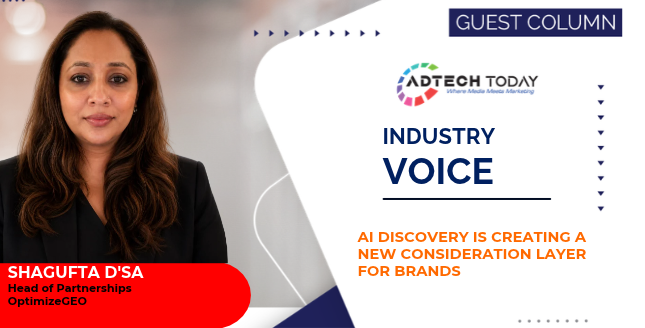
AI assistants are now shortlisting brands before consumers visit a website, open a marketplace or see an ad. Shagufta D’Sa, Head of Partnerships at OptimizeGEO.ai, argues that this new consideration layer sits outside what most marketing dashboards measure, and that brands need to know whether they are being named, and described correctly, at the moment the choice is made.
A consumer asks an AI assistant for a credit card for international travel. Another wants skincare for sensitive skin. A business buyer asks which software works for a team of 50.
None of them starts with a brand. They start with a need.
The AI works out which criteria matter and offers a handful of options. Before anyone visits a website or a marketplace, or sees an ad, the field has already shrunk.
I think of this as a new consideration layer, sitting between what a consumer wants and the channels marketers use to influence the choice. Much of the industry conversation is about AI search, GEO and agentic commerce. The nearer change is simpler: AI is starting to decide which brands are worth considering.
The familiar funnel runs from awareness to research to conversion, with media pushing people along. AI changes the order. A consumer can go from a vague need to a shortlist in one conversation, comparisons and review summaries included.
That means a brand can have strong awareness and healthy search rankings and still be missing from the shortlist. Reports show impressions, rankings, clicks and conversions. They don’t show a consumer who asked a category question, got three names and never saw yours.
The brand loses the sale before its own data starts counting.
Search advertising lets brands respond to declared intent. Someone types “running shoes” and you bid on it.
Conversational prompts carry far more detail: “running shoes for flat feet under a set budget”, or “health insurance for ageing parents with existing conditions”. The AI doesn’t only match keywords. It decides what matters in that situation and picks brands against it.
So your competitors change with the prompt. A premium brand can drop out when the question is about value. A challenger can sit next to the market leader because it is strongly linked to one use case. In our IPL 2026 study with MMA India, Minimalist, a digital-first skincare brand, led its category all season and appeared in about half the answers we tested in the final week.
Market share tells you who you’ve competed with. AI discovery shows you who you’re up against at the moment someone is deciding.
Ads will follow attention into AI answers, and that is already starting. OpenAI says its ads sit below the answer, clearly labelled, and don’t change what the answer says. Being advertised next to an answer is not the same as being recommended inside it.
“Being advertised next to an answer is not the same as being recommended inside it.”
The same study shows how far apart the two can be. We tracked more than 310 brands across four AI platforms through the season. In electric vehicles, Mahindra appeared in about 71% of AI answers by the final week. Kia, an official IPL advertiser, appeared in under 2%.
A big IPL presence did not get Kia into the answer. Media can introduce a brand at the right moment. What gets said about it everywhere else decides whether AI has a reason to name it.
AI draws on far more than your website and current campaign. Product pages, reviews, marketplace listings, press, expert opinion and community threads all shape how a brand is described. A campaign runs for a few weeks. That record builds over years, and errors in it travel: AI can misdescribe a brand’s ingredients because of third-party sources, not its own site.
The aim isn’t to say the same thing everywhere. It’s to be clear and consistent about the needs and attributes you want to be known for. That takes media, search, ecommerce, comms, content and product teams working from the same picture. No one can guarantee how an AI answers, but each team adds to what it has to go on.
Referral traffic will miss a lot here. Someone might find a brand in an AI answer, check it on social, compare prices on a marketplace and buy in a store. The AI shaped the choice and left no click behind.
There is also no single AI picture. In the same study, Johnson’s Baby did not appear in ChatGPT’s baby care answers at all, yet showed up in about 13% of Google AI Overviews answers. Check one platform and you get the wrong read.
So brands need to know a few things. Do we show up for the questions that matter commercially? Who appears next to us? What reasons does the AI give for recommending us? Is what it says accurate? And does that change by need, city, platform and stage of the decision?
These sit alongside reach, conversion and revenue, covering a decision point those metrics were never built to see.
Brands don’t need to show up in every AI answer. They need to show up, described correctly, in the ones that matter to the business. Ads, search and marketplaces still matter. But AI now decides which brands get there at all.