
Published on: October 15, 2026
Data may reveal what consumers are doing, but it doesn’t always explain why they’re doing it. That gap matters more now that no two consumers seem to discover a brand the same way.
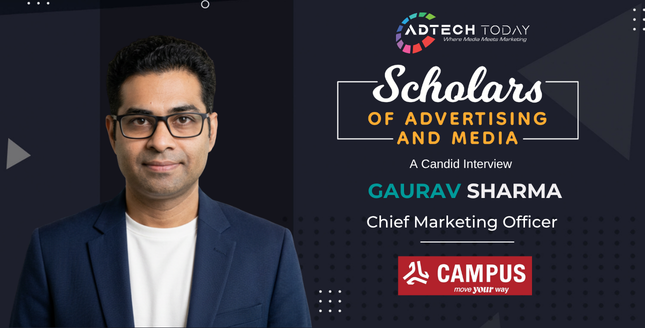
In this exclusive conversation with Adtech Today, Gaurav Sharma, Chief Marketing Officer of Campus Activewear, explains why he believes marketers need to look beyond the numbers when reading consumer behaviour, and what the shift toward occasion-led footwear tells him about how young India is choosing its next pair of shoes.
The biggest change has been moving from thinking about marketing as a series of individual campaign bursts to thinking about how the brand stays relevant throughout the consumer journey. Consumers today don’t engage with brands through one channel or one moment.
“Discovery could happen through a creator, consideration through digital or a marketplace, and purchase through retail or our own platforms.”
This has meant moving away from a purely campaign-led approach and investing more consistently in content, creators, digital engagement, retail experiences and consumer understanding. Our social, digital and influencer marketing are now always-on rather than tied to individual campaign periods, letting us respond to evolving consumer conversations in real time.
We’ve also had to become more agile in how we plan and allocate resources. The objective isn’t to be present everywhere for its own sake, but to make sure different touchpoints work together to build awareness, consideration and, ultimately, conversion.
Relevance is important because creators increasingly influence discovery, consumer opinion and purchase decisions. We look at whether a creator’s audience, personality and context naturally align with the community we want to engage, rather than looking at reach in isolation.
Relevance can’t come at the cost of scale altogether, though. There are moments where the objective is to build broad awareness or cultural visibility, particularly around a major brand platform or launch. In those situations, larger creators and talent help us create the initial scale and salience, while a wider ecosystem of niche, regional and community-led creators deepens the conversation.
The balance depends on the objective. A large creator may be more effective when we need to introduce something to a broad audience, while a smaller or more specialised creator can often build stronger engagement and trust within a particular community. The focus is on using the right mix rather than treating reach as the primary measure of success.
Festive periods are important commercial moments, but we don’t believe the answer is simply to compete on discount. For us, the larger opportunity is to understand what consumers are looking for during the season and make the product relevant to those occasions.
Given the scale of our target audience, festive periods also see a significant number of consumers entering the category or actively considering their choices. That makes it important for us to have the right marketing mix across media, digital, creators, retail and other consumer touchpoints to build salience and capture a meaningful share of that demand.
Our approach is to ensure that festive activity reinforces the broader value proposition of Campus around design, comfort, accessibility and versatility, rather than making price the only reason to purchase. When the communication is rooted in a relevant consumer need or occasion, the festive period becomes an opportunity to strengthen the brand while also driving conversion.
Ultimately, the objective is to use festive demand to bring more consumers into the brand while ensuring that the value they experience extends beyond the promotional period.
Consumer data is an important input into how we understand changing preferences, but it isn’t the only input. We also look at cultural shifts, consumer behaviour, feedback from our retail and digital ecosystems, and what we’re seeing across different markets and occasions.
There have been instances where the data suggested the product proposition was strong. We developed the product based on those insights and saw encouraging indicators in our launch analysis, but it didn’t land with the audience as strongly as we expected.
“Data can tell us what is happening, but it doesn’t always tell us why.”
There are situations where these signals may not point in exactly the same direction. In those cases, the answer isn’t to choose data over intuition or intuition over data, but to understand what’s driving the difference and test the hypothesis.Because we control design, manufacturing and distribution ourselves, we can move faster, which matters more as trend cycles get shorter.
The broader principle is that data helps us identify the signal, while experience and consumer understanding help us interpret it.
For us, brand building and business performance are not separate conversations. The role of marketing is ultimately to build preference and support sustainable growth, but different marketing investments work across different time horizons.
We therefore look at the consumer journey holistically rather than expecting every activity to deliver an immediate transaction. Digital, marketplaces and performance-led activity can support discovery and conversion, while ATL, including television, retailer experiences, creators, cultural storytelling and broader brand platforms, can build awareness, consideration and relevance over time. These investments work together rather than in isolation.
We have also institutionalised brand studies to track our annual brand funnel and movements in metrics such as Top-of-Mind Awareness (TOMA). This gives us a consistent view of how brand investments are influencing awareness and consideration over time, alongside the business metrics we track more closely in the short term.
The internal case for brand investment therefore comes from understanding how these pieces work together and whether they are contributing to measurable business outcomes. At the same time, being a listed company reinforces the need for discipline. We have to be clear about the objective of an investment, the consumer behaviour we are trying to influence and the metrics we will use to evaluate it.
“The objective is not to choose between brand and performance, but to build a marketing ecosystem where both reinforce each other.”
If I had to identify one shift, it would be the continued move towards footwear as a form of self-expression and occasion-led consumption.
“Young consumers are no longer looking for one pair that serves every purpose.”
They’re building wardrobes around different aspects of their lifestyle, while discovering trends through creators, communities and digital platforms.
That’s a real opening for Campus. We can participate in more occasions and consumer mindsets, while continuing to bring design, comfort and accessibility together. Our expansion into sneakers, women’s lifestyle categories and newer propositions such as ÉLAN reflects this.
For this to work, three things need to come together: we need to stay close to evolving consumer behaviour, respond quickly enough to bring relevant products to market, and
build the cultural relevance around those products through the right mix of creators, storytelling, retail and digital experiences.
If we can continue to translate emerging consumer aspirations into accessible products at scale, the opportunity is much larger than simply growing within the existing footwear categories. It’s about becoming increasingly relevant to how India’s young consumers express themselves and live their lives.
Read more: Tim Armstrong: Most Transformations Fail on People, Not Technology