
Published on: August 18, 2026
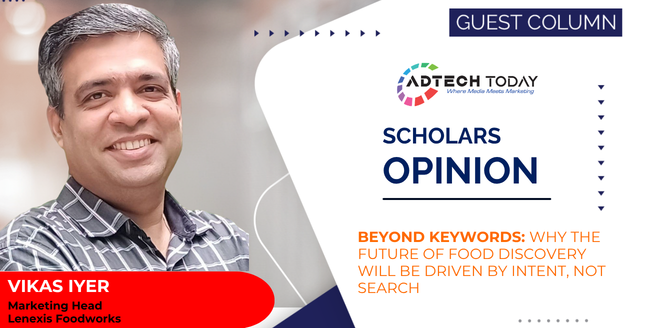
As AI reshapes how consumers discover restaurants and food brands, Vikas Iyer, Marketing Head at Lenexis Foodworks, argues that the next frontier of discoverability is not keyword ranking but earning the confidence of AI systems through trust, consistency and genuine consumer advocacy.
Every few years, marketing convinces itself that a new technology has rewritten the rules. Social media was expected to replace television. Apps were meant to replace websites. Today, the conversation has shifted to AI, with many proclaiming that ChatGPT and AI-powered search will replace traditional search engines.
I believe we’re asking the wrong question. The real disruption isn’t that AI has changed search. It’s that consumers have changed how they express what they want.
A few years ago, discovering a restaurant meant typing fragmented keywords such as “Chinese restaurant near me” or “best momos in Mumbai.” Consumers were willing to sift through pages of search results, compare ratings across multiple platforms and make their own judgement.
Today, the journey looks very different. Instead of searching, consumers increasingly ask questions like, “I am looking for a quick vegetarian lunch under ₹400,” or “Suggest a good restaurant nearby that’s family-friendly and delivers fast.” Tomorrow, AI assistants won’t just recommend options – they will compare reviews, check delivery times, evaluate menus, apply offers and even complete the transaction.
The shift is subtle but profound.
“Consumers are no longer searching with keywords. They are expressing intent. And increasingly, they are expecting recommendations rather than results.”
Travel perhaps illustrates this shift better than any other category. A few years ago, discovering a restaurant in a new city meant switching between Google Search, Maps, review platforms and food delivery apps. Today, many consumers simply ask an AI assistant, “Where should I eat nearby?” or “What’s a good local restaurant that’s authentic, hygienic and popular with families?” The conversation continues until the recommendation feels right. AI is no longer just answering questions – it is orchestrating discovery.
For marketers, this changes the rules completely.
For years, discoverability was largely about optimising websites and keywords. In an AI-first world, discoverability extends far beyond a website. Large language models (LLMs) build recommendations by synthesising signals from customer reviews, business listings, PR coverage, creator content, menu descriptions, delivery platforms and social conversations. The website is one input among many, and often not the loudest one.
In many ways, a brand’s entire digital footprint has become its new storefront.
This also means discoverability is no longer just a marketing responsibility. It is an organisational capability. Take something as simple as restaurant information. If operating hours are inconsistent across platforms, menu descriptions are outdated, customer reviews go unanswered, or listings are incomplete, AI has less confidence in recommending that business. Conversely, brands that maintain accurate information, earn authentic reviews and generate credible third-party conversations become easier for AI to recommend.
“In the AI era, discoverability is increasingly built on evidence rather than optimisation.”
This is where I believe many marketers need to focus on the right opportunity. The conversation today is dominated by hyper-personalisation. While AI undoubtedly makes personalisation easier, its importance for mass consumer categories like QSR is often overstated.
Most food decisions aren’t made by weighing a personalised message – they’re made out of habit, convenience, what’s open, and what someone’s craving at 8pm. Nobody needs a hundred versions of your brand. They need one version they recognise instantly the moment the craving hits.
In my view, AI should personalise execution, not the brand.
Use it to test creative faster, spend media more efficiently, and spot behaviour shifts sooner. Don’t use it to make the brand mean something slightly different to every person it talks to.
The colours, the assets, the products people recognise without thinking – that consistency is still what does the heavy lifting. AI should make the machinery around the brand sharper. It shouldn’t be allowed near the brand’s identity itself.
This is where technology and brand building must complement each other rather than compete. The brands that succeed will use AI to become more efficient while continuing to invest in broad mental availability and distinctive brand assets.
Perhaps the biggest implication is that we are moving beyond search optimisation towards recommendation optimisation. For years, marketers asked, “How do I rank first on Google?” Tomorrow, the more important question will be, “Would an AI confidently recommend my brand when someone expresses this need?”
Those are fundamentally different challenges. One rewards technical optimisation. The other rewards trust, consistency and genuine consumer advocacy.
For marketers, that means thinking differently about what drives discoverability. Reviews are no longer just reputation metrics. PR is no longer just earned media. Creator content is no longer just social engagement. Structured menu data is no longer just operational hygiene. Together, they become the evidence that AI uses to understand and recommend a brand.
Technology will continue to evolve. Search interfaces will change. New AI assistants will emerge. But the objective of marketing remains remarkably constant: build a brand that consumers trust, remember and choose.
“The brands that thrive in the AI era won’t necessarily be those that master every new algorithm. They will be the ones that consistently earn the right to be recommended.”
Because in the next decade, the ultimate competitive advantage won’t be being searchable. It will be “being the answer.”
Disclaimer: This article was originally written by the author. Views expressed are the author’s own. All rights belong to the original author.
Vikas Iyer, Marketing Head - Lenexis Foodworks. Vikas Iyer is an experienced marketing leader with over 19 years across QSR, FMCG, Retail, and Automotive sectors in India and Latin America. At Lenexis Foodworks, he leads marketing and brand strategy for Chinese Wok, Big Bowl, and The Momo Co., driving growth, innovation, and consumer engagement. Previously, he led marketing at More Retail and played key roles at Bajaj Auto and Marico, building iconic brands and driving business transformation across diverse categories.
View LinkedIn
Neha M Parikh is Editor and Head of Content at Adtech Today and Adtech Today Middle East, where she leads editorial strategy across both editions. She interviews senior marketers, media and adtech leaders across India, APAC and the Middle East, and commissions bylined perspectives from C-suite executives. With a Master's in Finance, she brings a commercial lens to how she reads the industry: following where budgets, technology and accountability are moving, and asking leaders what that shift looks like from the inside.
View all posts by Neha M Parikh