
Published on: July 8, 2026
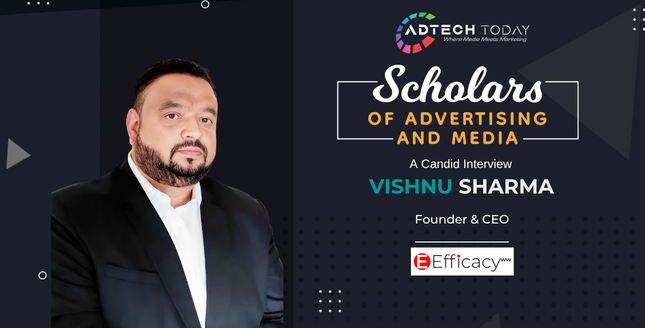
What happens when someone who thinks like an engineer builds a career in advertising? They stop accepting industry beliefs just because everyone else does. Vishnu Sharma, Founder & CEO of Efficacy Worldwide, has built his career by questioning assumptions and focusing on what delivers real business outcomes.
In this conversation, he shares why attention is replacing impressions, why agency size no longer guarantees value, and why influencer marketing needs better accountability. He also offers an unfiltered look at what it really takes for an Indian independent agency to expand globally—from rebuilding credibility in every new market to navigating hiring and operational realities that few talk about openly.
Honest, practical, and free of industry clichés, this is a conversation that challenges conventional thinking and leaves readers with plenty to reflect on.
What did that unconventional path teach you that a straight career route wouldn’t have?
Engineering didn’t prepare me for advertising. In every broken structure, there is usually one specific point where the real failure lives; the rest of the chaos is just noise. At the end of the day, nobody applauds architecture that doesn’t ship; you either solve the problem or you don’t.
When I first arrived in this industry, advertising was deeply in love with its own craft; the language was purely emotional, the metrics were approximate, and accountability felt optional. I had no romantic attachment to any of that, and I found myself questioning things that others treated as inherited truths simply because I hadn’t been trained to treat them as sacred.
This engineering path also builds a comfort with being wrong quickly. Back in the early 2000s, agencies would run campaigns for three months before even asking whether they worked; that pace felt absurd to me from day one. Now, when I talk to a CFO about ROI, I am not just using the language of business; I actually speak it.
What does the attention-over-visibility argument actually change about how an agency plans and buys media today?
“Visibility is counted, but attention is actually earned.”
The distinction might sound purely semantic but it isn’t. An impression below the fold on a cluttered news site costs exactly the same as an ad someone actually stops scrolling to read. They sit on the exact same media plan line, yet they carry an entirely different commercial value. When you accept attention as the real currency, three things change.
First, context becomes just as important as the audience; reaching the exact right person in the wrong mental state is just wasted spend. Second, you start paying a premium for quality environments over cheap reach. And finally, you have to fight your client’s natural instinct to chase the lowest CPM.
The data backs this up. Eye-tracking research shows that below-the-fold digital display averages less than half a second of fixation. Essentially, you are paying to not be seen. Karen Nelson-Field’s attention research has completely shifted the global conversation around this. In India, the measurement infrastructure is still early; however, agencies that build attention-weighted planning frameworks today are the ones who will own the next five years of client confidence.
How close is the Indian market to genuinely moving past age and gender as targeting proxies?
My honest answer is that we are probably five to seven years away from genuinely moving past demographic targeting at scale.
“The biggest obstacle isn’t technology; it’s the client brief.”
Most Indian brand teams still brief agencies with “SEC A, 25–34, male, metro”; asking for psychographic segmentation usually gets you a polite nod and the exact same demographic brief the following week. On the supply side, mid-tier and regional publishers, where enormous audiences live, mostly lack the data infrastructure to offer behavioral segments; they count pageviews, but they simply don’t model intent.
The new DPDP regulations add another layer of complexity because consent mechanisms are still quite immature; the reality is that behavioral targeting could get much harder before it finally gets easier.
What genuinely exists right now for brands willing to demand it are intent signals from search, content affinity from streaming, and transactional clusters from fintech data. The thing is, the sophistication is very real in Mumbai boardrooms, but it remains quite thin on the ground everywhere else.
Is scale still the right measure of an agency’s value to a client in 2026?
Scale was a legitimate advantage back when it meant negotiating leverage with Doordarshan and print publishers; however, that world is long gone.
“Today, programmatic has completely democratised access to inventory.”
An independent agency sits behind the exact same DSPs and bids on the same impressions as giants like WPP or Publicis; the inventory gap has effectively closed. What holding groups actually sell now is organisational comfort because procurement teams often feel safer signing off on familiar legacy names. The thing is, that’s a reflex, not a strategy. What many clients sacrifice for that comfort is senior-level attention on mid-size accounts, genuine speed, and clean incentive alignment.
A holding group that simultaneously owns a buying entity, a research firm, and a creative network has deep structural conflicts that nobody discusses openly. In 2026, the real measure of success is outcome velocity. Independents consistently win on that front because fewer layers separate the decision from the action.
The reality is that CFOs are increasingly driving the marketing accountability conversation; they don’t care about network scale, they care about what actually moved the business.
Is the influencer-first model sustainable for the industry or a scale play only big advertisers can afford?
the influencer market is very real; globally it reached around $24 billion in 2024, with India contributing an estimated ₹2,500 crore and growing. However, the right question isn’t whether the category works; it’s about who it actually works for.
For large advertisers, influencer marketing has essentially become just another media channel with a human face.
“The authenticity that made it compelling has eroded at the macro level.”
When a creator promotes six different brands in a single month, the audience knows; the trust signal inevitably weakens. The asymmetric ROI still lives at the micro end of the spectrum. Creators with 50,000 to 200,000 genuinely engaged audiences consistently outperform on conversion because the connection is real.
The structural problem remains measurement; brands are currently comparing engagement rates across platforms that define engagement very differently. It is
quite funny that a category generating billions operates on shakier standards than direct mail did back in 1995. Brands that build standardised measurement frameworks now will extract genuine ROI; the rest will just continue to confuse noise with signal.
What does scaling an Indian-origin independent agency globally actually demand that no one tells you upfront?
The first thing nobody tells you when you’re looking to expand is that your Indian reputation simply doesn’t travel. You can have fifteen years of strong work in Mumbai, but the moment you walk into a Singapore pitch, you are essentially a brand-new agency. The relationship capital built over a decade at home means nothing in a market with no local trace of you.
The second surprise is purely operational; you bill in USD or AED, yet your cost base sits in INR. Every exchange rate movement hits your margin directly; nobody warns you until you are managing it mid-quarter.
And the third is hiring. Hiring senior leaders in new markets is far harder than people suggest because a strong candidate in Dubai takes a real career risk joining an Indian independent they’ve never heard of.
What actually works is following a client; you have to let an existing relationship do the credentialing for you. Cold-pitching against holding groups in international RFPs is costly and usually fails.
The Middle East is compelling right now, especially with Saudi Arabia’s Vision 2030; however, the UAE already hosts a sophisticated advertiser base. These markets don’t reward patience, and you must establish a physical presence within six months or the window will close.

