
Published on: June 9, 2026
Thirty years. Five industries. Dozens of brands. One belief: when a brand and a consumer truly align, it is a match made in heaven.
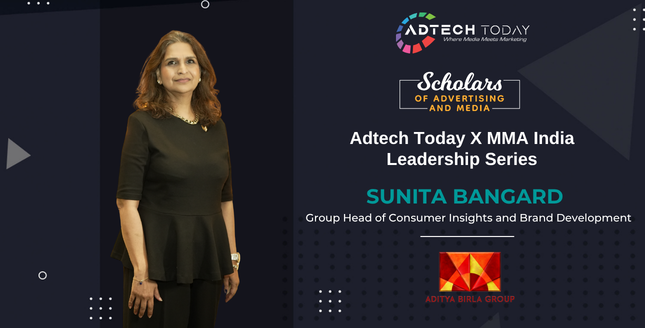
Few marketing leaders have shaped brands across as many industries as Sunita Bangard. As Group Head of Consumer Insights and Brand Development at Aditya Birla Group and a Board Member at MMA India, she has spent three decades turning brands into business assets. She has built brands from scratch at L’Oréal, helped strengthen Idea’s position as the No. 2 brand on key brand-health metrics, and now champions the role of brand as a valuation multiplier across 50 businesses at ABG.
In an exclusive conversation with Adtech Today as part of the MMA Impact India 2026 series, this direct, principled and refreshingly sharp leader speaks with rare candour about the CMO-CFO divide, why marketing must move from comms engine to commercial engine and why, in an age of AI, the most urgent capability a marketer can build is still deeply human.
Across FMCG, telecom and now a conglomerate, what has been the most brand-defining moment, and what did it teach you?
I cannot really single out one instance because the challenges have been different at every stage, but each has reinforced the same belief.
At L’Oréal, we started from scratch — six months after the company launched in India. Whatever you see from Maybelline, L’Oréal, or Garnier today, we built each of those brands from the ground up in India. They are all top aspirational brands in beauty and personal care today, and that business was built entirely on brand.
At Idea, we were No. 3 from a revenue standpoint but a solid No. 2 on brand health. The love people had for that brand was remarkable. Even after the Idea brand was merged, lines like “No Idea? Get Idea” and “An idea can change your life” are still part of our everyday lexicon. That tells you everything about how deeply a brand can embed itself into people’s lives.
Over the last six years in a conglomerate, the big shift for me has been seeing how a brand can become a multiplier of valuation. With Hindalco, we created and launched a master brand with a clear intent — to shift a company known purely for manufacturing into a value-chain partner brand. With Pivot, we proved that branding is equally powerful in B2B; in three years, we scaled it significantly because the brand made the real difference.
For me, brand is what builds a relationship and an identity with the consumer. When there is a match between how a brand thinks and how a consumer thinks, that is a connection made in heaven; it is emotional, it is nurtured for life and consumers are far more forgiving of the companies they believe in.
“When you are buying into a brand philosophy, that is something which is nurtured for life.”
Products can be replicated. Relationships cannot.
At MMA Impact 2026 recently, your session centred on what CMOs and CFOs misunderstand about each other. What is the one misalignment that costs brands the most?
The conflict starts before the conversation even begins. We assume CFOs are out to save money, and CFOs assume marketing is out to spend it. The moment that mindset goes, everything changes, because both functions are working for the same organisation and both want it to perform well.
The first real gap is that marketing has not done enough work to translate its activities into business impact. Not fancy KPIs about millions reached or ROI achieved, but what did it actually do for the top line, the bottom line, the growth? Every other function in an organisation is anchored to those numbers. Marketing cannot be the exception.
The second gap is on the finance side: the belief that everything must deliver this quarter, this year. Brands are not built that way. You are interviewing me today not because of what I did last quarter, but because of what I have built over the years. It’s like an SIP that I am doing for my business so that in future it gives me the rewards.
“Everything is not for today. There has to be a blend — what gets the business growing now and what are we building for tomorrow.”
That ratio, whether it is 50-50, 60-40 or 40-60, depends on the category, the competition and the stage of the business. Sometimes you do a little more performance. Sometimes a little more brand building. But at no time can one be zero.
And we have always said at MMA, if your brands are strong, you can command a 10%-20% premium. That goes straight back into the P&L. Marketing is not a cost centre; it is the very capability that allows a business to charge more. We just need to understand each other a little more and speak each other’s language a little more.
If marketing is to be viewed as a commercial engine, what must leaders do differently in the boardroom?
A senior leader taught me early on that marketing should not talk about marketing. Marketing should talk business. Every activity, every action must be related back to one question: how does this impact the business? The moment you do that consistently, you stop being a peripheral function and become the driver of growth and not an enabler.
The good old days of brand management had marketing at the fulcrum — what to produce, how much, where to sell, how to sell. Marketing defined all of it. Somewhere along the way, we became a comms engine and lost the full picture. But the moment every activity is tied to business outcomes, marketing regains its role at the centre of strategic decision-making.
Here is what makes marketing unlike every other function in an organisation. A factory optimises production costs. Finance optimises spend. Logistics optimises efficiency. Every other function thrives on optimization. Marketing thrives on addition — new audiences, new products, new geographies. We are the link between the outside world and the inside world. We understand consumer needs, market gaps, and organisational capabilities. Connecting those dots is where growth comes from.
“Growth will not come from optimization. Growth will come from what additions you can do.”
You have lived inside a legacy brand building for decades. What do you think insurgent brands genuinely need to learn from incumbents who have stood the test of time?
Each needs a dose of the other. And I saw this firsthand at L’Oréal, which was itself an insurgent when it entered India. We were twenty people launching brands into a market where fairness creams held a 50% share. However, we did not launch a fairness cream. We launched an anti-ageing cream in Garnier — a category that did not exist. And we launched a hair colour at 230 rupees when the market leader was selling hair powder at 7 rupees. Both felt like long shots. Both helped consumers embrace solutions they did not yet know they needed. That is what made those brands aspirational.
A lot of people say to go to consumers to ask about innovation. But consumers can only tell you what they are suffering from today. It is up to marketers to solve for what they do not yet know they need.
Large incumbents tend to think inside out — is this a ₹50 crore opportunity, is it worth the investment? What they miss is that a small underserved segment, when served well, becomes the next big segment. One great product pulls consumers back for the second, the third, the fourth. And incumbents need to keep asking — you have the big brands that give you the money; how can you always be one step ahead of where the consumer is going?
Insurgents have the opposite problem. They go after real needs with speed and instinct, but quality, safety standards, systems and governance get neglected. That is exactly where they cap out at ₹100 or ₹250 crore and cannot scale further.
“There is a word I heard recently that I really like — stagility. Stable and agile. I think that is what both need to adopt going forward.”
For insurgents, stagility means becoming more stable without losing agility. For incumbents, it means bringing in agility without losing stability. The direction is different. The destination is the same.
What is that one capability Indian marketers must build urgently to lead the next phase of growth?
It is not one; it is three. And they are deeply connected.
The first is tech. Not to compete with it but to work with it. With AI, everybody will have the same data and the same information. So what will make one brand different from another? The human angle. That is where differentiation will come from. I am a strong propagator of humanised growth. The growth that does not just chase numbers but has the human aspect built in. It is no longer a marketing-only job; it is increasingly a MarTech job. Marketers do not have to be absolutely great in tech, but they need to understand it well enough to deliver.
The second is business. Marketers do not have to become CFOs, but they have to understand the financial language of how they run their marketing department. We are here for business; we need to speak the language of the organisation we are building. And it is a collaboration with the factory, logistics, and finance. Everybody contributes to building the brand. It is not a job by itself.
The third, and for me the most critical — is the consumer. We get so wrapped up in shiny new tools that the consumer disappears from the radar entirely. We relegate the fundamental questions to agencies or buy reports and think we have the answers, but we don’t. Double click, triple click, ask why. Why am I doing this? What need am I solving? Why should this person choose me?
“Cannot, cannot, cannot lose sight of who we are doing the business for.”
Understand tech, business, and your consumer. Know these three, and you are well placed to take the organisation where you want it to go. I cannot say I have created iconic brands — but I have been part of the journey for many; L’Oréal, Sunsilk, Idea and most recently Indria, which I am very positive will become an iconic brand in the future.
Before signing off, Sunita had one more thing to share — unprompted and from the heart
At MMA India, we pick up real issues that marketing organisations are actually grappling with. We do not create reports or frameworks for the sake of it. Every year, we start with ten things and narrow them down to three or four. It’s better to do deeper work on a few priorities than superficial work on many. That is why MMA has earned its acceptance; it is a body driven by business people, for business.
The board itself is a learning place — publishers, tech leaders, FMCG veterans, e-commerce voices, conglomerates. No matter what body of work you bring in, there is always a new perspective waiting. I was never a tech person. Today I can speak to it comfortably because of the conversations I have had on that board. And ultimately, it is our responsibility to raise the next generation of marketers — ones who can take organisations well beyond 2030.

