
Published on: May 23, 2026
Saturday, May 23, 2026: As the curtains fall on the 19th edition of Goafest, the industry is heading home with a fresh mandate for the year ahead. After three days of intense dialogue and a record-breaking awards night, the “Reset for Growth” has officially concluded. While the final day featured a masterclass in creative bravery and cultural reflection, it was also the night the industry crowned its newest champions.
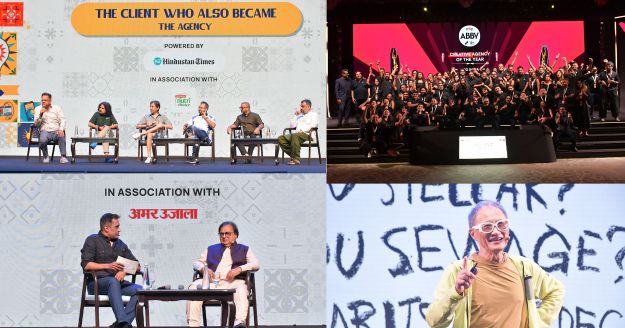
The day began with a provocative discussion titled ‘The Client Who Also Became the Agency.’ Featuring Ajay Kakar (Adani Group), Chandan Mendiratta (Zepto), and Gaurav Ramdev (Visa), the session explored the aggressive rise of in-housing.
Zepto’s Chandan Mendiratta highlighted that in the world of quick commerce, “speed is the only currency,” making in-house teams essential for moment marketing. Ajay Kakar shared how conglomerates like Adani prioritize brand consistency and strategic control through dedicated internal setups. However, Raj Kamble (Famous Innovations) provided a necessary counter-point, arguing that agencies provide the “creative friction” and external perspective that internal teams—often prone to “echo chambers”—might miss.
The final day sessions didn’t pull any punches regarding the state of the industry. Eugene Cheong (Creative Director & Partner, Euge Publishing) delivered a sharp critique, stating that agencies are becoming process-driven “asset delivery businesses” where creativity is being choked by bureaucracy. With AI set to eliminate the repetitive 70% of execution-heavy work, Cheong and Adam Izen (One Show) both argued that the future belongs only to those who prioritize “human creative instinct” and the courage to take risks.
This was echoed by Santosh Desai (Think9 Consumer Technologies) during the AAAI Subhas Ghosal Memorial Lecture, where he described our current world as the “Age of Outrage.” He noted that while advertising helped build this emotion-driven economy, the industry has often buried its own storytelling soul under award culture and process.
Away from the trophy tally, the session by Rajiv Dubey (Dabur India) on “Resetting Bharat” provided a crucial strategic takeaway. He highlighted that the gap between urban and rural India is effectively narrowing. Marketing, he argued, must now move from “geography-led” to “intent-led,” using regional culture and hyper-personalization to reach a newly aspirational “Bharat.”
The festival reached its peak at the ABBY One Show Awards, where the results reflected a significant shift in the creative hierarchy.
– Publicis Groupe was crowned Creative Network Agency of the Year, delivering a dominant performance with a total of 796 points and a Grand Prix.
– Leo India continued its strong showing, being named Creative Agency of the Year with 640 points and a Grand Prix.
– Enormous secured the title of Creative Independent Agency of the Year, ending the night with 372 points and reinforcing the power of independent creative shops.
– PepsiCo India was recognized as Client of the Year, while Good Morning Films took home the Video Craft Specialist of the Year honor.
In a historic moment for the media track, Tribes Communication secured a Grand Prix for their work on Kansai Nerolac Paints (“The Barefoot Journey”).
Goafest 2026 was more than a celebration; it was a reality check. Whether it was Ashish Khazanchi (Enormous) reminding the quorum that “strategy is ultimately an informed opinion, not an exact science,” or veteran actor Rakesh Bedi urging the community to live through “risks and mistakes,” the message was uniform.
For an industry aiming for its next growth leap in a ₹2 lakh crore market, the tools—AI, data, and agents—are now in place. But as the 19th edition concludes, the mandate is clear: technology provides the scale, but only human bravery provides the soul.
With the winners crowned and the 2026 edition officially in the books, the industry looks ahead to a year of “agentic” technology and culture-led storytelling.

