
Published on: March 17, 2026
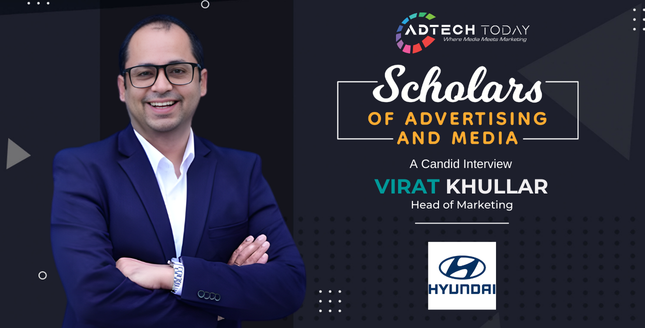
Virat Khullar knows that scale can easily dilute a brand’s soul. As Head of Marketing at Hyundai Motor India Limited, he is guiding one of India’s most recognisable automotive brands at a time when expectations have never been higher. Following Hyundai’s landmark IPO, the spotlight on the company has only grown sharper—from customers, investors, and the wider industry. Yet for Khullar, the real challenge isn’t scale alone, but keeping the brand’s human connection intact.
In this exclusive conversation, he reflects on balancing data with emotion, why the test drive still matters in a digital world, and how regional storytelling is helping Hyundai stay close to Indian consumers.
Since Hyundai Motor India’s landmark IPO, the brand has evolved from a global subsidiary into a publicly accountable national entity. What leadership philosophy guides your marketing strategy in safeguarding legacy trust while addressing the expectations of a new generation of stakeholders?
Hyundai Motor India’s IPO in 2024 was the largest the country has ever seen. For us, it was more than a financial milestone. It was a reflection of the trust that families across India have placed in Hyundai for almost 30 years. The sheer scale of investor participation showed us clearly that Hyundai has become part of the country’s everyday life.
From a marketing standpoint, this translates into three clear priorities: purpose-led storytelling, always-on reputation management, and integrated marketing governance. Our campaigns are rooted in real consumer insight and social relevance—whether it is championing accessibility through initiatives like Samarth by Hyundai, celebrating national pride and inclusion, or supporting causes that reflect India’s evolving social fabric.
“Marketing must contribute meaningfully to society, not just drive visibility.”
In a digital-first world, stakeholders are vocal, informed and expect transparency. That’s why our ORM framework is proactive, not reactive. We actively listen across platforms, engage with empathy, and respond with speed. This allows us to protect the legacy trust built over nearly three decades while remaining credible to a new generation that values openness. As a publicly accountable company, every message – paid, earned, shared, or owned must reflect a single, coherent brand voice aligned with our long-term values, ethical standards, and regulatory responsibilities.
Ultimately, our leadership philosophy is about balancing scale with sensitivity. We leverage data, technology and digital platforms to stay relevant, but we lead with values, responsibility, and respect for public trust.
As growth accelerates across ‘Bharat’ and vernacular digital adoption deepens, how do you ensure Hyundai’s messaging remains locally relevant while maintaining a strong, unified national identity?
More than half of our new customers today come from non-metro markets. That shows how India has changed and how marketing must evolve with it. Tier 2 and Tier 3 India today is aspirational, digitally fluent and deeply rooted in culture and language. OTT viewership, regional creators, and connected TV have democratised storytelling. Consumers outside metros share the same aspirations as those in metro cities and they expect communication that feels local, familiar and culturally aware.
Purchase decisions in these markets are shaped by a blend of aspiration and accessibility. That is why we adopted a more region‑first approach, and why Pankaj Tripathi became such a natural fit for our 360-degree integrated campaign – Chahe Dil Ki Suno Ya Deals Ki, Loge Toh Hyundai Hi.
The campaign was a national campaign but architected for regional execution. To ensure it truly resonated, the TVC was presented in seven regional languages: Gujarati, Marathi, Bengali, Kannada, Malayalam, Tamil, and Telugu, ensuring a powerful and lasting impact across diverse geographies. Ultimately, his authenticity, tone, and cultural relevance perfectly mirror the voice of the country.
“Marketing is not just about sales. It is about nurturing a lasting sense of belonging with the brand.”
With Hyundai moving closer to the million-unit annual capacity milestone through the Talegaon integration, how does this scale strengthen your ‘Made in India’ narrative and national positioning?
The Talegaon facility is not just incremental capacity; it is a strategic deepening of Hyundai’s commitment to India’s industrial ecosystem. As we move towards our goal of a million units annually, our ‘Made in India’ narrative becomes both broader and more credible. Hyundai treats India not as a sales market alone, but as a manufacturing and export hub of global significance – a philosophy that sits at the heart of our vision of Made in India, Made for the World. Our products built here are shipped to more than 150 countries, reinforcing the belief that the exact car an Indian customer drives at home meets the highest global standards.
From a brand standpoint, this scale allows us to participate meaningfully in the national conversations on Aatmanirbhar Bharat and Vocal for Local – not as rhetoric, but through real investments, employment generation and technological capability. It strengthens our position as a company that is building in India, building for India, and building for the world.
Hyundai’s premiumization journey in India has been significant. How do you balance mass-market scale with the rising aspirations of a lifestyle-driven, premium consumer?
The aspiration curve in India has risen sharply. Today’s consumers want it all—global design, advanced technology, connected experiences, and strong safety—and they expect all of this at accessible price points.
Hyundai’s premiumisation journey actually began early. The Sonata brought luxurious comfort to India, and the first-generation Tucson introduced a modern monocoque SUV experience long before the segment even became popular. These products set the tone for Hyundai as a progressive, global brand.
Over the last decade, the CRETA strengthened this significantly by redefining the midsize SUV space and becoming a benchmark for design, technology and premium experience. Alongside it, the EXTER and the VENUE have made SUV aspiration accessible to a wider set of customers with modern design, safety and connected features.
At the top end, the IONIQ 5 represents our most premium expression of design and EV innovation. Together, our portfolio allows every Hyundai customer, at every price point, to access a future-ready, modern premium experience. That is how we balance mass scale with rising lifestyle aspirations across India.
Hyundai has been a pioneer in ‘Click-to-Buy’ and 3D configurators. In 2026, as the car-buying journey becomes almost entirely ‘Phygital’ (Physical + Digital), how do you ensure the sensory, emotional thrill of a new car remains intact in a screen-dominated world?
“We operate with one fundamental insight: digital builds confidence; physical builds conviction.”
Data is clear – 90% research online, but 95% still purchase offline. Consumers are telling us exactly what they want from each world.
Our job is to make the journey seamless. Click to Buy and our full omnichannel retail ecosystem allow customers to configure, compare, check finance eligibility and even book online. When they walk into the showroom, the experience picks up exactly where the
digital journey left off. Our teams already understand their preferences, which makes the interaction more meaningful.
The emotional thrill does not get lost in this process. In fact, it becomes stronger. When customers arrive well informed and have already personalised their choices, the test drive becomes a celebration rather than a discovery step. It is the moment where confidence turns into emotion, and that is something digital alone cannot replicate.
Looking ahead to 2030, how do you see the relationship between Indian consumers and their vehicles evolving in an era of connected ecosystems and shared mobility?
By 2030, the car will be a connected and intelligent part of a consumer’s life. Features will evolve through updates; personalisation will be shaped by behaviour and vehicles will interact with homes and city infrastructure. The experience will become more intuitive and more predictive as mobility becomes an extension of the consumer’s digital ecosystem.
This is a journey Hyundai began many years ago. Hyundai Motor India was the first OEM to introduce connected car technology in India with the Bluelink platform in 2019. That step changed what Indian customers expected from their cars. We continued to build on that momentum and in 2025, with the new Hyundai VENUE, we debuted Hyundai’s advanced ccNC system, the Connected Car Navigation Cockpit accelerated by NVIDIA. These milestones reflect our belief that-
“Connected mobility will define the next decade of Indian automotive evolution.”
At the same time, India’s emotional relationship with personal mobility will remain very strong. For many families, a car is still a symbol of progress, independence and shared memory. That meaning will not disappear – it will evolve.
Technology will make mobility smarter and more efficient, and shared mobility will grow across urban corridors. But the desire for personal ownership, especially in Bharat, will remain significant.

