
In an era defined by 15-second Reels and gamified trading, DSP Mutual Fund’s recent documentary, The Immortals, offers a stark counter-narrative: patience is the ultimate wealth.
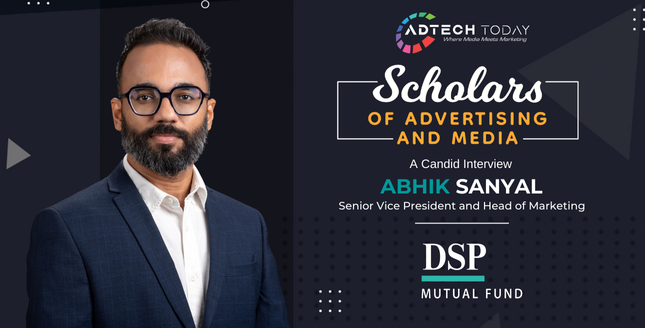
This philosophy is the brainchild of Abhik Sanyal, Senior Vice President and Head of Marketing at DSP Mutual Funds. A self-described “average middle-class guy” who joined the firm as an intern two decades ago, he has become one of the industry’s most unconventional voices.
While competitors scream “Buy Now,” Sanyal advises you to pause, arguing that great investing and a great life is a “Test match, not a T20.” In this interview, he breaks down why “Call to Actions” kill trust, why women are statistically superior investors, and how a brand survives in 2025 by simply telling the truth.
We live in a Gen Z world dominated by a 30-to-60-second mentality. In this context, what inspired you to come up with a documentary like The Immortals? What was the core idea behind it?
The goal wasn’t just to attract Gen Z; it was to reach anyone wanting to build a better life. That’s why the concept cuts across ages. Even people in their 50s told me, ‘We relate to this,’ because the human story is universal.
Older guys like me often make the mistake of questioning Gen Z’s intelligence. But they aren’t difficult to talk to; they are just different to talk to. My generation wanted safety my parents in Delhi taught us ghar khareedo sabse pehle (buy a house first). Gen Z values experiences; for them, choices equal freedom.
But if you speak to the human inside them, humanity hasn’t changed. The emotions—patience, determination, resilience, love, and family are the same. That hasn’t changed from my parents’ time to now.
It’s important, however, to understand what they go through. Their environment is a pressure cooker. It forces them to ‘heat up’ immediately for social validation. That is why we must not insult their intelligence. I tell my team: no Call to Action. Imagine a moving Netflix documentary ending with ‘Go to this website’—it kills the authenticity.
“We want to show that while the world sells them a T20 match, great investing and a great life is actually a Test match. It’s a long game.”
You’ve said that ‘speed’ is the enemy of wealth. As a marketer, how do you sell ‘slowness’ to a Gen Z audience that lives on 15-second Reels and instant gratification?
Gen Z appreciates honesty above all else. You can’t cheat them. They spot what is fake immediately. If a message doesn’t come from the heart, it just feels like a selling concept or a marketing gimmick.
My goal is to win trust, not just transactions. In our industry, returns are cyclical—you might invest with me today because performance is high, but you’ll leave when it drops. But if I can authentically ‘rewire your neural network’ to think long-term, that builds a relationship far deeper than an immediate transaction.
And honestly, Gen Z values slowing down. They want to take breaks; they want to travel. Look at Sahil, the poet in The Immortals campaign, he talks about travel as the best way to learn about the world. But how will you travel if you can’t take the time to slow down?
I personally made the mistake of not taking a break for over 10 years. When I finally traveled recently, it made me rethink everything I was chasing on a daily basis. It taught me that experiences define a better life. Gen Z already understands this. If we connect with that human truth, it resonates.
The recent ‘No More’ campaign urges investors to stop, pause, and say ‘no’ to noise. In an industry that usually screams ‘Buy Now’ or ‘Don’t Miss Out,’ why did DSP decide to take such an unconventional path? Is ‘patience’ the new sales pitch?
Patience isn’t a new pitch; it just hasn’t been spoken about enough. It’s like a two-hour recipe—you can’t cook it in 15 minutes and expect the same result. But today, apps have gamified investing. They constantly nudge you with notifications—’do this, do that’ making everyone, including us, trigger-happy.
The ‘No More’ idea actually started internally. We asked, ‘What should we stop doing?’ We realized the ‘beast’ is inside us too. That’s why I tell people: you can live a beautiful life just investing in FDs if you have discipline. It’s about behaviour, not the product.
“My success metric isn’t transactions or views; it’s acknowledgement.”
We saw this with our ‘I’ll Not Stop’ campaign. People posted screenshots on LinkedIn saying, ‘This isn’t an investment ad; this is how I feel when I have a hard time at work, or when my girlfriend leaves me.’ It became a manifesto document because it was written with complete honesty.
I tell my team: I don’t need catchy headlines; I need stark truths. Unfortunately, many new investors haven’t seen a crash yet. But true learning only happens when
you make a mistake. The day your portfolio bleeds red is the day the first seed of learning is planted. We want people to pause and plan for that adversity before it happens.
You’ve been a pioneer in ‘Edutainment’—making finance actually fun to watch. Since these aren’t hard-sell campaigns, where do they fit in the investor’s journey? Do you see them as a way to open the door and build affinity, or do they actually help in nudging people toward making investment decisions?
Think of content like opening the front door to a house with many rooms. Traditional advertising tries to shove you into one specific room to make you transact immediately. I don’t want that. I want to let you explore the whole house first—to understand the risks and the potential profits before you commit.
We realized that people only learn when they feel the need. I can preach about child education plans, but if your mind isn’t ripe for it, it won’t stick. Content isn’t just about creation; it’s about context.
That’s where edutainment fits. We create complex, intelligent content for serious investors, but for others, education needs to be entertaining to be accessible. If adding that layer of fun helps you stay longer than a standard ad would, we’ve won. I don’t want to gamify you; I want to make you smart. I value affinity over immediate transactions. But it’s a daily challenge. You can’t just copy-paste content from LinkedIn to Instagram; the audience and algorithms are totally different. We are still learning and making mistakes, but the validation we’re getting tells me we are on the right path.
You’ve famously said that while content might only command about 20% of the focus or budget today, that number is bound to increase because ‘content is what holds everything together.’ Why do you see the balance of power shifting so heavily toward content, and is the industry ready for that pivot?
To me, this is philosophical: Everything is content. I look at it through the eyes of a stand-up comedian. For them, life is constant observation. Observation leads to writing, and good writing connects. That connection is what we call great content. We’ve believed in this for a long time. We were actually the first in the industry to set up a YouTube channel back in 2009. We ranked number one on Google simply because no one else was doing it. We were naive, but we hit gold. But today, the game has changed. You can’t just create ‘anything’ or toss a brief to an agency and say, ‘Solve this.’ My filter as a marketer is now critical. I keep telling my team: I don’t want to swim in the ‘sea of sameness.’ The whole world looks the
same right now. To stand out, we have to tell the story differently. It has to move something in your heart, just like a great movie does. If it doesn’t move you, it’s just noise.
You launched a specific initiative for women’s financial literacy last year. Moving beyond the ’empowerment’ narrative, are you seeing a shift in the data? Are women actually starting SIPs differently than men in 2025?”
I’ll answer this differently. We didn’t just start this; we launched ‘Winvestor’ in 2012 and created ‘Sheconomy’ with CNBC way back. But really, women have been managing household finance since time immemorial.
The barrier is often just legacy. There’s a ‘hunter-gatherer’ logic that has existed for centuries—men went to hunt, women nested. So, women often trust the men in their lives to make decisions. But why is a husband or brother any better? They aren’t.
The data proves it. Within our ecosystem, while the number of women investors is lower, the quality of their behavior is superior. Their average investment value is higher, their SIP tenure is longer, and most importantly, the average returns they earn are actually higher than men.
Why? Because they exhibit more discipline. Men often prefer a self-reliant, ‘I know it all’ approach. Women, however, naturally exhibit an openness to learn. They are more willing to sit down with a qualified mutual fund distributor—someone who charges for advice and say, ‘Understand my risk appetite and guide me.’
I’ll give you a fascinating data point: they say the best investors are dead people, because they can’t meddle with their portfolios. Women behave similarly, they are less reactive to market noise, they stay the course, and by simply doing less, they end up earning more.
So, we realized we don’t need to teach different investment lessons. We just need to remove the intimidation. Once that barrier is gone, the data shows they are naturally inclined to be better investors.
You’ve been with DSP for nearly two decades, how has your relationship with the brand evolved over the years? And how do you challenge yourself to keep finding fresh perspectives when you know the brand so intimately?
DSP is like a second home to me—I joined as an intern fresh out of my MBA at 22. But honestly, it hasn’t been a ‘comfortable’ home, and I mean that in the best way. Comfort implies stagnation. But here, there are so many rooms to unlock that even in 20 years, I haven’t visited them all. Just when you think you know the place, you
find a new challenge. When I started, I was the Gen Z of that era. We grew up on DD2 and cable TV; it was one-way traffic. Today, everything is on-demand, and the consumer holds the power.
The market has changed, too. We see so many people jumping into F&O and opening Demat accounts, vastly outnumbering mutual fund investors. So, my challenge shifted. I realized I can’t just talk about ‘funds’ or ‘categories’—that’s just selling. I had to move from selling to telling. How do I make you think differently? I’m a marketing guy, not a finance guy. But coming to work every day is precious because I’m surrounded by experts who understand finance way better than I do; I just pick it up. But to keep finding fresh perspectives in this environment, you need to get a little crazy, and you need bosses crazy enough to support you.
Take our ‘Garuda Rakshak’ campaign. We planned to use drones to reunite lost children with their families at the Kumbh Mela. Now, which CEO signs off on an activity with zero monetary ROI? I was nervous pitching it to Kalpen, my boss. He’s a hardcore business guy with 25 years in the industry. I thought he’d ask for the business case. Instead, it took one minute. He simply said, ‘Yeh dil ka idea hai, let’s do it’ (It’s an idea from the heart)
That campaign won a Cannes Lion—iconic for a mutual fund.
“My ROI was the number of lives saved. That moment proved that ‘Invest for Good’ isn’t just a marketing tagline; it’s something we actually live. When there is no disconnect between what you say and what you do, the work happens beautifully”
What is your personal philosophy of finance? how do I invest or what do I think about money? philosophy of investing or you know, managing finance
I’ve learned my lessons the hard way by making mistakes. That is why I don’t do things I don’t understand. I need to keep my life simple.
I’ve played football and cricket all my life. I always tell my squad: when you don’t know what to do, stick to the basics. Others might be more skilled or flamboyant, but my advantage lies in clarity. Simplicity is a strength.
Don’t try to prove how intelligent you are. People are smart; they can spot nonsense in a second. It’s much easier to just be honest.
Unlike many, I don’t have complex goals. I just want to have ‘enough.’ I have a number in my mind, and I keep chugging away at it. Investing is a Test match, not a T20.
As long as you accept that, short-term dips won’t bother you. The entire game is in your mind. It’s not in the choices you make, but in the behaviour you exhibit. So, if I had to sum it up:
Right principles, right behaviors, simplicity, and authenticity. That’s the simplest way to describe it.
Read more: DSP Mutual Fund Unveils “The Immortals” — A Documentary Celebrating Wisdom That Lasts A Lifetime

