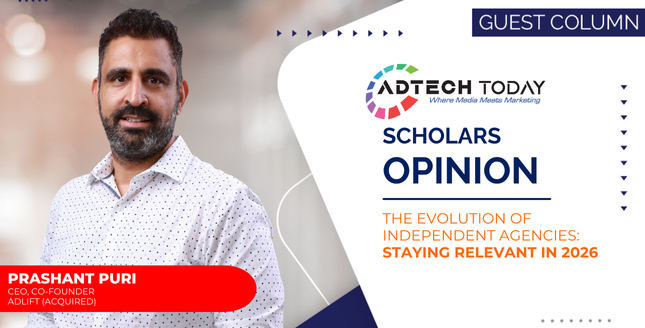
For more than fifteen years, I’ve run an independent agency and seen firsthand how quickly the digital and marketing landscape can change. Now, as part of a larger integrated network, I’ve gained a front-row view of how the agency model is evolving from both sides. And the truth is this: 2026 is the most pivotal year independent agencies have faced in the past 15 years.
AI Is Restructuring What Marketers Expect from Their Partners
65% of CMOs believe that AI will reshape their roles, team structures, and operating models. AI has become the underlying layer powering content creation, optimisation, forecasting, insight generation, and measurement.
This change matters because it moves the agency conversation away from execution and toward expertise, interpretation, experimentation, and system design.
Every major consulting firm reporting on marketing transformation in 2025 – McKinsey, Deloitte, BCG- cites the same pattern:
For independent agencies, this means the historical differentiator of “speed and craft” must now be matched with AI fluency, data maturity, and integrated thinking.
In-Housing Is Rising, But Not in the Way People Think
The ANA’s 2025 In-House Agency Report shows that in-housing is still gaining momentum, especially in digital content, always-on creative, community management, and rapid-turnaround production. But the same report also highlights that most brands with in-house teams continue to partner with external agencies, not less, but differently.
Most CMOs I speak with aren’t asking their agencies to ‘scale’ with them anymore. They’re asking us to integrate into their data, experimentation rhythms, and product cycles. The independents who learn to behave like extensions of the client’s organisation will win.

Fragmentation of Attention Has Increased the Demand for Specialists
Comscore’s 2025 State of Streaming report shows consumers are increasingly embracing streaming and ad-supported content models, with total hours watched on free ad-supported services rising sharply and platforms like Netflix and YouTube becoming core parts of daily viewing routines.
GroupM’s This Year, Next Year 2025 report reinforces this fragmentation. Retail media, streaming, digital audio, and creator ecosystems continue to grow faster than traditional channels. Meanwhile, AI-driven discovery interfaces, from search assistants to conversational platforms, are reshaping how people find and evaluate brands.
This complexity doesn’t reduce the role of agencies. It amplifies the need for:
Independent agencies that narrow their focus and deepen expertise will outperform those relying on generalist capabilities.
Why Independent Agencies Remain Competitive in 2025
Even as the ecosystem evolves, several factors continue to strengthen the appeal of independent agencies:
Independents typically operate with fewer layers, enabling faster iteration and decision-making, essential in a market where platforms update weekly, and AI-driven insights refresh in real time.
Brands value direct access to experienced leaders, strategists, and creatives. This proximity has become more important in 2025 as marketing decisions grow more complex and cross-functional.
Specialisation- in performance, content, AI optimisation, analytics, commerce, or vertical categories- is now a differentiator brands actively seek.
One nuance I’ve seen firsthand is that independent agencies built their reputation on being able to do everything for a client. In 2026, that strength flips if not managed well, because the market now rewards depth, not breadth. The future belongs to independents who choose what not to do
Independent agencies continue to deliver strong value-for-investment due to leaner operations and the ability to tailor services without network overhead.
How Independent Agencies Must Evolve for 2026
Staying competitive requires an intentional transformation.
Not tools. Not dabbling. AI-native workflows across planning, content, measurement, and performance.
Frameworks, not one-off deliverables. Clients want integrated systems that solve repeatable problems.
2025 made it clear: the separation of brand and performance slows teams down. Cross-functional pods accelerate everything.
With privacy changes, shifting data signals, and the rise of AI-driven interfaces, brands need modern measurement partners more than ever.
Independents thrive when teams think like owners, solving, not servicing, predicting, not reacting.
The Opportunity Ahead
With AI acceleration, retail media expansion, creator ecosystems, and marketplace transformation shaping 2025, brands need partners who can operate with:
• Strategic clarity
• Deep specialisation
• Data literacy
• Creative ingenuity
• Technical fluency
But there’s a reality the industry doesn’t call out often enough: evolution is not just about staying relevant. it’s about preparing for larger outcomes. The independents that invest in AI capabilities, measurement maturity, and system-level thinking not only win clients but also become acquisition-ready or even IPO-ready agencies.
And I say that from experience: acquisition is not a loss of independence; it’s a milestone in the agency maturity curve. For many independents, joining a network, or scaling toward a public future, is the natural progression once the right capabilities are built.
Conclusion
2025 is not the decline of independent agencies, but it is the decline of the old independent agency model. The agencies that survive, and lead, will be the ones that evolve into AI-native, system-driven, deeply specialised partners with the agility and craft that defined the independent advantage.

