
15 January 2026 – WARC’s latest forecasts show that global advertising spend is forecast to grow 9.1% in 2026 to $1.30trn, doubling in size since the pandemic and equivalent to $150 spent on every person.
The incremental growth is mostly being captured by digital platforms, not traditional channels. Almost 80% of ad spend now flows into retail media, paid search, and social platforms. The remaining 20% is shared across the whole of the rest of the media industry. These changes in the media landscape are forcing a rethink of traditional planning approaches.
Paul Stringer, Managing Editor, Research & Insights, WARC, says: “The established model for media planning and buying is breaking apart – and nobody knows exactly what comes next. The groundwork for a new model is just beginning.
“This year’s Future of Media report maps the contours of this emerging model. First, by looking at how structural changes inside client organisations and across the media landscape are giving rise to a new model for planning, inspired by systems-thinking. Second, by examining how AI is rewriting the rules of search and simultaneously creating a secondary audience for marketing: machines. And finally, how growing investment in user-generated content and creator marketing represents a new form of brand-building that, at this stage, most marketers seem underprepared for.”
The Future of Media 2026 report explores these three key trends set to shape the media landscape this year, to help marketers navigate these challenges, adapt, and find opportunities for growth.
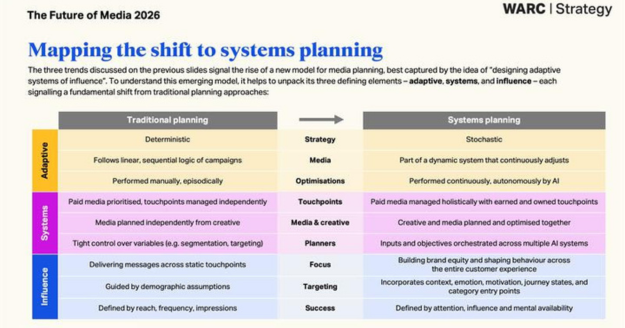
The shift to ‘Systems Planning’
Traditional planning approaches, based on static plans, rigid personas and stable channel definitions are being disrupted by structural and technological shifts in media and marketing making them no longer fit for purpose. They must evolve to meet the demands of an increasingly complex, AI-driven marketing and media landscape.
‘Systems planning’ describes a new approach that focuses on “designing adaptive systems of influence”, argues Dan Gilbert, CEO of Brainlabs, that build equity and shape decisions across the entire brand experience, recognising how touchpoint influence varies by context, category and consumer. This requires new mental models, frameworks, and planning tools that are only just beginning to emerge.
‘Systems planning’ puts an emphasis on developing talent with connective capabilities across data, commerce and creativity – skills that are essential for steering AI-enabled marketing platforms effectively and deliver better outcomes.
Visibility in the era of AI search
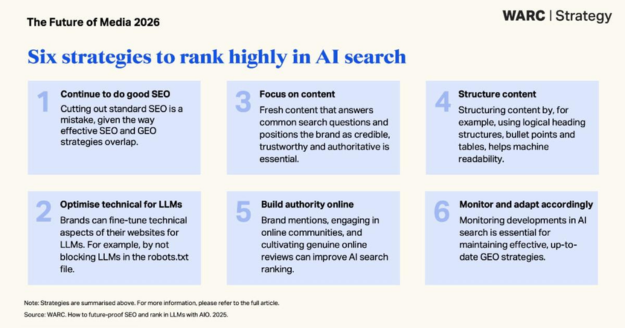
AI-driven search is reshaping how people find information and make decisions, and is beginning to impact consumer search behaviours. Buyers are using AI-powered search engines for longer, more complex queries and to satisfy a broader range of intents, discoverability and information, which vary significantly by category and context.
Optimising content for AI search requires new skills. Generative engine optimisation (GEO) marks a departure from traditional search engine optimisation (SEO) with a focus on producing structured, credible and authoritative content, aligned around different category entry points. Content which is optimised for both humans and machines such as large language models (LLMs) and AI agents. A greater focus on owned and earned media is also a key driver of GEO success.
Cutting through with creators
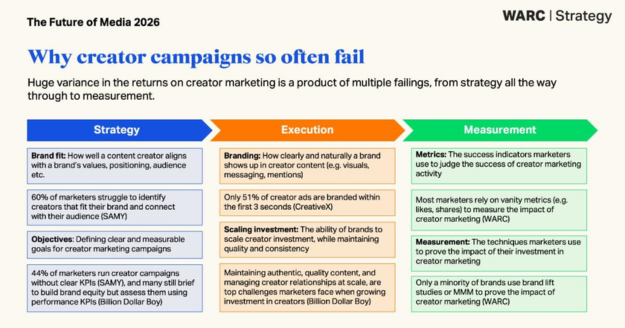
The creator economy is maturing quickly, with revenues expected to more than double to $376.6 billion by 2030 per WPP Media, but a large portion of this investment is currently wasted. Problems range from creator marketing’s lack of clear definitions, to poor brand fit and weak measurement.
To stabilise ROI, marketers need to work with creators who align with their brand, set clear and measurable goals, and use robust measurements to gauge true business impact. Creative quality and choosing the right brand assets are essential to creator marketing success but requires a nuanced approach. Commitment to a structured learning agenda is also essential by looking at what worked while testing new hypotheses and strategies for growth.
The Future of Media 2026 draws on a combination of WARC insights and external research to provide marketers and strategists with key actionable takeaways. The report is part of WARC’s Evolution of Marketing programme helping marketers address major industry shifts to drive effective marketing. The report follows the recent publication of WARC’s Voice of the Marketer 2026, The Marketer’s Toolkit 2026, and The GEISTE report.
WARC members can read the full report. Complementing The Future of Media 2026 will be a podcast out early February.
Read more: An Industry First: WARC & DDB Mudra Group Unveil Brand Strategy Portfolio Evening

