
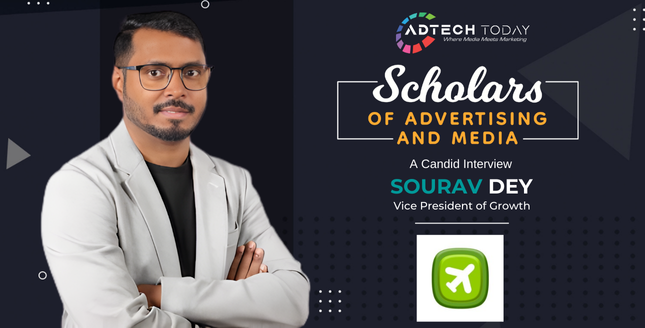
With more than thirteen years of experience across agencies and in-house leadership roles, Sourav Dey has built his career at the intersection of data, technology, and performance-led marketing. His journey spans almost every pillar of digital growth — from SEO and SEM to app marketing, automation, retention, and full-funnel analytics — giving him a rare, end-to-end view of how brands scale across markets.
Before stepping into his current role, he managed digital mandates for several Fortune 500 companies across the US, Canada, Europe, APAC, the Middle East, and emerging regions. Sourav is the Vice President of Growth at Wego, the MENA region’s largest travel group. He leads global growth strategy across paid, organic, and lifecycle channels. Based in Dubai, he also contributes actively to the industry as a speaker at leading marketing forums, where he shares his perspectives on AI, analytics, and the evolving science of performance marketing.
In this conversation, Sourav reflects on the realities of scaling growth across GCC and Southeast Asia, the limits of automation in a volatile travel category, and the mindset that separates a strong marketer from a strategic one.
Operating across diverse regions like the Middle East and Southeast Asia, what’s the toughest market dynamic you’ve had to adapt your growth strategy to?
One of the toughest dynamics has been managing market maturity gaps. GCC markets are digitally advanced with high intent, strong mobile adoption, and premium ARPU, whereas parts of Southeast Asia are still evolving in terms of online travel adoption and reliability of data signals. The same playbook simply doesn’t work everywhere. I’ve had to build parallel growth systems:
• High-automation and efficiency-driven frameworks in the Middle East, where competition and CPCs are intense.
• Education-focused and funnel-expansion strategies in developing markets, where trust-building, localized messaging, and incremental channel introduction matter more.
Finding the right balance between scalable global frameworks and deep local customization is an ongoing challenge, but it’s also the reason Wego continues to grow consistently across these regions.
You’ve led growth across e-commerce, education, and travel. What makes performance marketing in travel uniquely challenging compared to other industries?
Travel is one of the most volatile and high-consideration categories. Three things make it particularly challenging:
Flight and hotel prices fluctuate multiple times a day. A bid strategy or audience segment that works in the morning might lose efficiency by evening. Marketers must adapt in real time.
Unlike e-commerce, travel decisions involve research, comparisons, and multiple re-entries. Users browse across apps, OTAs, metasearch, social, and aggregators before booking.
Geopolitics, visa rules, weather, airline operations, and global events, none of these are in a marketer’s control but can drastically shift demand.
Performance marketing in travel requires a combination of agility, forecasting discipline, and deep consumer intent modelling. It challenges you every single day.
With complex martech stacks and fragmented data, how do you simplify operations and ensure marketing drives real, profitable growth?
My approach is built around a simple principle:
Complexity belongs in the backend, clarity belongs in decision-making.
Every channel and every campaign must tie back to incremental contribution, not vanity metrics. That’s how we ensure growth that is real, sustainable, and profitable.
In mobile-first, privacy-led, multilingual markets, what blind spots do marketers still overlook?
The biggest blind spots today:
8 . Not building first-party data foundations early enough
Privacy-led markets reward brands that own the customer relationship. Many marketers still depend too heavily on third-party platforms for targeting, measurement, and retention.
You’ve built and mentored global teams. What truly separates a strong growth marketer from a strategic one today?
A strong growth marketer can optimize campaigns. A strategic growth marketer can shape business outcomes.
Here’s the difference:
5. Coaching mindset
The best leaders grow other leaders. They build teams that can think independently, not just execute tasks.
Can you share a campaign or experiment that didn’t work as planned—and what it taught you about the limits of data and automation?
We once launched a large-scale automation-driven retargeting experiment across multiple markets, relying heavily on machine-led segmentation. Despite strong predictive signals on paper, the campaign underperformed.
When we unpacked it, two things became clear:
The learning was powerful:
Data and automation are incredible enablers, but they are not the strategy.
Human intuition, market understanding, and contextual judgment remain irreplaceable — especially in a category as dynamic as travel.

