

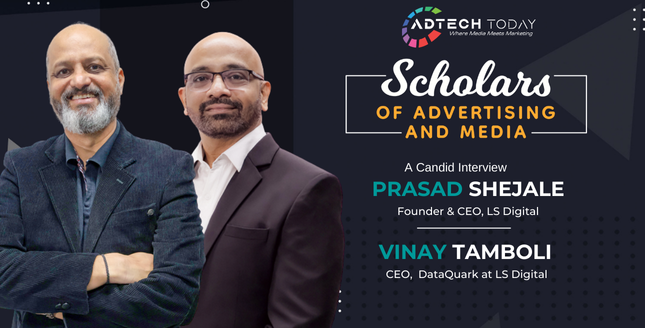
While the industry scrambles to replace the third-party cookie, Prasad Shejale and Vinay Tamboli argue that most brands are solving the wrong problem. It isn’t just about finding a technical substitute for tracking; it’s about surviving a total collapse of the old signal infrastructure. Prasad Shejale, Founder & CEO of LS Digital, views this as a boardroom crisis—a failure of organizational design. Meanwhile, Vinay Tamboli, CEO of DataQuark, sees it as an engineering emergency where “blind” algorithms bleed money.
In this joint discussion, they outline why 2026 belongs to the brands that stop chasing hacks and start building their own truth.
With privacy regulations accelerating and cookies fading out, what fundamental shift do you believe marketers still haven’t fully understood about first-party data?
Prasad Shejale: We all know that first-party data isn’t a simple substitute for cookies—it represents a completely different way of operating. Cookies allowed us to depend on external identifiers for years. First-party data requires us to build our own identity layer, our own consent framework, and our own measurement truth.
To be honest, the shift isn’t technical; it’s organisational. First-party data only works when the business treats it as a core strategic asset, not just a marketing project. It needs structure, clarity, and alignment across marketing, tech, CRM, and compliance. The brands that recognise this early will navigate the next few years smoothly. However, the ones that continue to treat data as a campaign-level input will struggle with visibility, accuracy, and performance far sooner than they expect. Not because the tools failed, but because the organisation wasn’t prepared for the new operating model.
Signal loss and pixel decay are often discussed but not fully understood outside performance teams. How would you explain the real-world impact of signal degradation on business outcomes?
Vinay Tamboli: Signal degradation sounds technical, but the business impact is very straightforward. When signals weaken or break, platforms start seeing only fragments of what’s happening on your website or app. When they can’t see the full picture, they can’t optimise properly. And when they can’t optimise, costs go up even if your strategy stays the same.
In real terms, signal loss means paying more for the same conversions, reaching the wrong audiences, and losing visibility on what’s truly driving revenue. It slows down learning and forces teams into reactive troubleshooting. That’s why brands looking for sustained performance have to treat signal quality as seriously as they treat media planning or creative investment.
DBT has become a broad term. In the context of marketing measurement and data ownership, what does Digital Business Transformation practically mean for enterprises today?
Prasad Shejale: Today, Digital Business Transformation is really about preparing the organisation to make decisions with complete confidence. It’s not just about digitising workflows or adopting new tools. It’s about bringing measurement, identity, privacy, and activation into a single, accountable framework the business can trust.
In practical terms, DBT means taking ownership of your marketing data rather than relying entirely on what platforms choose to report. It means shifting from retrospective dashboards to real-time intelligence that helps teams act faster. And it means embedding privacy and governance into every part of the customer journey, not as compliance overhead, but as a foundation for better performance.
When Enterprises approach DBT this way, they gain a clear, unified view of what truly drives growth and teams can act with far more speed and certainty in a privacy- first, platform- agnostic world.
Global enterprises are increasingly looking to India for data and performance innovation. What factors are enabling this shift, and how can India strengthen its leadership in this space?
Prasad Shejale: India has reached a point where scale, talent, and innovation are all moving in the same direction. With one of the world’s most dynamic digital ecosystems, we have a unique understanding of how users behave across platforms, devices, formats, and languages. The highly –velocity environment gives India a depth of behavioural insights that global enterprise increasingly sees as a strategic advantage.
What’s changing now is that India is no longer just delivering execution — it’s contributing meaningfully to strategy, measurement, and next-generation data systems. To strengthen this leadership, we need to deepen capabilities in privacy engineering, identity infrastructure, and advanced measurement models.
If we continue investing in these areas, India won’t just be a hub for global digital operations, it will be a source of global digital innovation.
Platforms like Meta and Google have strong measurement systems, but each operates in its own silo. Why does this fragmentation create blind spots, and how should brands think about unifying their data signals?
Vinay Tamboli: Each platform measures success through its own model, its own identifiers, and its own attribution logic. None of them see the entire customer journey, which means every platform gives a partial view. When a brand makes decisions based on these isolated views, it inevitably creates blind spots.
The solution is to build a unified signal foundation — something that gives all platforms consistent, high-quality information. When first-party data, server-side events, and conversion signals flow through a single, well-structured pipeline, it becomes easier to compare performance, deduplicate events, and make decisions that reflect actual business outcomes. This is the shift brands need to make if they want clarity and accountability across their investments.
When signal quality improves, what are the most meaningful ways it can influence marketing efficiency, CAC, and profitability over the next few years?
Vinay Tamboli: When signal quality improves, everything downstream improves with it. Algorithms learn faster, budgets get deployed more intelligently, and campaigns start aligning closer to revenue rather than vanity metrics.
Over time, this leads to lower acquisition costs, stronger retention, and a much clearer understanding of where to invest. It’s not a short-term lift — it becomes a structural advantage. As
platforms rely more on machine learning and privacy frameworks evolve, strong signals will differentiate the brands that grow consistently from those that get stuck in optimisation loops.
With performance marketing entering a new era of privacy, platform shifts, and signal complexity, what is the single most important preparation CMOs should make for 2026?
Prasad & Vinay: The one thing CMOs should focus on before 2026 is getting their measurement and signal foundation in place. The rest of marketing — whether it’s media, creative, or customer experience — only works as well as the data supporting it.
We’re moving into a period where platforms will keep changing, identifiers will continue to fall away, and a lot of optimisation will be handled by automated systems. In that environment, the only thing a brand can genuinely depend on is the data it owns and the way it chooses to organise and apply it.
CMOs who start preparing for a privacy-first, platform-neutral signal setup now will walk into 2026 with much more clarity and control. Those who push it to the side will end up reacting to changes rather than steering through them.

