

Let me begin by congratulating the Hon’ble Prime Minister on his vision and leadership in centring the country’s growth agenda around artificial intelligence. I must also pay compliments to Minister Vaishnaw, the Ministry of Electronics and Information Technology, and the IndiaAI team for executing on the PM’s vision and bringing us all together at this seminal forum. This summit could not have come a day too soon.
At the outset, I must clarify that I do not claim to have a technologist’s lens on artificial intelligence and am not here to talk about its development. But I am a big believer in the power of harnessing emerging technologies to transform societies, businesses, and consumer experiences. Over three decades as a media professional, I have had a ringside view of technology’s transformative impact, starting with the introduction of the first personal computer in newsrooms and the launch of India’s first digital news platform at Aaj Tak. At every stage since, technology has allowed the businesses I’ve been involved with to operate with speed, agility, and efficiency that fundamentally changed our relationship with audiences. And I would like to believe that at each of these inflection points, these businesses have been at the forefront of adopting and introducing these innovations to the Indian masses.
It is exactly because of this adoption of cutting-edge technologies that India, a late entrant to the world of audio-visual entertainment, has rapidly become one of the most exciting media markets globally. The transformation has truly been extraordinary. Within the span of a quarter century, we have gone from an industry valued at a few billion dollars to the fifth-largest media and entertainment market in the world, with an economic contribution of more than $30 billion. We have transitioned from one state broadcaster to more than 900 channels across dozens of languages. Our reach has expanded from about 70 million households to more than 210 million television households and over 800 million video consumers. And the content itself has evolved beyond recognition — from a few tentative experiments in family drama to a vast, diverse, multilingual ecosystem serving the most heterogeneous audience on earth.
In this process, we have built an ecosystem has helped ignite the ambitions of India. The aspirations of a generation of Indians — what they wanted to become and what they thought was possible — have been shaped as much by what they watched as by what they were taught.
While the social impact gives me immense satisfaction, the economic and business impact is equally compelling. At JioStar alone, we have invested over $10 billion in content over the past three years. Every major global media enterprise is competing fiercely for the Indian viewer. Those who are not here are absent because they could not crack this complex market.
So the key question is: what can AI do for the media industry that we are not already doing? To answer that, we need to zoom out and look at the broader global landscape. Despite our remarkable domestic progress, India has not yet broken through as a global content powerhouse.
Compare this to countries with far smaller populations, less cultural diversity, and less formidable technological capabilities that have managed to capture the global imagination. South Korea gave the world Squid Game and Parasite. Puerto Rico — an island of three million people, just gave us the most-streamed artist on the planet, performing entirely in Spanish, headlining the Super Bowl halftime show. These cultures dared to imagine that their stories and their languages could command a global stage, and they succeeded.
This is precisely the mindset the Hon’ble Prime Minister called for in his rallying cry at WAVES last year: “Create in India, create for the world.” It is a dream many of us in the media industry have shared. But until now, that is largely what it has remained — a dream.
So why have we been unable to break out of our domestic bounds and achieve a larger mindshare globally? In my view, our ability to translate our abundant ambition into reality has been constrained by a few structural factors — chief among them a lack of capital, an inability to attract global talent, and a target audience largely confined to the domestic market.
The numbers make these constraints stark. The average Hollywood studio production commands a budget of $65 to $100 million. A major tentpole runs $150 to $300 million. The average Indian film? Three to five million dollars. And this is equally true of television production. A single episode of a marquee series from HBO or Paramount costs $20 to $30million to produce. A typical Indian television serial? Seven to ten lakhs per episode — roughly ten thousand dollars. This is an order-of-magnitude chasm.
And this financial ceiling has created a paradox in talent. India has some of the finest creative and technical talent anywhere in the world. The breathtaking VFX of Life of Pi was largely created in Mumbai and Hyderabad. Indian artists worked on Avatar, The Dark Knight, and Game of Thrones. The talent was always here. But our own producers and directors, who had the quality and ambition, could not afford their services at the rates global productions commanded.
When both capital and talent are constrained, the horizon of your content narrows with them. Our films, our television, our music have been made primarily for consumers within the country, or at best, for our diaspora abroad. There have been spectacular exceptions — RRR at the Oscars, Dangal’s global box-office success. But that is exactly what they are: exceptions, not a pattern.
The result is a peculiar chicken-and-egg problem. Limited capital — much of which owes to our status as a developing economy — and a primarily domestic audience constrain our global competitiveness. That lack of competitiveness, in turn, hinders our ability to attract the capital that would close the gap. This is not to lament what we have achieved. We have done remarkably well with what we had. But the opportunity at hand is much larger.
AI provides India a once-in-a-generation opportunity to become the creative capital of the world. Not the back office for the world’s content. The leader. The standard-setter.
Because our business is built on human creativity, the Media and Entertainment sector is set to be the biggest beneficiary of the AI era. This is a catalyst that fundamentally rewires the three core pillars on which our entire industry is built: Content, the Consumer, and Commerce.
On content: For decades, the sheer cost of infrastructure has been a constraint on the business of media and entertainment in this country. Today, that barrier is coming down. AI-powered production is not just reducing costs; it is unlocking an unprecedented volume of high-quality storytelling. At JioStar, we recently produced Mahabharat: Ek Dharmayudh, a 100-episode live-action series, which is exhibited right here at the Summit. We achieved the visual scale and emotional depth of a global production, three to five times faster than a traditional pipeline.
What this tells me is that the old barriers are vanishing. The only binding constraints left are imagination and creativity. And in a landscape where imagination determines the winner, India’s formidable cultural depth and inherent DNA for storytelling become our most powerful competitive assets. Our agenda at JioStar is clear: to harness these attributes and position ourselves as the world’s leading foundry for stories and creativity.
For consumers, we have an opportunity to retire a model that has been one-directional for a century: we produce, they receive. AI shatters that monologue. It allows us to create experiences that audiences have never had before. We are opening a new frontier in the viewer relationship—conversational discovery, interactive storytelling, and regionalisation that goes beyond simple dubbing to capture the authentic texture of India’s distinct markets.
And finally, commerce. Since the first newspapers, this industry has operated with exactly two monetisation models: subscriptions and advertising. These are two incredibly blunt levers for a market of 800 million viewers with wildly different economic realities. AI makes genuine consumer segmentation a reality. It enables dynamic pricing and packaging that actually reflect how people live, what they consume, and what they can afford. It unlocks entirely new categories of value we haven’t even begun to imagine.
Taken together, the disruption across these three pillars—content, consumer, and commerce—forms the very engine of the Orange Economy that the Hon’ble Prime Minister envisions powering our GDP. The global media market is nearly $3 trillion today, heading to $3.5 trillion by 2029. India’s share is currently less than two percent. AI has the potential to explode our share of this pie. Even a modest shift in our share of global revenue—from two percent to five—would represent tens of billions of dollars in new value creation.
But opportunity and outcome are not the same thing. We need all stakeholders pulling in the same direction. To seize this moment, we need three commitments from everyone in this room.
First: disrupt ourselves, or be disrupted. I’ve seen this movie before. When we introduced digital newsrooms, senior editors resisted. When OTT arrived, traditional broadcasters looked the other way. The pattern is always the same: incumbents defend the fortress until the walls come down. We cannot afford that mistake today.
Right now, we have an advantage the West does not: the freedom to move. Hollywood is approaching AI defensively—paralyzed by legal battles and locked in protectionist reflexes. Their hesitation is our opportunity. We have the chance to build the definitive business framework for AI-driven entertainment. We can design the revenue models that actually work for everyone—the writers, the actors, the technicians, and the producers. This is not a zero-sum game; it is a larger pie. We can set the global precedent, but only if we lead with ambition rather than anxiety.
Second: India must become the global hotbed for AI-native creative talent. The most valuable person in tomorrow’s media industry is not a pure technologist, nor a traditional artist. It is the hybrid: someone who can conceive a world-class story and command the AI tools to bring it to life. We have the deepest creative traditions and the sharpest engineering minds. The task now is to fuse them deliberately through a relentless focus on skilling and upskilling at scale, so that the world looks to India for this exact kind of talent.
Third: policy must be an accelerator, not a brake. Our creators do not need a roadmap handed to them; they simply need the obstacles removed. Because these are early days, the guardrails we set now will have a massive multiplier effect on our future competitiveness. As we shape these frameworks, we must resist the temptation to import
Western regulatory constructs wholesale. China has been clear-eyed about this: they identified exactly what they needed to outpace the West and built their regulatory approach around that goal. Our frameworks must also reflect our unique ambitions.
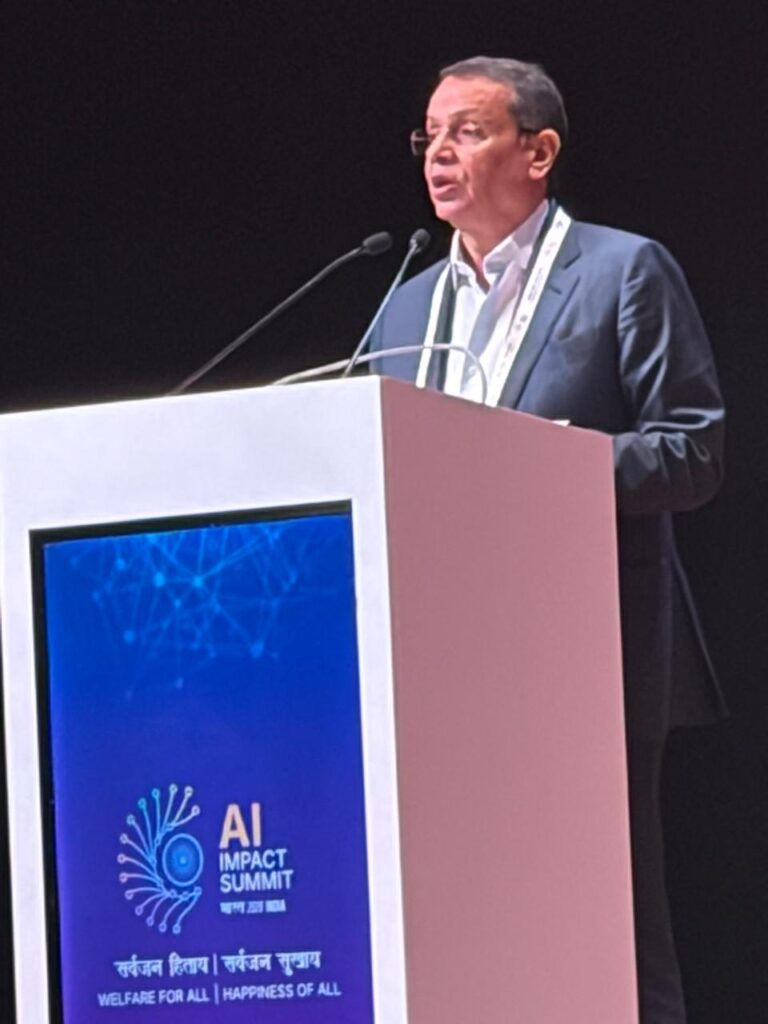
We are sitting in Bharat Mandapam, at the first global AI summit hosted in the Global South. That is significant in a way that goes far beyond symbolism. For too long, the intersection of technology and media has been dominated by a handful of countries and companies. The tools were made elsewhere. The platforms were built elsewhere. The rules were written elsewhere.
AI changes that equation forever. When the barriers across the entire value chain collapse, the advantage shifts decisively. It moves away from those with the deepest pockets, and toward those with the deepest wells of culture, the most dynamic audiences, and the sheer scale to define new global markets. And no country on earth is better positioned for that shift than India.
The question before us today is not whether India can become the global media powerhouse of the AI age. It is whether we will move fast enough to claim that position. I believe we will. The energy in this room, the ambition of this summit, and the momentum of this country tell me that we are ready. The stories have always been here. Now, the scale of our market and the power of our technology have finally aligned. This technology is the ultimate leveller. Let us not just participate in this new era. Let us lead it.
Read more: Tata Group And OpenAI Partner To Advance AI Infrastructure And Enterprise Adoption

