
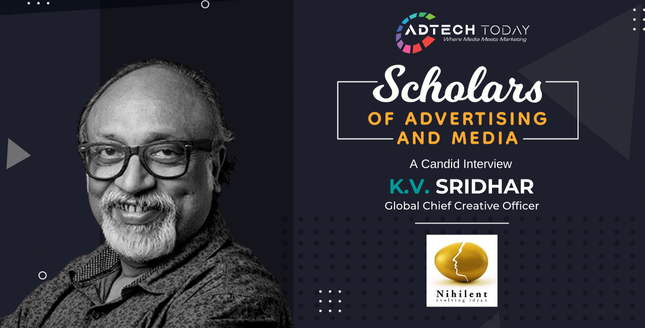
In the frenetic world of advertising, few voices carry the warmth, wisdom, and enduring relevance of K.V. Sridhar, affectionately known to the industry simply as ‘Pops.’ With a career spanning nearly five decades, he has not only shaped iconic campaigns for global giants but has also served as a mentor to generations of creative talent. Today, as the Global Chief Creative Officer at Nihilent and Founder of HyperCollective, Pops continues to bridge the gap between cutting-edge technology and human emotion. In this deeply personal conversation, he reflects on the industry’s pivot from performance to purpose, the delicate balance between AI and empathy, and why the most powerful stories are still the ones that bring us back to our roots.
As someone who has led some of India’s most influential creative organisations and is now shaping HyperCollective within Nihilent’s global ecosystem, how has your philosophy on creativity evolved over the years?
Nothing is static. Business, culture, the economy, and consumer behavior remain in constant flux. Therefore, creativity cannot simply be imported—like ideas formerly arriving from London—it must stem from life and resonate at a basic human level. As I often maintain,
“Creativity in advertising reflects society’s behaviour and what you want to communicate. Different times demand different things.”
Consider the drastic evolution of gender roles. Decades ago, advertising celebrated the “superwoman” solely for flawlessly managing her husband, children, and office duties. Today, society is far more gender-sensitive, and our storytelling must reflect that shift.
I do not see a dilution in advertising, but rather a transformation. The classic Onida campaign using the “Devil” as a metaphor for envy worked because it was real and relevant, creating immense value even in critical markets like Bengal. Today, television is no longer the sole powerhouse; it coexists with mobile screens, fundamentally altering consumption habits. However, the core principle persists: a good creative always borrows from life, ensuring the work remains relevant to the very moment it is consumed.
With Nativepur, you’re building something very different from a classic agency. Do you view it as a brand, a commerce platform, or a movement?
Nativepur is an e-commerce platform, which is another venture I have. The name is based on the simple idea of “A Place You Come From.” We are building this to connect everyone to their native town. That means whatever you can buy in your hometown, you should be able to buy from anywhere in the world; it doesn’t matter where you live. Many local products aren’t available on standard sites, and the idea is to promote these products while helping people stay connected.
This initiative helps small vendors, farmers, artisans, and local manufacturers reach a global audience. If you are from a small town in Orissa, your product may not even reach outside your own district, let alone the national or international market. This platform aims to change that by giving them global access.
At the same time, no matter where you live, you stay emotionally connected to your roots. Social media and OTT platforms have brought us closer visually and culturally—you can video call on WhatsApp or watch regional shows instantly. But what about the local ingredients you need to cook the dishes your mother used to make? That tactile connection is missing. We intend to fill that void.
How do you see India’s creative voice evolving on the global stage in the next decade?
India has always held a very special place in the world. You know, the unique mix of our culture, religion, and rich heritage is truly distinct. It is this deep foundation that has shaped our people, and I believe that is exactly what will define India’s voice on the global stage for the next decade.
Globally, retail media is rewriting how brands spend. How do you see this shift impacting creativity over the next five years?
We have already seen that META is changing its returns. If I look at the last decade, the shift is absolute. At one point, brands spent only 5 percent of their budget on digital performance; today, it is 60 to 80 percent. The story is the same whether I speak to FMCG giants or e-commerce brands.
Marketing has fundamentally changed because you no longer have to worry about physical reach. Earlier, legacy brands like ITC, Dabur, and Emami had to be visible in countless stores—they had to be everywhere. Today, modern trade and quick commerce have solved availability, and companies save massively on distribution costs. That money is now poured into logistics and advertising. We moved from broad national TV reach to micro-level distribution. META itself says only 7 percent of people are genuinely interested at any moment, yet digital allows you to track even slight intent through the entire purchase cycle.
This created a phase of super-performance marketing. Brands got sales, but they stopped building brands. As I always say,
“You can push commodities for as long as you want, but people pay more for a brand.”
That is the defining challenge. Many brands have become mere products. Performance-heavy marketing forces you to compete on price, but customisation and freebies cannot sustain profitability. A product cannot survive long on price alone because someone else will always have better unit economics and sell it for less. What happens to you then?
To last, you must build a brand. The future depends on understanding that marketing has been reduced to a sales function. Marketing’s job is to create desire; Sales’ job is to make the product available and close the deal. But today, marketing is busy managing discounts instead of creating desire. We must use algorithm-driven insights not just to harvest intent, but to make people want your product even if they weren’t planning to buy it. Turning this around is the biggest opportunity for the next five years.
With CTV rising and agency networks consolidating worldwide, do these shifts unlock new possibilities for creativity — or do they add new constraints?
Fundamentally, CTV is still television. It remains the familiar canvas of sight and sound where audiences engage with stories—whether it is a 30-second ad, a blockbuster like Baahubali, or a long-form web series. People crave emotion and narrative; CTV is simply a different pipe for distributing that content. We have witnessed a clear evolution: from national broadcasters to regional channels, then to satellite connecting the country, and finally to OTT making content ubiquitous. Now, CTV means television works through the internet—no dish or cable required.
For advertisers, this unlocks massive customization because the internet provides far richer data.
“Traditional TV had no intelligent data. CTV does. The opportunity now is to make advertising contextual—not only in terms of the story but also in terms of the viewer’s emotional state. Technology will help you understand how people are consuming content and what mindset they’re in at that moment.”
You now know exactly when and how someone is watching—are they on a noisy metro, on a bus, or relaxing at home at 3 AM? That data reveals their mood. Knowing this should influence the creative design; the same core idea can be expressed differently depending on the viewer’s environment.
Think of real life. If a close friend sees you are feeling low, they won’t ramble about a party from last week. They will adjust their tone to suit your mood and try to lift you. Advertising should work the same way. With AI entering the mix, intelligent systems can help us emulate that empathy. In the future, CTV won’t just be about better targeting; it will be about using emotional insights to ensure stories land with the right intention. That is where the true transformation lies.
With AI, new formats, and rapid digital shifts changing how ideas come to life, which emerging developments excite you most for creative growth?
It empowers you because it is a natural progression: collecting data and finally using it the way you want. Generative AI has made technology accessible to everyone. The world has been amazed over the last two years by generative AI, and now by agentic AI as well. Search has become supercharged, and while the amount of data is overwhelming, the potential is undeniable.
For creative people, this is vital. Creativity relies on research, knowing the space you are working in. AI is a fantastic tool for this. Whether you are writing a feature film, a documentary, an ad script, or a blog, research becomes easier, and structure becomes tighter. You can provide an intelligent prompt and start writing whatever you want. We are seeing the same impact in visuals; OTT platforms are already using AI-generated styles inspired by epics like Mahabharat and Kurukshetra.
That is the positive side. But there is a dangerous side.
When you write, your voice, your ideas, and your vocabulary make it yours. When you rely on the machine, you risk losing that voice. Three people giving the same prompt will often get the same result. You start using the model’s vocabulary, instead of your own. Everyone speaks with their own rhythm and imperfections. If everything is corrected automatically, we all begin to sound like the machine. Over time, the individuality of writing disappears. Human imagination has its own beauty. For someone who cannot draw, AI feels like magic—anyone can now design a birthday card. That is great for them. But a professional graphic designer will not rely on the tool because originality matters. Mechanical tasks can be handed over to AI, but work that requires sensibility must come from your own mind. Then comes the major issue: originality and copyright. AI images are generated using public data scraped without permission. Someone can generate an image that resembles me- possibly my beard, hairline, or nose, because the model learns from millions of images. A part of me appears without my consent. This raises serious moral, legal, and ethical questions. As I always say,
“I’m not saying we should fight technology. Change will happen. But we must be cautious about how we use it.”
The impact will be huge. The winners will be those who understand both technology and creativity, using these tools to create original work while keeping their human voices alive.
When you teach or mentor, what is the ‘most important thing’ you want young creatives to take away from you?
The question that successful individuals—whether a filmmaker, writer, or advertising storyteller—must ask themselves is this: Do the stories we write stem from a genuine purpose?
The biggest realization I’ve had in my nearly 48 years in advertising is that the answer lies in living those stories. The stories you write all reside in your life: your experiences, a life lived well, and everything you have observed.
Consider the first 12 to 14 years of your life. This is such a rich time because you have no agenda. Your relationships are pure. You are open to all experiences: you write, sing, dance, play, listen, talk, or swing. You experience everything fully.
It is only after age 14, when you “grow up,” that a shift occurs. Selfish motives start creeping into relationships and education. You think, “This will be useful because I want to prepare for my exams.” Your pursuit of knowledge becomes transactional. You start filtering things: “I want to become a doctor or an engineer, so I don’t want to learn that.”
However, “unfiltered life experiences are what help you become a truly creative person.”
In advertising, it doesn’t matter what age you are; you must remain curious. You must observe and interact with people, even if they have simple questions, without that adult selfishness. As professionals, our only job is to ensure those genuine stories find the relevant audience and change perception. Take the life routine you have experienced—the little walk you took with your grandfather. That memory is going to be inspiring for you to write. It will help people truly understand the bond between generations and the things we need to cherish.
That same eager child—wanting to meet people, curious about how things work must be kept alive. Think of M.F. Husain. We all draw in school, but after we leave, we stop. He just kept drawing. If you lose that, you might become a good advertising professional, but you will not be a great creative one.
You cannot leave your childhood behind. You must continue with that childlike enthusiasm to remain connected with people. That is how you build a treasury of billions of memories, images, and observations. Keep the curiosity and the purity. Live on your memories, and that is what will help you write.
If you had to predict one shift that will define advertising in 2026 — something the industry is not prepared for — what would it be?
If you ask me the same question in December 2026, you will see the difference very clearly. There will be a distinct shift away from price cuts towards creating desire for a premium product.
“You will start seeing more brand-building advertising—advertising that connects with people emotionally rather than simply delivering a sales message or discounting the product.”
Consequently, you will likely see increased advertising spend, moving from highly targeted campaigns to broader, more brand-focused targeting.
–
Rapid fire :
One ad you wish you had created (but didn’t)?
Piyush Pandey and Ogilvy’s campaign for SBI Life, ‘Jiyo Dil Se’—‘Heere ko kahaan pata pehanne wale ki umar.’
What shaped this year for the industry?
2025 marks a turning point in advertising, driven by a shift in strategic ownership.
Three books or thinkers that shaped your creative worldview.
Bill Bernbach (DDB Mudra)
Leo Burnett (Both the agency and the man)
Hermann Hesse (German Poet and Writer)
If you weren’t in advertising, what would you be doing today?
I would be a painter
Read more: Adityan Kayalakal Steps Down as Head of Marketing at Jupiter Money

