Human-Centric, Financially Acute, AI-Enabled: The New Rules For CMOs In 2026
Over the past year, Indian marketers have navigated compressed margins, volatile consumption, urban slowdown, a K-shaped economy, rapid digitisation and a confusing, often noisy, wave of AI experimentation.
As the CMO’s role becomes more complex and fragmented – straddling brand, revenue, technology, data, CX and organisational capability – the MMA India Board has sent a clear signal for 2026: Sharpen. Simplify. Strengthen.
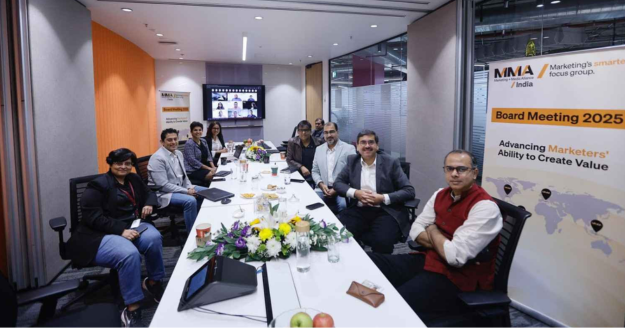
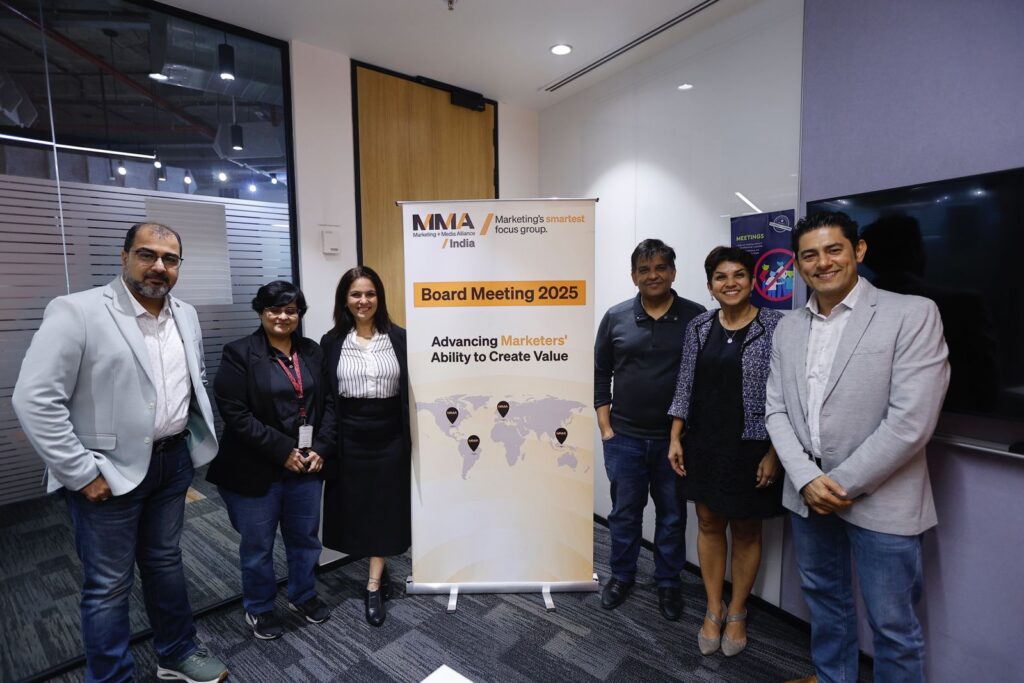
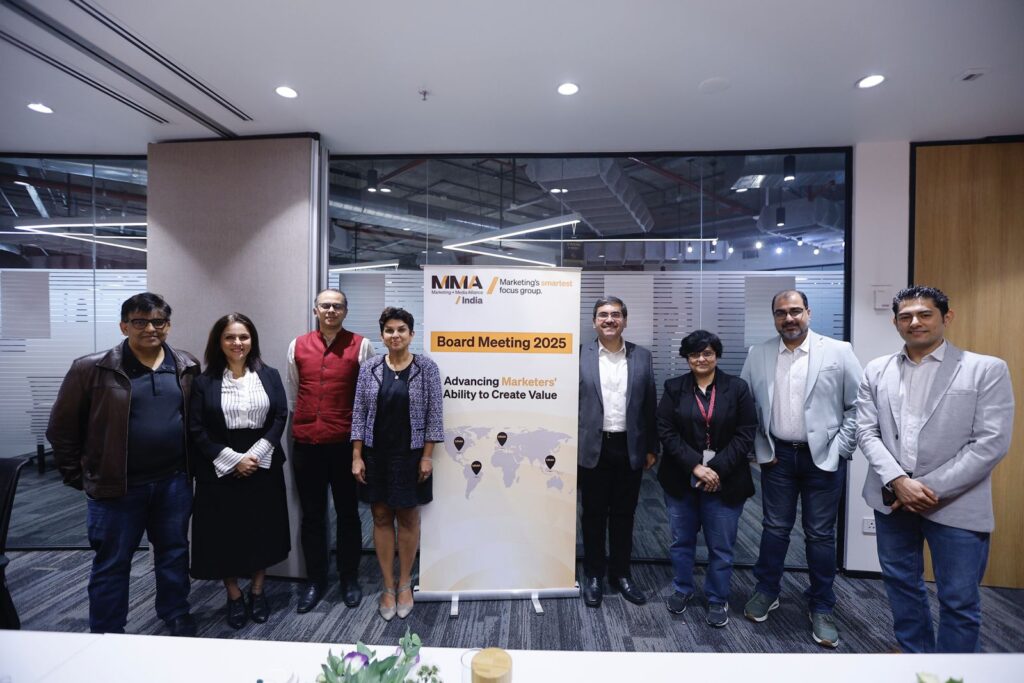
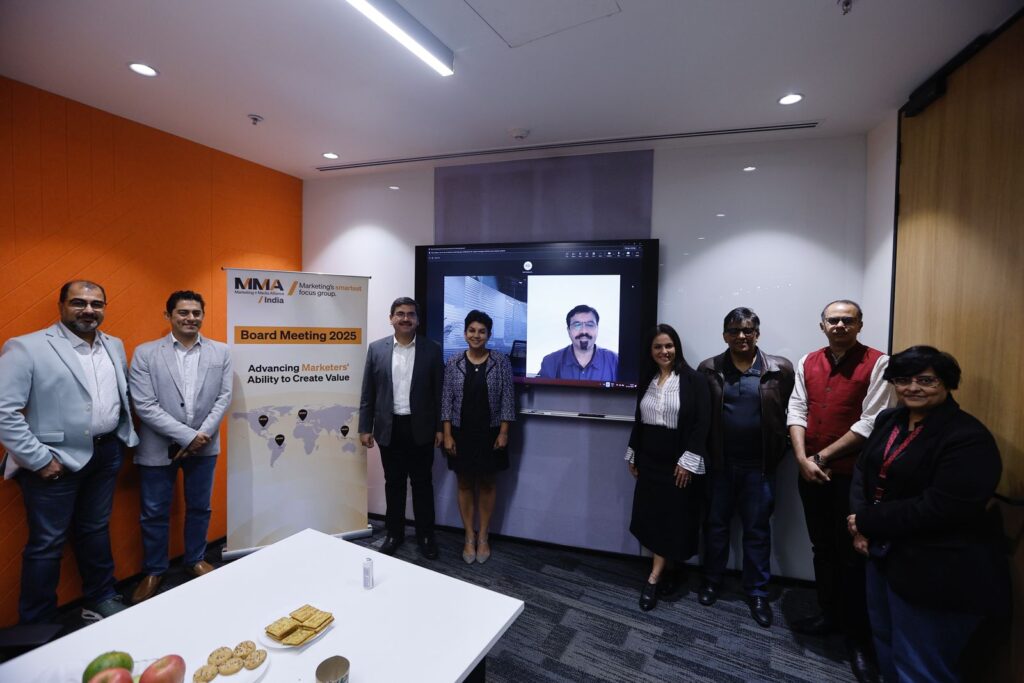
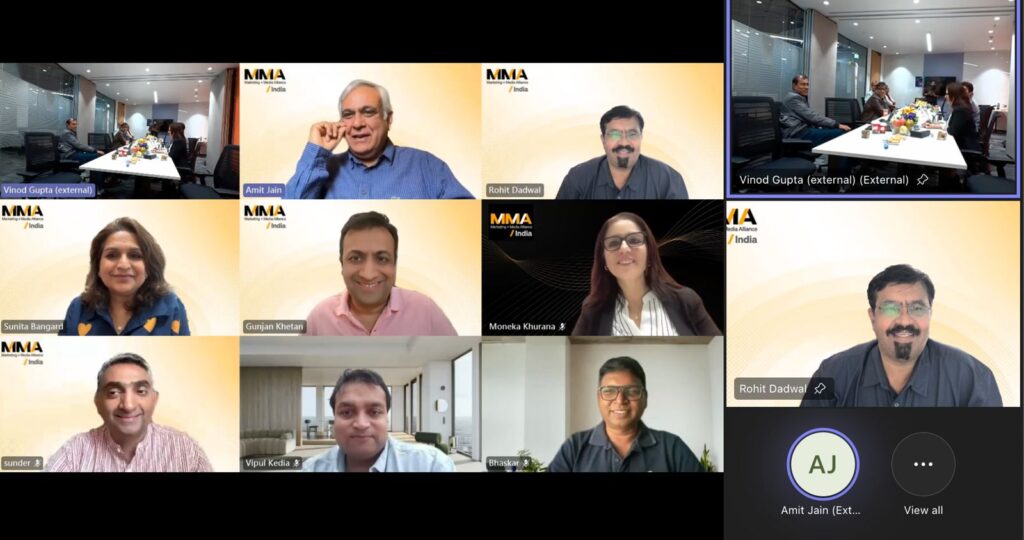
Board in Attendance: Amit Jain, MMA India Chair | Sanofi Healthcare
Saugato Bhowmik, Meta | Manish Aggarwal, Sony Pictures Network | Sunita Bangard, Aditya Birla Group | Vipul Kedia, Affle | Soumya Mohanty, Kantar | Anindita Veluri, Adobe | Arvind RP, McDonald’s | Chandan Mukherji, Nestle | Bhaskar Ramesh, Google | Dhruv Dhawan, The Trade Desk | Vijay Iyer, Flipkart Ads | Rohit Dadwal, MMA APAC | Moneka Khurana, MMA India | Sunder Balasubramanian, Myntra | Gunjan Khetan, Perfetti Van Melle | Deepak Bakshi, Accenture | Varun Sethuraman, Nestle | Gulshan Verma, Amazon Ads | Saloni Shah, L’Oreal
Special guest: Kirthiga Reddy, Verix
The board unanimously agreed: CMOs must now behave like Chief Business Officers.
The era of the CMO as just the “brand custodian” is over. The new mandate is commercial ownership.
7 key shifts for 2026 fresh from the boardroom:
- Creative + commercial + capability-building must merge
CMOs are expected to drive ideas, numbers and long-term capability – not just one of the three.
- P&L fluency becomes non-negotiable. CMOs must understand revenue and growth levers, margin pressures, and unit economics and payback periods.
- Every rupee must be tied to business outcomes. Marketing spends are increasingly judged on incremental sales, profitability impact and lifetime value, not just campaign metrics.
- Challenger brands are outpacing legacy brands. They are moving faster, experimenting smarter, and embedding financial discipline into marketing decisions.
- Boardroom credibility hinges on business impact. Campaign awards and vanity metrics will not be enough. CMOs will be judged on their contribution to the business P&L.
This is the industry’s biggest behavioural shift for 2026.

2. Consumer-Centricity Must Trump Tech-Centricity
Amid the AI wave, a clear warning emerged from the board: Don’t allow AI to overshadow the consumer. Technology is a powerful enabler – but not the hero. The consumer must remain the organising principle.
- Stop going tech-heavy for its own sake. AI, martech and automation must serve real consumer needs and business problems.
- OTT attention ≠ UGC attention. The context of attention is splitting. Long-form, lean-back OTT viewing vs short-form v/s lean-in UGC environments: Both demand different creative, media and measurement strategies.
- India is returning to real-world experiences. Live events, concerts and on-ground activations – offline discovery is back in the mix, and brands must rediscover experiential depth.
- Aspirations are nonlinear. Premium and value are rising at the same time. The same consumer may trade down in one category and trade up in another.
- AI must enhance empathy and personalisation, not replace it. The winners in 2026 will use AI to sharpen relevance and avoid generic, over-automated experiences
2026 will reward marketers who keep the human at the centre, even as AI accelerates.
3. The New Battleground – The Fragmented Consumer Pyramid
India’s consumer pyramid is being rewritten in real time. Key forces reshaping the landscape:
- Urban slowdown vs. rural resilience
- Urban growth has become patchy and cautious
- Rural consumption continues to show pockets of resilience
- Gen Z’s anti-legacy brand behaviour
- Younger consumers are less attached to traditional brands
- They reward authenticity, speed, and cultural relevance
- Premiumization and affordability rising together
- Luxury, SUVs, travel, and lifestyle categories are booming
- Simultaneously, value brands and mass offerings are critical for volume
- India’s “squeezed middle”
- The middle-income consumer is under pressure
- This demands sharper value propositions and segmentation
- Quick Commerce is reshaping distribution and margins
- Q-commerce is no longer a side-channel; it is central to full-funnel strategy
- It forces marketers to rethink pack-price architecture, portfolio and profitability
To navigate this, 2026 will require marketers to connect three previously disconnected axes:
- Consumption patterns: Who is buying what, where, and in which basket?
- Channel shifts: Retail, Q-commerce, OTT, UGC, CTV, social commerce – all have different roles
- Competition intensity from new-age challengers: New brands are using data, speed, and sharper positioning to win share
Winning brands will integrate these factors rather than solving them in silos.

4. AI Will Rewire Creativity, Media & Measurement – But Must Stay Grounded
AI is no longer optional – but irresponsible or ungrounded AI is dangerous. The board made it clear that 2026 must move from AI hype to AI effectiveness. The board stressed:
- AI must drive effectiveness, not jargon. Impact on ROI, not just experimentation will lead to clear uplift in precision, speed and outcomes.
- Every part of marketing will be reshaped. AI will meaningfully influence creative development, content generation, media planning & optimisation, measurement and attribution, analytics and modelling, and CX design and personalisation.
- Adoption must be responsible, business-first, human-led:
- Clear governance and guardrails.
- Transparency and data ethics.
- Sensible pilot-scale pathways.
- 2026 is the shift from “AI pilots” to “AI performance”. AI will be expected to prove its commercial value. Marketers will need to separate signal from noise quickly.
5. Growth Will Come From the ‘Movable Middles’
One of the clearest opportunities for 2026 was captured in a simple directive: Stop advertising to everyone. MMA’s global Movable Middles Growth Framework emerged as a critical growth lever:
- Delivers the highest incremental ROI – Focuses spend on consumers who are most likely to move with the right nudge
- Avoids wasted spends on loyalists and never-buyers. Loyalists often buy anyway. Never-buyers are expensive and inefficient to convert.
- Now applies across omnichannel – TV, Digital, Commerce & retail media, CTV and programmatic.
In a low-growth, high-pressure 2026 environment, ‘Movable Middles’ targeting becomes a critical tool in the performance and profitability arsenal.
6. Marketing Organisations Must Be Rebuilt for Agility
The marketing function itself needs a structural reset. 2026 will require marketing organisations to be redesigned for:
- Faster consumer response – Shorter feedback loops. Always-on listening and iteration.
- Integrated CX + data + digital maturity – Breaking silos between brand, performance, product and CX. Shared KPIs across functions.
- AI-led processes – Automation of repeat tasks; human focus on judgment, creativity and strategy.
- New capability mixes – Marketing capabilities have expanded from 72 to 92 in recent years. Teams now need skills in:
- Data science
- Product thinking
- Retail media
- Harnessing AI tools
- Experience design
MMA’s global Marketing Capability Benchmark proves: A 1% improvement in capability fit can translate to a 2.5% increase in revenue. This makes organisational agility and capability-building central pillars of marketing work in 2026, not side projects.
7. Purpose & Gender Equity 2.0 – Not Performative, But Structural
Finally, the board emphasised that purpose and gender equity must move from optics to operating model. 2026 calls for deeper, more accountable action:
- Gender equity requires org-level policy shifts and male allyship
- Support structures for women at critical career stages
- Leadership sponsorship and advocacy
- Discoverability of women leaders is a real growth lever
- Boards, juries, panels and leadership roles must better reflect available talent
- MMA’s platforms & initiatives can be an ally and also amplify visibility
- Purpose must be embedded into business, not just marketing
- Purpose can’t be a campaign tagline
- It must influence decisions on product, hiring, investment, partnerships
This is now a business priority, not a cultural talking point.
Finally: The Dual Mandate For 2026
The MMA India Board landed on a clear duality for the year ahead. Solve for now – Growth, Profitability, Performance, Efficiency & Focus.
Build for what’s next:
As MMA India Board Chair Amit Jain put it, 2026 is about “changing the wheels of a car moving at 80 mph.” MMA India’s role is to help the industry do exactly that – accelerate, without breaking traction.
Read more: DSP Mutual Fund Unveils “The Immortals” — A Documentary Celebrating Wisdom That Lasts A Lifetime