

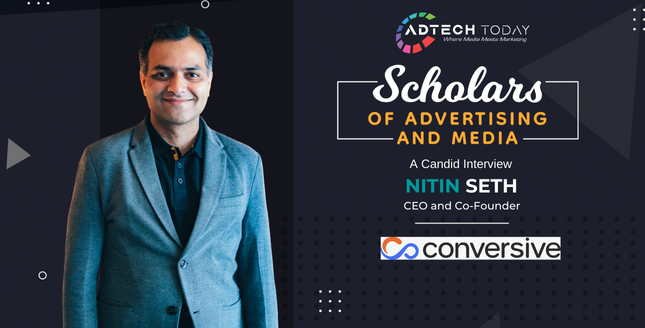
Conversational AI is entering a new phase where context, compliance, and real-time intelligence matter more than scale alone. In sectors like healthcare, education, and financial services, communication is no longer about high-volume outreach but about building trust through timely, personalised, and secure interactions. This is the space Conversive is shaping with its CRM-native, AI-driven messaging cloud.
Leading this shift is Nitin Seth, CEO and Co-Founder of Conversive, who has spent 16+ years transforming how enterprises engage customers. From launching the first SMS automation app on Salesforce AppExchange to building Conversive’s next-generation AI platform, his journey reflects a deep commitment to innovation grounded in responsibility. Seth has scaled Screen Magic from a 9-member team to a global organisation of 220+, powering communication for more than 2,000 enterprises across regulated industries.
In this conversation, he shares what it takes to build credibility in compliance-heavy environments, how AI is reshaping customer communication, and why the future lies in conversations that are intelligent, contextual, and human at their core.
From pioneering SMS automation to launching Conversive AI, which moments shaped your approach to enterprise communication?
There are a few moments that really shaped how I think about enterprise communication.
The first was back in 2008. While I was at Mobiance and Evalueserve, I noticed something simple but powerful. Businesses had no structured way to engage customers through SMS inside their CRMs. SMS was the most personal, immediate channel, yet completely underused. That insight became the foundation for Screen Magic.
The second was our 2012 Salesforce partnership. Becoming one of the first ISVs to bring SMS automation to Salesforce changed everything. It taught us that the best communication tools are the ones that disappear into existing workflows. If a tool feels invisible, it’s working perfectly.
And the third was the evolution to Conversive AI. Over the years, we’ve seen messaging evolve from basic notifications to real, strategic conversations. Businesses no longer want more channels, they want one unified platform where context follows the customer everywhere.
Those moments taught me that enterprise communication isn’t really about technology. It’s about removing friction between intention and interaction, making sure every message actually moves a relationship forward.
Conversive AI blends automation, NLP, and CRM context. How do you keep conversations human, ethical, and compliant at scale?
For us, keeping conversations human and ethical is part of the design. We treat compliance and humanity as core principles, not limitations.
First, context is everything. Every Conversive interaction is grounded in CRM data, the customer’s history, preferences, and stage in their journey. That’s what turns automation into understanding. When AI knows why someone is reaching out, it can respond with empathy and relevance, not just speed.
Second, compliance is built in, not added later. We’ve spent more than 15 years operating in regulated industries where trust is everything. So things like TCPA, HIPAA, GDPR, and A2P 10DLC compliance are part of our foundation. Built-in consent controls, audit trails, and intelligent routing make sure every message respects both regulations and relationships.
Third, humans stay in the loop. AI handles the volume, but people handle the nuance. Conversive gives teams visibility and control at critical moments, so human judgment always guides important decisions. That balance keeps conversations authentic.
And finally, we set clear ethical guardrails. Not everything should be automated. Our platform helps teams decide when to let AI take over and when to bring in a person, so efficiency never comes at the cost of empathy.
“At the end of the day, our goal isn’t to make AI sound human, it’s to make every customer feel understood.”
Screen Magic grew from 9 people to 220+ globally with 32x revenue growth. What leadership lessons were key in scaling both team and product?
Scaling from a team of 9 to more than 220 people taught me a lot about leadership and what really sustains growth over time.
First, conviction before consensus. In the early days, we didn’t have a detailed roadmap. What we had was a strong belief that messaging would completely transform business communication. That conviction kept us going when things were uncertain, and it became our biggest recruiting tool. We didn’t just hire for skills, we hired people who
shared that belief.
Second, culture isn’t something you preserve, it’s something you reinforce. As we grew, I realized culture doesn’t fade because of size, it fades because of inconsistency. We stayed disciplined about being customer first, even when things got complex. Every product decision and every support conversation had to reflect our mission of enabling meaningful communication. That consistency became our identity.
Third, build for the organization you want to become, not just the one you are. Early on, we made a conscious choice to embed ourselves deeply in CRM ecosystems instead of building standalone tools. That decision, to be platform-native, created long-term advantages and taught me to think beyond immediate needs.
Fourth, empower people and then trust them. Global growth only works when decision-making is distributed. My earlier experiences taught me structure and agility, but Screen Magic taught me the value of true delegation. I believe leaders don’t solve every problem themselves, they build teams that can solve problems they haven’t even seen yet.
And finally, celebrate milestones but stay hungry. I’m incredibly proud of what we’ve built with Conversive AI, but pride can’t turn into complacency. The moment you start protecting what you have instead of imagining what’s next, you stop leading.
So for me, scaling isn’t just about managing growth. It’s about keeping clarity of purpose even as everything around you changes.
Integrating deeply with CRMs enables data-driven workflows. What challenges do enterprises face adopting conversational AI, and how do you help overcome them?
Enterprises usually run into three big challenges when adopting conversational AI, and we built Conversive to tackle each of them head-on.
First, data silos. Customer information is often scattered across CRMs, marketing tools, and legacy systems. Without that full context, AI ends up sounding generic. Conversive solves this by connecting everything, Salesforce, Zoho, HubSpot, ActiveCampaign, so all conversations stay in sync across channels like SMS, WhatsApp, and chat. That way, when a customer switches channels, the AI still knows who they are and what’s happened before.
Second, complexity. A lot of enterprise tools are powerful but hard to actually use. Teams spend months on setup and training before seeing any value.
We take the opposite approach, Conversive works right out of the box. SMS Magic runs natively in Salesforce, so agents can message customers directly from Campaigns or Reports. We also include pre-built templates and workflows so teams can start fast and scale over time.
And third, compliance anxiety. In regulated industries like healthcare or finance, one mistake in communication can create huge risks. Many companies delay adoption just out of fear.
We solve that by baking compliance right into the platform, TCPA, HIPAA, GDPR, A2P 10DLC, it’s all built in, not bolted on. We even help with carrier registration and industry-specific guardrails through SMS Magic for Financial and Health Cloud.
And beyond the tech, we don’t just hand off the platform and walk away, our Success and Managed Services teams stay involved to ensure smooth adoption and optimization.
In short, we simplify, we integrate, and we make compliance effortless, that’s how enterprises actually succeed with conversational AI.
AI-driven, contextual messaging is transforming engagement. How do you see this shift impacting healthcare, education, and fintech?
Yeah, we’re seeing a massive shift in how organizations communicate, especially in complex, compliance-heavy industries like healthcare, education, and fintech. In these sectors, conversations aren’t just touchpoints, they actually drive outcomes.
In healthcare, we’re moving from transactional to truly proactive care. Instead of generic reminders, patients get personalized, contextual messages, like pre-visit questionnaires or tailored recovery instructions. And when someone doesn’t respond, the system knows to loop in a care coordinator. It’s automation with empathy, and it’s improving outcomes while saving time.
In education, it’s all about scale. Students expect personal attention, but teams are stretched thin. With Conversive, schools can automate nudges, check-ins, and reminders while still keeping the human touch. That shift from reactive support to proactive engagement is directly improving retention.
And in fintech, trust is everything. Customers want instant, transparent updates, but also to feel heard. Our platform helps balance automation with real human oversight, ensuring secure, compliant, and timely communication.
Across all three, the theme is the same, AI isn’t replacing people, it’s amplifying them. That’s the kind of intelligence we’re building at Conversive.
Which emerging technologies—like multilingual NLP, emotion recognition, or AI-human collaboration—will most influence AI-powered customer communication?
I think the future of AI-powered communication really comes down to three big shifts that are happening at the same time.
First, it’s all about context over just language. At this point, multilingual NLP is table stakes, every serious platform can handle multiple languages. The real game changer is contextual understanding. AI that doesn’t just translate words, but actually understands intent based on who the customer is, their history, and the situation.
For example, when someone says, “I need help”, that could mean something totally different for a patient after surgery versus a fintech customer reviewing their account. The AI that wins will be the one that understands why someone’s reaching out, not just what they’re saying.
That’s exactly what we’re building at Conversive, every conversation is grounded in CRM context, so the responses feel natural and relevant.
Second, it’s about AI and humans working together. Emotion recognition is interesting, but what’s more powerful is decision intelligence, AI that knows when to handle something on its own and when to bring in a human.
“The future isn’t humans or automation, it’s humans with automation.”
Our tools are built around that idea. The AI monitors things like urgency and conversation flow, and then routes intelligently. So agents can focus on what humans do best, which are judgment and relationship-building.
And third, communication is becoming proactive. Instead of just reacting to customer requests, AI will start anticipating needs. Let’s say if your system could spot when a customer might churn and reach out before they even think about leaving. Or if healthcare AI could predict when a patient might miss a follow-up and send a helpful, personalized reminder.
That’s the direction we’re moving, bringing together behavioral data, customer lifecycle, and channel preferences so businesses can act before the customer even asks.
In the end, it’s not about one shiny technology. It’s about bringing context, collaboration, and prediction together into a single, intelligent platform. My vision is a world where conversations become the default interface for business, intuitive and human-centered. Where AI doesn’t just help us talk faster, but helps us communicate better.

