

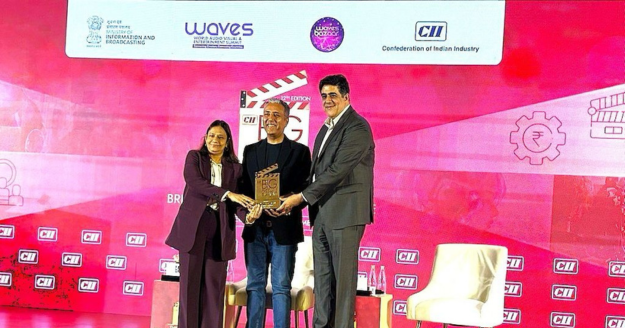
MUMBAI, India—December 03, 2025— At the recently concluded 2025 CII Big Picture Summit, Gaurav Gandhi, vice president, APAC at Prime Video, was recognized as a “Visionary Shaping India’s Media & Entertainment Future”. He was felicitated by Rajan Navani, co-chair of the CII National Council on M&E and managing director and CEO of JetSynthesys, who also moderated the specially curated session. Gaurav was honoured for his leadership in expanding streaming access across the Asia Pacific region, pioneering innovative content strategies, and advancing India’s position in the global media ecosystem. The felicitation took place during the summit’s valedictory session, underscoring his role in driving industry transformation and inspiring the next generation of media innovators.
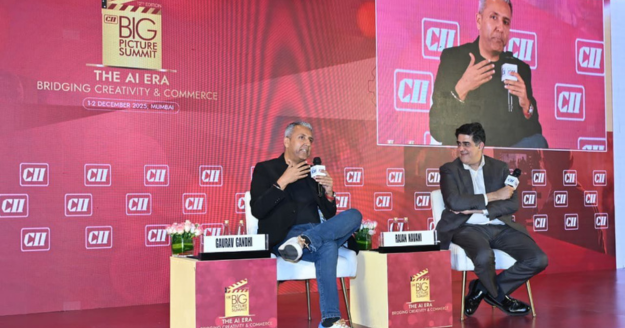
In a wide-ranging conversation, Gaurav spoke about the vision that has shaped his journey in the industry. Talking about how imagination and experience help in developing long-term strategy, he said, “Every experience you go through, successful or not, shapes what you are going to do in the future. And if you learn from it, you get a sense of what the world could be. And I think oftentimes, to really change the world, you have to imagine what it could be and not just take it as it is.” He added that this mindset guided many of the foundational decisions he took when streaming was still at a very nascent stage in the country.
Gaurav also spoke about the power of stories to transcend boundaries, noting that cultural resonance always begins at home. “Stories have to connect locally first before they can travel globally. If something doesn’t move its local audience, it rarely becomes world-renowned. We don’t think about designing a story to be global; at Prime Video, we think about telling a truly great story – and when that connection is authentic, the world follows.”
He added that this belief is already playing out meaningfully on Prime Video, where over 25% of viewership for Indian content now comes from outside India — demonstrating how deeply local stories can inspire global audiences.
Gaurav also spoke about the importance of intention and execution in shaping a differentiated content ecosystem. “There are so many things that you can be intentional about, but it’s not just about the intention, it’s about carrying it through in the execution. You can actually think and imagine a world, but if you can’t execute it, then there’s a challenge as well.” This approach, he noted, has underpinned Prime Video’s efforts to build authentic stories and relatable characters, and to make them not only pan-Indian but global with stories that can travel across languages, formats, and cultures. “In the early years of Prime Video, we knew if we had to create a variety of content across each language to build a sustainable business model. So, the thesis was, how can you make that content travel, not just globally, but also within the country.” He emphasized that while localization through subtitles and dubbing has helped, building nuanced storytelling requires characters who resonate universally. This is where intentional casting choices played a key role. Talent crossovers, such as Shahid Kapoor and Vijay Sethupathi in Farzi, or Manoj Bajpayee and Samantha Ruth Prabhu in The Family Man Season 2, were examples of intentional decisions that, when executed well, helped create deeper connections with wider set of audience.
On leadership, Gaurav emphasized curiosity as the single most essential quality in a rapidly evolving industry. “Curiosity is the starting point of everything. It’s the number one trait I look for – because it means being humble enough to acknowledge what you don’t know, and driven enough to seek answers and ask ‘why?’ or ‘why not?’” He added, “The biggest leaders are the most curious – that’s how they imagine the world differently.”
In response to Rajan’s question on what goes into building a strong, effective team, Gaurav shared, “I hire the best team and let them do their job. The best thing one can do as a leader, is to create more leaders. An important quality in leadership is knowing when to step in and support your team, and when to give them the space to experiment and do their own thing.”
He concluded by underscoring the importance of learning from people at every level of an organisation. “I play this mental game with my leaders and my teams – I imagine taking the best qualities of each person and building them into myself. That’s how I grow. Inspiration doesn’t come from one leader; it comes from everyone.”
Read more: Kimberly-Clark India Honoured Among Asia’s Best Employers At The HR Asia Awards 2025

