
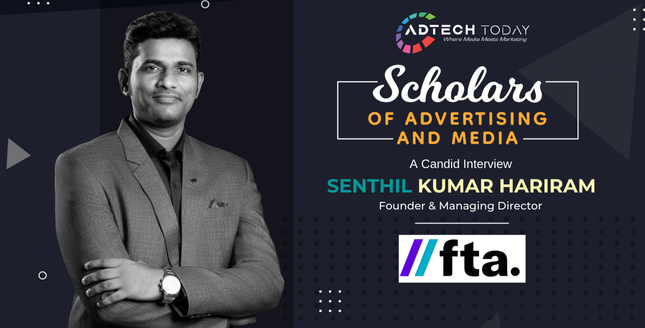
Over the past two decades, digital marketing has transformed from channel-driven optimisation to a discipline powered by AI, data, and integrated growth thinking. Few leaders have navigated this evolution as closely as Senthil Kumar Hariram, Founder and Managing Director of FTA Global. With deep expertise across SEO, paid media, analytics, automation, and product development, Senthil has built a career on understanding how technology and human judgement can work together to drive real business outcomes.
Before launching FTA Global in 2025, he played a key role in scaling NP Digital India as part of its founding leadership. That experience sharpened his belief that traditional agency structures — fragmented teams, vanity metrics, and rigid scopes — often limited the impact brands could achieve. FTA Global was his answer: a marketing operating system built on a unified “Team-as-a-Subscription” model, outcome-led pods, and innovations like Quant SEO™ and the AI Citation Score.
Today, Senthil’s vision centres on redefining how marketing teams operate in an AI-first world — faster, more accountable, culturally grounded, and equipped to deliver measurable growth.
In this conversation, Senthil reflects on the gaps that inspired him to build FTA Global, how “Team-as-a-Subscription” is reshaping collaboration, and why the next decade of marketing will demand curiosity, experimentation, and a mindset tuned to outcomes rather than activity.
You’ve had an impressive journey from building NP Digital India to founding FTA Global. What gap in the agency landscape convinced you that it was time to create a new kind of model?
When I looked across the agency ecosystem, two things stood out: fragmentation and an obsession with surface metrics. Too many agencies operated in silos, with creative, media, and analytics teams working independently, and success was defined by clicks or impressions rather than measurable business outcomes. At the same time, talent was stretched across multiple accounts with rigid scopes that often limited performance. That gap, the need for an integrated and outcome-first operating system that blends human judgement with AI, is what inspired the launch of FTA Global. It was built to be a full-stack marketing OS with unified teams, shared ownership of outcomes, and technology that enhances human expertise rather than replacing it.
The “Team as a Subscription” approach turns the traditional client-agency relationship on its head. How does it change accountability and collaboration in practice?
TaaS shifts the model from deliverables to people and outcomes. Instead of rigid scopes, we embed cross-functional pods into the client’s ecosystem so they operate like an extension of the internal team. Each pod owns specific business KPIs and works inside the client’s dashboards and workflows from day one. This creates clear accountability and fast decision-making. Transparent SLAs, shared run rates and real-time tracking using Notion dashboards make risks visible early and establish direct ownership. Collaboration becomes deeper, handoffs are reduced significantly, and both sides share responsibility for business outcomes.
You’ve pioneered tools like Quant SEO and the AI Citation Score. How do you see AI transforming the fundamentals of search and content performance in the coming years?
AI will transform both what search rewards and how performance is measured. Relevance will shift from keyword matching to intent-driven discovery, where conversational interfaces and LLM-based systems prioritise context, trust, and user value. Operationally, AI will automate large-scale tasks like forecasting, bidding, and creative testing, and will surface predictive insights that can be used to plan content and media with more accuracy. The biggest impact happens when these AI-generated signals are interpreted with human strategic judgment. That’s why our tools accelerate insights and prediction but still rely on human validation and editorial judgment to protect quality and long-term brand equity.
Introducing a model as disruptive as TaaS must have come with its own set of learnings. What aspects of the model have worked best, and what challenges helped sharpen your vision?
The pod structure and outcome alignment delivered the most significant impact. Embedding specialists directly into client teams created faster insight loops, stronger ownership and measurable business growth. The biggest learning was around scalability. To maintain consistency across pods while respecting the uniqueness of each client, we had to build playbooks, governance frameworks and stronger discipline around onboarding and training.
FTA Global emphasizes a “Human + AI” culture. How do you ensure technology enhances, rather than replaces, creativity and intuition within teams?
We implement every tool with a use-case-first mindset. The goal is to reduce low-value repetitive work so people can focus on high-value strategic and creative thinking. AI outputs are treated as hypotheses, not final answers. Pods test, validate and refine ideas before scaling. Tool adoption happens gradually through pilots, weekly knowledge-sharing huddles, and voluntary onboarding rather than enforced usage. This ensures AI becomes an enabler of creativity by giving teams more time and capacity to think deeply and experiment while keeping human intuition and storytelling at the core of decision-making.
As marketing becomes more integrated with data and AI, what kind of mindset or skill shift do you think future marketers will need to stay relevant and outcome-focused?
Future marketers need to combine analytical fluency with creative empathy and product-driven ownership. Being able to read data, set up experiments and iterate quickly will be as crucial as understanding audience intent and building trust-oriented messaging for conversational discovery. Comfort with AI tools and first-party data will become foundational. Just as importantly, marketers will need curiosity and a test-learn-scale mindset. Every tactic should connect to a clear business outcome. The people who can merge insights, creativity and experimentation will stay the most relevant in the new marketing landscape.

