
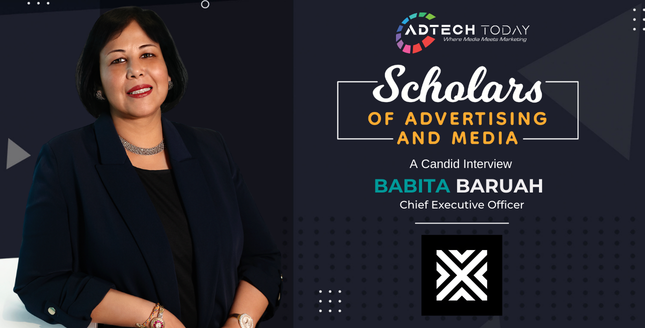
Babita Baruah has spent decades navigating the global advertising landscape. As Chief Executive Officer of VML India, she now leads one of the industry’s most ambitious digital transformation journeys. Yet her core philosophy remains deeply human.
In this exclusive conversation, she reflects on the tension between data-driven scale and the creative soul of brands. A strong advocate for artificial intelligence and integrated ecosystems, Baruah believes technology should remove friction, not replace creativity. The goal, she says, is simple: free up space for ideas that resonate culturally and emotionally.
Read on as she discusses the future of connected brands, the role of agencies in a performance-driven era, and why human imagination remains advertising’s most powerful engine.
The global advertising industry is consolidating toward integrated, full-funnel models. Beyond operational efficiency, what drives this shift intellectually, and how do you ensure that the creative ‘soul’ remains intact as you scale such massive organisations?
“Integration should be the fuel, not the filter.”
The consolidation toward integrated, full-funnel models isn’t just an operational play; it’s an intellectual response to how people actually live with brands today. Non-linear journeys, fragmented attention, platform-native behaviours, and a demand for measurable impact all require one connected idea system rather than isolated communications. When strategy, creativity, data, experience, commerce, and technology exist within one ecosystem, we can build coherence across every touchpoint. We move faster from insight to execution; we create work that doesn’t simply reach audiences but earns relevance and drives action.
The risk in scaling, of course, is dilution. So the key is to be deliberate about protecting the creative soul. Creativity remains the heartbeat of the model, guided by human-centric insight, strong craft leadership, and a culture that rewards bold thinking over process. It is an environment where diverse specialists collaborate around a single, powerful idea; ensuring the right message reaches the right audience with real impact, while keeping the work emotionally resonant, culturally grounded, and unmistakably creative.
With India’s AdEx consistently outperforming global averages in 2026, the conversation has moved from ‘spending for reach’ to ‘investing for resonance.’ How do you intellectually define the role of a creative agency in an era where digital growth is a given, but brand depth is becoming rarer? (In simpler terms: beyond scaling digital presence, how can agencies help brands create lasting impact and resonance?)
“Spending for reach without resonance cannot be a strategy.”
In a market where digital growth is a given, the agency’s role is to create and build meaning. Being “digital-first” should never imply a loss of brand depth; in fact, the brands that win are the ones with a clear strategic framework. They possess a sharply defined audience, a distinctive proposition, and a consistent point of view.
Our job is to help codify that foundation. And then, we translate it into culturally rooted ideas, stories, and experiences that feel native to each platform while staying true to one coherent brand truth.
When brand and performance are built from the same strategic spine, every single touchpoint, from media and content to commerce and experience, does more than generate impressions; it compounds memory, trust, and preference. Lasting impact comes from a creative that is culturally fluent, insight-led, and relentlessly human. It is designed not just to be seen, but to be felt and acted upon.
Following the recent AI Summit in India, the focus has shifted from experimentation to execution. As a leader who champions the ‘human’ side of business, how is VML India ensuring that AI is used to amplify the ‘magic’ of creative storytelling rather than just automate it?
“AI cannot replace creative authorship.”
We see AI as an enabler that accelerates and elevates human imagination. The “magic” in storytelling still comes from lived insight, cultural nuance, empathy, and craft; AI helps us get to that magic faster and take it further.
We are embedding it across the workflow to expand exploration, sharpen strategy, and prototype ideas at speed. But we are also keeping clear human ownership of the creative idea, the narrative choices, and the final expression. And just as importantly, we’re putting the right governance in place around ethics, data, and brand safety, so trust isn’t traded for efficiency.
The goal is simple. We use AI to remove friction and unlock more time and headspace for original thinking, deeper collaboration, and better work; ensuring technology amplifies the story, rather than replacing the storyteller.
VML sits at the heart of the ‘Connected Brand’ philosophy. In a landscape where advertising is no longer a single message but a continuous journey, what is the biggest intellectual challenge in ensuring data, technology, and creativity move in a single, harmonious rhythm?
“The real challenge isn’t technology. It’s culture.”
The Connected Brand philosophy is about orchestrating the brand experience, customer experience, and commerce as a single, unified ecosystem. To be honest, it is really about overcoming the mindset of working in silos.
Data gives us the insight, and technology provides the delivery mechanism, but creativity provides the human connection. With this foundation, we can design experiences that are incredibly relevant without losing meaning, craft, or consistency. Ultimately, harmony comes from aligning people, incentives, and systems around a single, connected idea, executed with agility.
As the Indian economy hits new milestones in 2026, the consumer is shifting from ‘digital access’ to ‘digital aspiration.’ How must brand narratives evolve to resonate with a ‘Viksit Bharat’ mindset that demands both global quality and local authenticity?
“While technology creates a level playing field, it is the brand narrative that will continue to drive true differentiation.”
The democratisation of AI and digital access is fundamentally changing our ecosystem. We are seeing people across all levels experimenting and seamlessly integrating technology into their daily workflows; this widespread adoption makes complex processes much easier and allows teams to operate with greater agility.
But as consumers shift toward digital aspiration, the Viksit Bharat mindset demands a unique blend of global quality and local authenticity. And to cater to this confident new consumer, our narratives must evolve with a strong cultural understanding, genuine appreciation, and work that is truly resonant for the consumer in India.
Looking toward 2030, what is your boldest prediction for how the Indian creative tech ecosystem will shift from being a ‘global delivery centre’ to becoming the world’s primary architect of brand innovation?
“The focus is moving from adaptation to invention.”
To be honest, my boldest prediction for 2030 is that India will innovate much more. The Indian ecosystem operates at a scale and complexity that is truly unmatched; we are navigating extreme linguistic diversity, rapid technological adoption, and a unique blend of traditional retail and cutting-edge quick commerce.
Our diversity provides the best testing ground for complexity. If a solution works across India’s linguistic and socio-economic spectrum, it is resilient by design; and that resilience can translate globally.
But there is also a growing confidence among Indian talent. With strong digital infrastructure and rapid AI adoption, India has the potential to define how connected brand ecosystems function at scale. When strategy, creativity, and technology are integrated with our cultural depth, India will not just participate in global conversations; we will shape them.

