
Two Indias
November 2021. Washington DC. Vir Das performs his “Two Indias” monologue at The John F. Kennedy Center for the Performing Arts.
February 2026. New Delhi. The same monologue is referenced in the Lok Sabha.
Both times, it makes news, controversy, conversation.
Boardrooms and conference rooms across India have talked about “The land of a billion people, a billion opportunities” and referenced “The Two Indias” in strategy and planning presentations so often that it has almost become a tiresome opening slide. Thankfully, without the outrage it so readily attracts in public discourse, and perhaps more ironically, without so much as a raised eyebrow at its overuse.
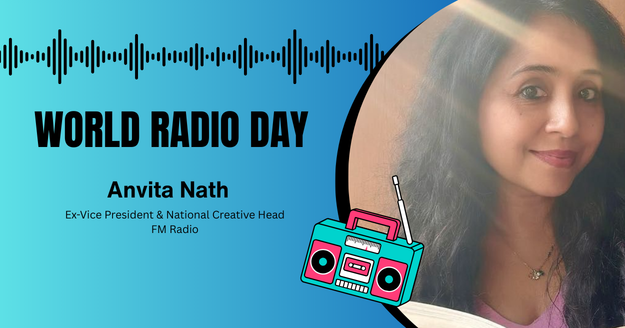
When I was asked to write this feature for World Radio Day, in true Carrie Bradshaw fashion I could not help but wonder: Is tuning in to radio truly in its tune out phase?
The answer is Two Indias.
One India still turns on the radio. In cars inching through traffic, in kitchens at 7 a.m., in cabs, in small shops, where the RJ is still a familiar voice, a steady presence in the daily routine. This India knows voices and the jingles that feel like muscle memory.
The other India opens a streaming app, asks the smart speaker to play the latest track, scrolls through playlists, discovers indie artists from across continents, checks Spotify Wrapped like an annual emotional report card.
The first instinct tells us these two Indias are in conflict. That this is airwaves vs. algorithms. That the new must eventually replace the old. But is that so?
Wait a minute!
My first instinct was to dive into numbers, and the numbers do speak volumes.
I borrow from one of music streaming’s biggest successes, Big Dawg by Hanumankind. Streaming apps are going “Ten toes in when we standin’ on business”. Streaming-led music revenues are several times larger than FM radio revenues and growing faster. Digital platforms command the attention of advertisers chasing data-rich, measurable returns. As per industry reports, private FM radio advertising in India sits at around ₹1,800 crore, roughly 2% of total advertising spends, and projected to shrink to 1%. The business gravity has shifted, putting FM radio in the role of “I’m a big stepper, underground methods”. FM radio has already responded to this shift with experiential IPs, B2B IPs, RJs as influencers, social media amplification as an integral part of client campaigns, content creation, and more. FM radio has stepped out of the studio like never before. “On air” is online, on ground, on it.
(Perceived) Dead Listeners Society: The clickbait of obituaries
In 1981, MTV launched with a bold proclamation, “Video Killed the Radio Star”. For a while, it felt prophetic. MTV shaped taste. It turned music into spectacle. It defined youth identity. MTV was “culture” before culture became a keyword in content discourses. On December 31, 2025, MTV officially shut down its 24-hour music channels. They ended their final broadcast with the very first broadcast, the iconic song by The Buggles. Radio was there to witness the first and the last broadcast of MTV. After all, video did not kill the radio star.
We are living in an era of clickbait obituaries. One of the key identifiers of a ChatGPT piece of writing is the “X is dead”, “Y just killed X” mode of language. Like a chicken-and-egg situation, AI, by design, mirrors dominant discourse patterns, in return strengthening the same discourse. In the attention economy, declaring something dead sounds visionary. The temptation and rewards of the clickbait and shock value of obituaries have taken over discourses everywhere, from LinkedIn posts to conference rooms. It has become an echo chamber we are not even considering exiting anytime soon. MBA, TV, long-form content, and even the need for humans at the workplace have been declared dead in recent times. “Television is finished”, “Print is obsolete”, “Email is irrelevant”, “Radio is over”. Radio particularly feels like a zero-risk prospect to be declared dead in the age of music streaming. However, formats evolve and platforms shift. Sound persists.
Immersive vs. Imagination: The magic of the theatre of mind
Streaming platforms are extraordinary. They are engines of discovery, distribution, and monetisation. They are data-rich, measurable, scalable. Streaming is immersive. It surrounds you with precision. Spatial audio places instruments around you. AI-driven curation anticipates your mood. Hyper-personalised recommendation engines learn your habits and refine them over time. It delivers perfectly mixed sound, dynamic suggestions, and seamless transitions across devices as it adapts in real time. Platforms are building adaptive, responsive listening ecosystems that may soon become even more emotionally intelligent. Streaming personalises at scale. It is technologically ambitious and commercially powerful. They are, undeniably, the business of music in 2026. Streaming will likely continue to expand this immersive strength in ways we are only beginning to see. However, radio’s business with music is neither done nor dead.
Streaming excels at engineered intimacy. Radio immerses you in imagination. Streaming helps us discover music. Radio helps music discover us.
Streaming works within frames and structures. It will give you an era, an artist, a mood, a theme in a playlist. Radio gives you the serendipity of just the song you wanted in the moment playing on radio, as if just for you. Radio gives you “your” song one moment, the latest super-hit the next moment, a forgotten gem the next. There is something quietly magical about switching on a radio station and hearing the exact song you were humming or remembering; not because you searched for it, not because you curated it, not because you pressed play. It simply arrived for you in that moment. Streaming gives us control. Radio gives us coincidence.
Every generation does this with media. We measure, rank, and compare. But culture does not disappear because a revenue curve dips.
Here, I am tempted to borrow from Dead Poets Society. In this movie, poetry was not extinct. Poetry cannot die. For a time, it was reduced to charts and formulas, measured into lifelessness. Very much like the business of radio looks at present. It took one teacher to remind a generation that poetry was not meant to be dissected. It was meant to be felt.
“We read and write poetry because we are members of the human race. And the human race is filled with passion. And medicine, law, business, engineering, these are noble pursuits and necessary to sustain life. But poetry, beauty, romance, love, these are what we stay alive for”. I am from a generation who knows these words by John Keating by heart. As someone who often says, “Radio is my first love, professionally”, I may sound biased towards Radio when I quote these lines. But I am also obsessed with the scope, excellence, and scale of music streaming. Radio cannot compete with streaming on infinite catalogues or hyper-personalisation. It does not need to. If I have referenced Dead Poets Society, I cannot not reference Main Hoon Na. If Streaming is the latest drop, the culture moment, Radio is akin to Shah Rukh Khan’s open arms declaring, “Main Hoon Na”. Radio may not be the loudest voice in the room at present, but it remains the comforting and steady voice that it always has been. If Streaming is intentional, Radio is serendipitous. If Streaming scales data, Radio scales belonging. Only Radio has theatre of mind. Streaming will give you rain playlists just as the first raindrop hits the ground. Radio will let you imagine your own sky, travel back to the time when you stood soaking in rain on Marine Drive or reached home with the help of strangers in a flooded city.
Radio is the first social media
Before we had posts and comments section, we had RJs opening a questions and people responding to it. Before we were sharing comments section and creating content responding to the comments section, we had what we call “passive listeners” enjoying conversations between RJs and actively participating listeners. Before we had crowdsourced content, Radio is where crowds converged and connected. Radio I being announced dead since over a decade now. I remember in 2013 or 2014, a panel discussion in India Radio Forum announced Radio dead in the age of social media. All in front of the radio industry. I had to point out to the panel of highly esteemed but non-radio experts that Radio is the OG social media. Radio was live, interactive, and personal before we had social media. I somewhat churlishly called it, “The L-I-Pstick Factor”. It is so obvious to ask the Radio vs. Music Streaming question that it almost becomes reductive. Actually, it’s music vs. other distractions of the attention economy and the time-poor world we live in. That’s where, Radio and Streaming find themselves in the same boat.
While ideally, I should be referring to industry reports talking about audiences tuning into Radio and the hours spent on Streaming Apps, I choose to reference a totally different aspect. Multiple cultural trend reports and lifestyle commentary identify return to analog and offline life as a major theme of 2026, not just nostalgia for nostalgia’s sake but a deliberate cultural response to digital overload and AI dominance. On that note, I say, Happy World Radio Day. Happy Radio Days.
Airwaves AND Algorithms
One India opens a music streaming app. Another India tunes in to their beloved frequencies. More often than not, it is the same India in different moments. It is not airwaves vs. algorithms. It is Airwaves AND Algorithms.