
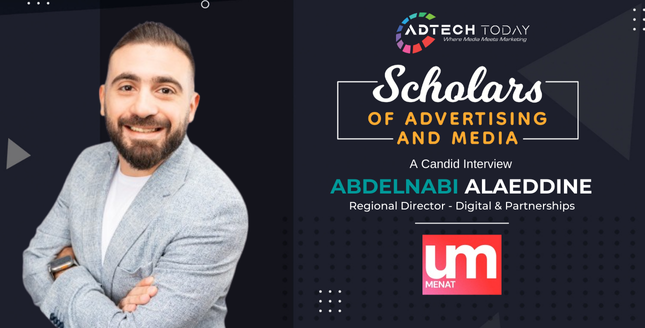
There’s a misconception that data stifles creativity, but Abdelnabi Alaeddine believes the opposite should be true. As Regional Director for Digital & Partnerships at UM MENAT, he sits right at the intersection of the region’s most complex shifts—from the fragmentation of retail media to the explosion of the gaming-verse. Yet, he isn’t interested in chasing the next shiny object. In this candid conversation, Alaeddine strips away the industry jargon to offer a clearer path forward. His message is urgent: it’s time to stop treating AI like a magic wand and start using it to free up the real magic—human ingenuity.
Given your focus on Partnerships across the region, looking beyond Google and Meta, where do you see the next wave of critical media partnerships emerging in MENA? Is it primarily in retail media networks, gaming ecosystems, or local content creators?
Looking beyond Google and Meta, the next wave of critical partnerships in MENA will emerge from a blend of retail media networks, gaming ecosystems, and local content creators. At UM, we champion diversification because we recognize the unique value in each.
“Retail media networks are paramount, given MENA’s e-commerce acceleration.”
We’ve partnered with leading tech providers to develop a robust platform for activating and measuring campaigns across these networks. Crucially, collaborating with major retail groups allows us to leverage their invaluable first-party data for precision targeting at scale—offering unparalleled purchase insights and driving measurable commerce activations.
Gaming ecosystems also represent a significant and rapidly growing audience. Our proprietary UPLAY product, launched in 2024, provides advertisers a robust framework to authentically engage this demographic.
Finally, solid partnerships with local publishers and content creators are essential. Their deep understanding of cultural nuances and access to local data, combined with innovative frameworks, ensure authentic campaign resonance. This holistic, insight-driven approach is key to diversified, effective media strategies.
Everyone talks about the importance of first-party data, but activation is the real challenge. What is the biggest gap you see in how brands in the region are using the data they already have?
The biggest gap I see is the challenge of translating raw data into actionable, privacy-compliant audience segments for scaled media deployment. Many brands collect data extensively, but they struggle to bridge the gap between simple ownership and strategic, ethical activation.
Encouragingly, our market has transformed. Major retail brands are now leveraging clean room solutions to democratize their data. This enables advertisers to precisely address audiences while upholding privacy—a significant leap forward. However, many local brands remain skeptical of monetizing their valuable first-party data, primarily due to internal privacy concerns. I believe this hesitancy will diminish as clean room technologies become more ubiquitous and regulatory frameworks mature.
At UM, we actively bridge this gap. We leverage diverse data sources—including client first-party inputs—to create unique audience segments based on nationalities, socio-economic classifications (SEC), and purchase behaviors. This moves us beyond basic demographics, enabling precision targeting and demonstrating how data can be ethically and effectively utilized for superior media outcomes.
Following the ‘uPlay’ initiative, how do you see gaming evolving from a niche test-budget item to an always-on component in media plans? And what is the biggest misconception CMOs still have about the gaming audience in MENA?
Gaming is rapidly evolving from a niche test-budget item to an always-on media plan component, driven by its pervasive audience reach. At UM, we’ve identified over 625 distinct ways for brands to activate in this space, highlighting its immense complexity. Our uPlay initiative is the solution—a collective of experts assembled to navigate this ‘gaming-verse’ and craft tailored, confident activations for each brand.
The biggest misconception CMOs still hold is viewing gaming as a ‘tick-the-box’ opportunity, solely for experimental media. They often forget that almost every person in MENA is a gamer, extending far beyond the ‘hardcore’ stereotype. Mobile gaming, in particular, has democratised this, encompassing Gen Z, parents, business owners, and more. The challenge isn’t audience scarcity, but the need for smart, nuanced approaches to address these diverse segments effectively, moving beyond superficial engagement to truly resonate.
Managing digital investment across MENAT means balancing hyper-mature markets like UAE and KSA with emerging markets in North Africa. How do you standardise best practices while still respecting local nuances?
Managing digital investment across MENAT really requires a dual approach: standardising global best practices while deeply respecting local nuances. At UM, our clients’ KPIs are always at the forefront of this balance.
We leverage global best practices—particularly on major tech platforms—to ensure efficiency, consistency, and access to cutting-edge capabilities. This provides a strong foundation for our strategies.
However, every market has unique consumption patterns and cultural specificities, even when using those same global platforms. To address this, we prioritize crafting strong local partnerships. These relationships are critical for boosting brand trust, fostering loyalty, and accessing unique inventory that resonates specifically with local audiences.
Ultimately, the successful formula is a dynamic blend: applying global standards where effective, but always adapting and enriching them with local expertise. This ensures our media strategies are not only efficient but also culturally relevant, consistently delivering on business KPIs across both hyper-mature and emerging markets.
Retail Media in MENA is booming but also highly fragmented — from Amazon and Carrefour to Talabat and HungerStation. How are you helping clients navigate this complexity? And from your discussions with CMOs, is Retail Media expanding the overall digital pie or simply reallocating budgets from channels like Meta and TikTok?
We help clients navigate this complexity by advocating for a fundamental shift: treating retail media as a powerful, standalone channel, not just a conversion platform. We highlight its unique value, access to high-value audiences based on actual purchase behavior and transactional data. This enables precision marketing far beyond traditional targeting. Our partnerships with leading tech providers and retail groups facilitate activating and measuring campaigns across this fragmented landscape, leveraging first-party data for scaled reach.
From a budget perspective, the key is to stop viewing retail media solely for conversions. We encourage A/B testing reallocations from other media to rigorously measure ROI and sales uplift. For luxury brands, retail data offers unparalleled precision targeting. For mass brands, careful testing proves its incremental value. Ultimately, this demonstrates the potential to expand the overall digital pie by unlocking new, highly qualified customer segments rather than just moving money around.
If we look ahead to 2026, what is the one digital buzzword you hope we stop using, and what is the one topic you hope we are talking about more
By 2026, I sincerely hope we stop using ‘AI’ as a buzzword. It’s not a novel concept; AI has been integral to our industry for over a decade in various forms. While its capabilities are expanding, framing it merely as a buzzword diminishes its true value as a practical tool. We should simply integrate it seamlessly into our workflows, rather than treating it as some standalone, magical solution.
The topic I do hope we talk about more is bringing back creativity and critical thinking in media planning and strategy. For years, the industry has been constrained by a relentless focus on immediate ROI and an over-reliance on
automated tools. While efficiency is vital, it has often come at the expense of groundbreaking ideas and innovative solutions.
I envision a future where AI empowers us by handling the routine, freeing planners to apply their strategic acumen. We need to bring back the ‘magic’ to media—fostering an environment where bold ideas and human ingenuity drive truly impactful campaigns, rather than just optimizing existing ones.
Read more: Havas Expands ANZ Presence With Acquisition Of Independent Media Agency Kaimera

