

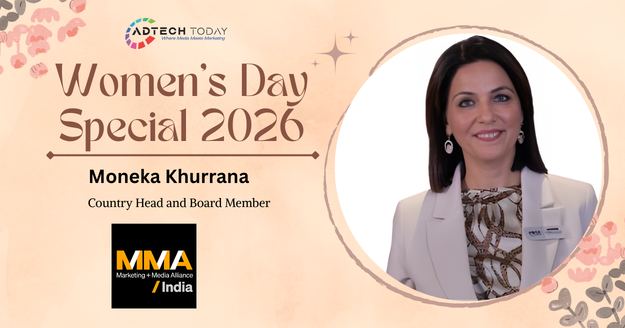
By Moneka Khurrana, Country Head and Board Member, MMA Global India
After more than two decades in marketing leadership, Moneka Khurrana reflects on the subtle dynamics that shape who leads and whose voices carry influence in decision-making rooms. Her perspective explores why meaningful progress for women in leadership requires more than representation. It requires systems that create real opportunities to lead.
If you spend enough time in leadership rooms, you begin to notice patterns: who speaks first, who is interrupted, whose ideas travel across the table, and whose remain in their notebooks.
Early in my career in marketing, these patterns were hard to ignore. The industry was evolving quickly, yet the decision-making rooms often looked very similar. Fewer women shaping strategy. Fewer women are influencing budgets. Even fewer women are sitting on boards.
And yet, talent was never the issue.
The real question was always this: how do we create systems where more women lead with confidence and influence?
Because leadership is not simply about entering the room. It is about changing what happens inside it.
One of the most persistent biases I have seen, both externally and internally, is the idea that women are still “earning” their place in leadership rooms.
But the reality is far more straightforward.
“Women can and should have a seat at the table in every boardroom. Always. Not as symbolism. Not as a diversity checkbox. But because better representation leads to better decisions.”
Marketing, more than most industries, should understand this. Our entire discipline revolves around understanding people: their motivations, cultures, behaviours and aspirations.
If leadership does not reflect that diversity of experience, we limit the perspective that drives our strategies.
A lot is written about confidence gaps among women leaders. But over the years, I have come to believe that what we often call a “confidence gap” is actually an opportunity gap.
Confidence grows in environments where people are trusted with responsibility. Where their voices are invited into conversations that shape outcomes. Where leadership is something they are encouraged to practise, rather than something they are expected to perfect before stepping forward.
This is why I often talk about lifting with purpose.
To lift with purpose means intentionally creating pathways for others, particularly women, to grow into leadership roles and feel confident owning those spaces. Not just mentoring them in theory, but bringing them into the rooms where decisions are made.
“Leadership is learned through participation.”
The most meaningful leadership journeys are rarely individual ones. They are ecosystems.
Throughout my career, one idea has stayed with me: give to gain. Women often bring a natural sense of nurturing into the environments they operate in. When they are given the opportunity to lead, they tend to create cultures where others grow alongside them.
And that changes organisations.
It creates teams that collaborate more deeply. Cultures that value inclusion. And businesses that benefit from broader thinking.
The more leaders create opportunities for others, the stronger the system becomes.
The marketing industry itself is undergoing one of its biggest transformations.
-Data is reshaping decision-making.
-Technology is redefining customer journeys.
-AI is accelerating how brands communicate and operate.
But beneath all these shifts lies something even more fundamental. Marketing is becoming more accountable.
-Brands are expected to demonstrate real value.
-Strategies must show measurable impact.
-Leadership must navigate complexity with empathy and clarity.
In that environment, diverse perspectives are not just desirable. They are essential.
The future of marketing leadership will depend on teams that combine analytical rigour with human insight. That combination becomes stronger when leadership reflects the diversity of the audiences we serve.
International Women’s Day often brings inspiring conversations about empowerment and representation. Those conversations matter. But real progress is measured differently.
Are more women influencing strategic decisions?
Are more women managing budgets and business outcomes?
Are more women shaping the direction of industries?
True progress happens when representation moves beyond symbolism and becomes embedded in leadership structures.
When more women lead, organisations do not just become more inclusive. They become more resilient, more innovative and more reflective of the world they operate in.
Over the years, my understanding of leadership has evolved.
It is not about being the only woman in the room. It is about ensuring the door remains open for many others to walk through.
That requires intentional effort from leaders, organisations and the broader industry.
When we lift with purpose and create opportunities for others, leadership becomes something bigger than individual success.
It becomes a collective shift.
And that is the kind of progress that truly changes industries.
Part of the Women’s Day Leadership Series highlighting the journeys and perspectives of women shaping the future of business.
