
Published on: February 16, 2026
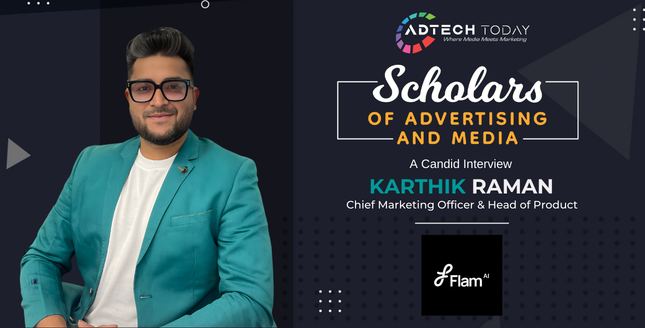
Karthik K Raman is the Chief Marketing Officer and Head of Product at Flam AI, where he is helping shape the next frontier of AI-native content and interactive brand experiences. At the intersection of marketing, product, and technology, Karthik leads the development of Flam’s mixed reality engine and enterprise AI suite, enabling brands to move beyond static media into participatory, experience-led interactions across marketing, communication, and commerce. With a background spanning computer science, finance, economics, and product strategy, and a career that includes entrepreneurship, growth leadership, and product design, he brings a rare systems-level perspective to how brands can turn attention into action in an AI-driven world. In this interview, he argues that the future of advertising lies in moving beyond viewability and clicks toward attention quality, active engagement, and experience-driven discovery—where ads evolve into interactive moments that drive both trust and transaction.
Many adtech and martech platforms still operate on reach and targeting at scale. What core gaps exist in today’s advertising stack when it comes to interactivity, real-time feedback, and consumer participation?
While most adtech platforms are great at the automated ‘push,’ they’re really just built for delivery, not a conversation. We’re in a spot where a one-second video play counts as a ‘view’ on a spreadsheet, but in reality, it’s just a number that ignores whether a person actually cared or participated. The core gap today is this reliance on one-way broadcasting; it’s all fragmented data and zero continuity, which makes it a challenge to build a real relationship with a consumer.
“People wantstoriesthey can actually feel and be a part of, without the jargon or the complicated setups, experiencesthat they can feel and share with their friends and family.”
It needs to be simple and more human.
As marketing shifts from impression-led buying to experience-led engagement, what new metrics or signals should the industry prioritise to understand real consumer intent, attention, and action beyond clicks and views?
As we move deeper into 2026, the industry must rethink “viewability” and pivot towards Attention Quality and Return on Experience (ROX). We need metrics that measure the value exchange of the moment, not just the volume of delivery.
The new gold standard is “Active Dwell Time”, not just eyes-on-screen, but time spent engaging with the ad/experience. How long did someone actually engage with the content? Did they come back for more? Did they share it, comment on it, or, better yet, act on it? In the world of experience-led marketing, the real currency is engagement that goes beyond a click and a swipe. Videos struggles to hold 3 to 4 seconds of real attention from a 30-second spot. Experience-led formats, like immersive and interactive experiences consistently deliver 18 to 24 seconds of true engagement for the same length. That is ~4X higher active attention.
With AI-native content becoming more dynamic, contextual, and real-time, how do you see consumer discovery and decision-making changing over the next two years
We are entering the era of ‘Liquid Creative.’ Content is evolving from Images and Videos into live, AI-native experiences that adapt in real-time. Consequently, consumer discovery is shifting from ‘Search & Scroll’ to ‘Interact & Experience.’
In this new paradigm, the decision happens inside the ad unit. We are transforming the ad from a signpost into the point of sale.
“A consumerscans a code, instantly accesses a virtualshowroom, tries on the product, and checks out—all without leaving the experience.”
No redirects, no setups, and zero latency between intent and action.
From an ecosystem standpoint, how do you see India contributing to the next phase of global AI-led consumer experiences?
The country is a hotbed of innovation and adoption of new technologies, and we’re already seeing tremendous growth in AI-driven solutions across sectors. The most significant contribution is the democratization of Spatial Computing and WebAR. Global players are now looking to India for the playbook on engaging the “Next Billion Users”through voice-first, vernacular, and immersive AI interfaces that prioritize utility over flash.
Recently, which industries do you see are gaining the most value from interactive and AI-led advertising
Interactive and AI-led advertising is delivering its strongest impact in sectors where decisions are high-involvement and experience shapes trust. Retail and FMCG, automotive, BFSI, healthcare, education, and real estate are emerging as clear leaders in this shift.
I believe Retail and E-commerce are currently extracting the most tangible value from this. We’ve reached a point where the storefront is being reimagined as an “experience theatre,” moving away from the old model of rows of physical racks toward compact, AI-native immersive experiences. These industries are finally solving the “offline data gap” by using interactive elements like QR-activated immersive explorations and voice-powered AI associates to capture high-intent first-party data that was previously impossible to track in-store. By shifting product discovery to these digital layers, retailers are seeing their floor space become 10× more productive, essentially turning every square foot into a content platform where engagement is both measurable and immediately profitable.