
Published on: February 1, 2026
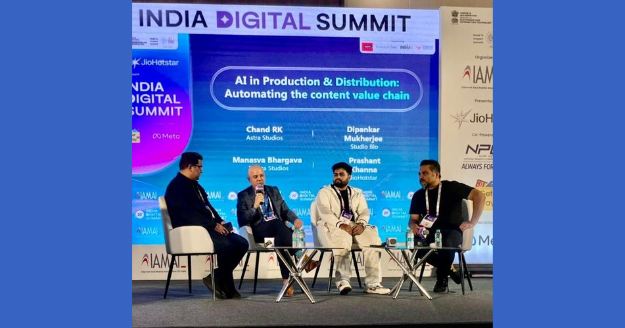
Bengaluru: Artificial intelligence is no longer a peripheral tool in media workflows but is increasingly becoming the operating layer across the entire content value chain, said Prashant Khanna, Head – Sports & Live Experiences, Production Technology & Services, JioStar, while speaking at a panel discussion on AI in Production & Distribution: Automating the Content Value Chain at the India Digital Summit 2026, organised by IAMAI
Khanna noted that live sports, in particular, demands a level of certainty and precision that few other forms of entertainment require. With tens of millions of concurrent viewers, every frame, graphic and data point has to be accurate in real time. In this environment, AI and automation are not replacing creative talent but augmenting it, enabling teams to prepare better, anticipate outcomes and execute with greater confidence.
He explained that AI is fundamentally changing live production from being reactive to predictive. By processing multiple layers of data, context and historical patterns, automated systems are now able to suggest what information, visuals or storytelling elements are likely to be required next, rather than simply responding to what has already happened. This shift, he said, allows commentators, designers and production teams to focus more on storytelling and less on manual execution.
Beyond production, automation is transforming distribution by allowing the same live content to be delivered in multiple formats and frames like horizontal, vertical, short highlights or extended viewing depending on how different audiences choose to consume it. Viewers may experience the same match as a three-minute highlight, a 20-minute recap or a full-length live broadcast, all powered by the same underlying production pipeline.
According to Khanna, owning the fan relationship increasingly depends on how seamlessly this end-to-end value chain operates. “The ability to automate across production and distribution is what allows platforms to acquire new viewers, deepen engagement and offer differentiated experiences around the same core event,” he said.
On personalisation, Khanna highlighted how AI is helping democratise premium live production at scale. What was once available to a limited audience such as high-quality language commentary or advanced camera work can now be extended to many more viewers. Innovations such as vertical live sports broadcasts, auto-framing of play and real-time language adaptation are enabling fans to experience events in ways that feel personal without compromising broadcast quality.
He also addressed the growing conversation around AI-generated content and creators. While acknowledging that AI has significantly lowered barriers to entry, Khanna emphasised that quality storytelling remains the deciding factor. AI, he said, is most powerful when it expands creative possibilities, enabling richer environments, faster iterations and new formats, rather than when it attempts to replace narrative depth or craft.
Looking ahead, Khanna described a future where live entertainment becomes increasingly immersive, interactive and user-controlled. From virtual reality broadcasts and metaverse experiments to second-screen experiences and personalised data layers, audiences will have more agency in how they watch, hear and engage with live events. He envisaged a world where fans can effectively “produce” their own version of a live game at home, choosing perspectives, information and formats that suit their preferences.
Despite rapid technological change, Khanna stressed that the fundamentals of content remain unchanged. Audiences have finite attention, and only high-quality experiences endure. “It’s not about fighting for eyeballs,” he said. “It’s about delivering exceptional content that people across ages, languages and geographies want to come back to.”
In Khanna’s view, AI’s true impact on media will be measured not by novelty, but by how seamlessly it integrates creativity, certainty and scale, turning the entire content lifecycle into a more intelligent, responsive and inclusive system.
Read more: Kedar Shetye Appointed As Director – Performance Marketing At WPP Media

