
Published on: December 19, 2025
As DOOH moves beyond digitised billboards into a more data-led, dynamic, and measurable medium, the role of outdoor advertising is being fundamentally rethought. What was once treated as a visibility-led channel is now evolving into a responsive, tech-enabled layer that connects physical spaces with digital intelligence. By 2026, this shift is expected to reshape how brands plan, buy, and measure outdoor media.
For Rajat Sikder, Director at Walk the Talk, the most consequential change lies in how accessible and outcome-driven DOOH is becoming.
“The most impactful shift will be the accelerated adoption of DOOH, powered by more economical hardware and smarter operations, enabling brands to engage audiences dynamically with stronger ROIs. Equally transformative will be DOOH’s evolution into a more programmatic and data-driven ecosystem, with real-time triggers, sharper audience targeting and dynamic creatives making the medium more meaningful. Additionally, deeper integration with mobile ecosystems will unlock cross-device mapping and seamless retargeting, driving clearer attribution and elevating DOOH’s strategic role in 2026.”
His perspective highlights how cost efficiencies and smarter operations are pushing DOOH from experimentation into scale, while programmatic layers and mobile integration bring accountability closer to what digital marketers expect.
That evolution is already visible in how the Indian DOOH ecosystem is experimenting ahead of many global markets.
Gautam Bhirani, Founder of SignX.AI, points to a market shaped by both innovation and intent.
“India’s DOOH evolution is being shaped by two powerful shifts: innovation and intent. From UGC-led screens and score-based triggers to deeper API integrations and day parting, the market has experimented ahead of many peers. At the same time, new large-format DOOH across key maetros is enabling big spenders to demand higher Share of Voice – driving increased OOH investments through digital formats. With offline agencies still anchoring buying decisions, the next phase will be led by technology that enables automation, transparency, and accountability while empowering agencies, not disrupting trade dynamics.”
This balance between experimentation and ecosystem stability is critical. As budgets move toward digital formats, the emphasis is shifting toward systems that bring transparency and automation without breaking existing buying structures.
Jayesh Yagnik, Chief Executive Officer at MOMS Outdoor Media Solutions Private Limited, sees this transition as a defining planning shift for brands.
“As we look toward 2026, the biggest shift in DOOH won’t just be the increase in digital screens it will be the move toward programmatic, data-led and contextually intelligent DOOH. This evolution will really change how brands plan and use the medium.
We’ll be able to see far more flexible buying, sharper audience targeting and movement analysis, creatives that adapts to real moments:- Time of day, weather, cultural cues, even movement patterns across a city. And while OOH will always remain a reach-first medium, we can expect a rise in measurability through improved footfall studies and mobile-based exposure modelling/targeting, giving brands greater confidence in optimisation of campaign placement.
The real impact is that DOOH is helping the shift from static visibility to smart, context-rich reach. And when relevance, data and flexibility come together at scale, the medium becomes far more powerful for brands than ever before.”
His view reinforces how relevance and flexibility are becoming central to DOOH’s value proposition, while improved measurement frameworks bring confidence to media planning and optimisation.
For some leaders, however, the shift goes even further, redefining what DOOH represents at its core.
Fabian Trevor Cowan, Director at Connect Network Inc., frames the change as a structural transformation.
“I believe that in 2026 DOOH will metamorphose from a ‘screen you advertise on to an operating system of real-world consumer engagement’; moving from an inventory layer to an intelligence layer . Yes DOOH will evolve from just a ‘screen medium’ to an intelligent, real-time influence layer that powers commerce, creativity, and context in the physical world.” Additionally Connect Network Inc.’s collaborative efforts with global AdTech partners will make DOOH accessible to the lowest common denominator powering its next phase of growth.”
This idea of DOOH as an intelligence layer signals a future where outdoor media actively participates in commerce and consumer decision-making rather than merely broadcasting messages.
Ankit Rastogi, Founder & CEO at Ambient DOOH Media, connects this evolution directly to accountability and relevance.
“This shift is bigger than just “digitizing billboards”; it’s about making out-of-home media as smart, flexible, and most importantly accountable.
Programmatic DOOH fueled by AI and deep data integration will ensure its relevance, measurability and contextual relevance delivers both massive real-world scale and digital-level precision, fundamentally changing the perspective of DOOH.
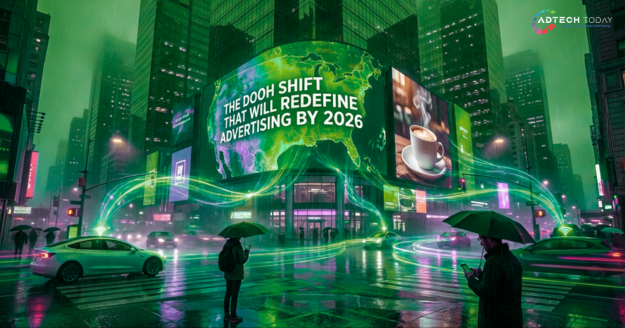
For instance , The ad creative itself can change instantly based on these real-time triggers. A coffee ad could display a hot latte on a cold morning, switch to an iced drink during a hot day or even show a live traffic update with an offer for a nearby restaurant.
All this hyper-relevance is all set to drive significantly higher engagement !”
Together, these viewpoints answer the central question clearly.
By 2026, the most impactful shift in DOOH will be its move from static digital presence to a programmatic, data-led, and contextually intelligent medium. As real-time triggers, creative adaptability, mobile integration, and improved measurement come together at scale, DOOH is no longer just about visibility. It is becoming a strategic, accountable, and responsive channel — one that brings digital precision into the physical world.

