
Published on: December 4, 2025
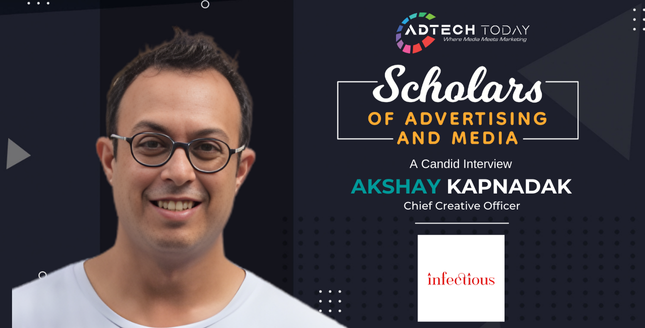
Every great creative journey begins long before the first campaign goes live. Sometimes it starts with a spark of curiosity, like a child taking apart a spring-loaded tape measure to understand how it works. For Akshay Kapnadak, that restless urge to break things down and rebuild them better became the foundation of a career shaped by craft, storytelling, and a deep understanding of people.
Across 16 years at McCann Erickson Mumbai, he helped shape some of India’s most memorable work for brands spanning beverages, beauty, FMCG, finance, and entertainment. His ideas travelled across continents, earning recognition at Cannes, The One Show, Spikes Asia, and more. But for Akshay, the real thrill has always come from understanding behaviour, decoding mindsets, and turning insight into impact.
Today, as Chief Creative Officer at Infectious Advertising, he leads with the same philosophy that guided him from the start: making begins with breaking. In an industry constantly evolving with AI, new formats, shrinking budgets, and shifting consumer expectations, Akshay anchors creativity in clarity, curiosity, and craft.
In this conversation, he reflects on his transition from a global network to an independent agency, the creative culture he’s helping strengthen at Infectious, the growing role of AI in advertising, and the timeless values he believes every young creative should hold close.
How has the creative output of Infectious Advertising enhanced since you joined, since one of the mandates for you was to ‘enhance the creative output’ of the agency?
Infectious had already been doing great work all along when I came aboard. It’s a strong agency culture built around a deep respect for our clients’ business, being insightful — always asking ‘what do people care about?’ — powerful storytelling, and craft. This has become even more important as we scale up, work with younger talent, bring in people with skill sets outside traditional advertising, and work with emerging tech like AI. Since I’ve joined, the focus has been to double down on what we believe in and be more consistent with it. So, the more we’re working with newer stuff like AI, the more we’re also asking the questions that matter — Is it insightful? Is it simple? Does it tell a story? Can it be crafted better? That has driven the work we’ve done in the last few months, whether it’s the campaigns for Ultratech, mixing live action with AI for Bayer, or completely AI-generated content for TransUnion and Eureka Forbes.
Lessons for you from moving from a network agency to an independent one?
There’s a form of rock climbing called free soloing, where you climb without ropes or a safety net. Moving from a network agency to an independent one feels much like that. On one hand, you are keenly aware that the margin for error is much smaller. On the other, there’s the rush of adrenaline and independence. An independent agency has to quickly learn to punch above its weight. And the only way to do that is to blur inter-departmental lines and rigid profiles and take on multiple roles.
“You cannot be ‘just a planner’, or ‘just an art director’, or ‘just a content writer’. You also need to get tighter as a team and have each other’s back fiercely. There’s no place for overseeing or supervising.”
Everyone just rolls up their sleeves and gets down to it. It’s all hands on deck. All the time. That, in a way, plays in favour of independent agencies. Without levels, the senior people are immediately a lot more accessible to the youngest people in your team.
What do you think ails the advertising industry today?
‘Ail’ is a strong word. I do not personally think that the advertising industry is either sick or dying. The Indian advertising industry has been growing in terms of numbers. Network agencies as well as independent agencies are getting more recognition for their work. Is it getting more difficult? Absolutely. Production budgets are getting tighter, it’s more difficult for agencies to be as profitable as they once were, networks are consolidating, and good talent has a lot more options like OTT. Then there is AI that threatens to upend everything. However, just because you find the road getting steeper and you’re now breaking a bigger sweat does not mean that you are ailing. It just means you’re being challenged more. This is probably true for most other industries as well.
“Creativity shines brighter in adversity.”
I’m very optimistic that the advertising industry is up for it.
Is AI a threat to ad agencies at large? Are agencies relying too much on AI? If yes, then do you think that over reliance on AI could result in losing distinctiveness or originality?
Just a few months ago, I was asked to comment on Zuckerberg’s statement about AI declaring war on advertising agencies. Today, there’s a debate raging about whether the AI bubble is about to burst. Go figure. Is AI a threat to agencies? Only if we let it be one. It depends on how you’re using AI and for what. If you’re being lazy and using AI to completely replace critical and original thinking, then that’s a problem — one that quickly becomes apparent. However, AI is great when it’s used to make labour-intensive, expensive, and complex tasks easier. It’s great for taking a lot of data and gleaning quick learnings, for instance. Or it makes images or videos that would require elaborate production and planning achievable at scale. And when you have creativity and originality backed by AI, there’s no telling what’s possible. Whether agencies are relying too much or too little on AI, or if they’ll lose distinctiveness and originality, cannot be answered simply. The question we should be asking is how we should use AI.
Advice you would give a newcomer who wants to join the industry?
Be curious. About people, their lives, and their stories. Places you haven’t been to. About how everything works. About clients’ businesses and what’s important to them. Be silly — some of the most successful people I’ve met are. And it’s a lot more fun. No matter how good your craft is, it can get better. Work on your craft every single day. Fall in love with the process of creating — on some days it’s the only thing you’ll have. You are more than your work.
“Respect is non-negotiable. Give it, expect it.”
There are days when your talent will fail you, but hard work will always see you through. Remember to have fun. Read ‘IF’ by Rudyard Kipling and burn it into your memory. It will hold you in good stead.
What will you remember the most about the legend Piyush Pandey?
I never worked with Piyush Pandey. I have only known Piyush Pandey through the many stories, the ones widely written about him, and those shared in conversation with the people who worked with him closely: bosses, colleagues, and directors. Some of the things that have stayed with me? Firstly, how much he cared about people, the people he worked with, be it his colleagues or his clients. But also people in general. Being invested in their lives, speaking their language, and telling their stories. Then there are the stories about him unconditionally loving a truly great idea regardless of where it came from — anyone from his team or even someone from outside his agency. I find that remarkable. And there is of course the work! He knew how to keep it simple, tell a story, and craft the hell out of it. But the stories I’ll hold closest are the ones about how more than the work, he made the people better.

